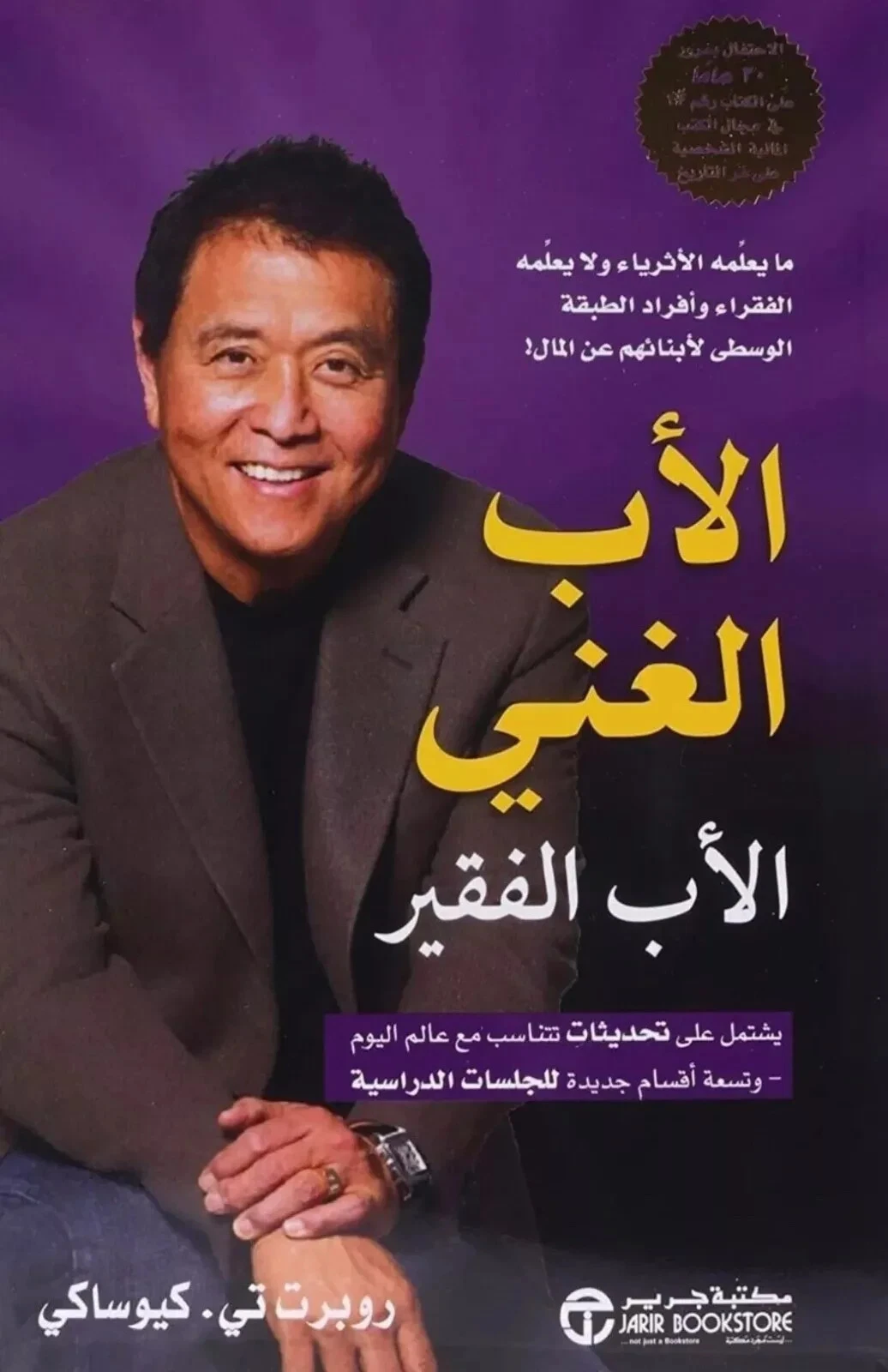
Rich Dad, Poor Dad: How to think about money in a life-changing way.
Book Summary
The book simply says: Don't measure your success by how much you earn, but by how many "assets" you have. A salary stops when you stop working, but an asset is something that brings you money continuously. So he contrasts a mindset that sees security in a degree and a job with a mindset that sees security in owning assets. He then explains why people fall into the "rat race": Income increases, liabilities increase, and people have to work more to make ends meet. The book's solution is to learn about money in a different way: Distinguish between what puts money in your pocket and what takes it out, and build assets gradually so that your life doesn't remain dependent on a single salary.
About This Book
Robert Kiyosaki's Rich Dad, Poor Dad is not a book about wealth in the showbiz sense, but rather an attempt to deconstruct the idea that we have been raised with: That money is the direct result of a degree, a job, and playing by the rules. Kiyosaki presents it as a pedagogical tale based on two characters: A "poor father" representing the traditional mindset (job security, salaries, degrees), and a "rich father" representing the asset-building mindset (owning businesses, investments, and systems that generate income). He doesn't claim that one was a saint and the other a devil, but rather puts them as two lenses: How do we see money, how do we see business, how do we see the future?
The central idea that the book repeats is that wealth is not how much you earn, but how much you keep and what you build. One person may have a large salary, but his life is threatened because everything is based on a salary that stops if the work stops. Another may have a lower income, but own assets that generate a steady income: Rental property, a small business, stocks or equity, or any asset that produces a cash flow. This point flips the definition of success from "how much you earn" to "what you have that works for you." This is where the book's catchphrase comes into play: make money work for you, rather than you working for money.
Kiyosaki relies on a simple but powerful distinction: Asset and Liability. An asset is what puts money in your pocket, and a liability is what takes money out of your pocket. With this lens, he reevaluates things that many see as signs of success: A fancy car or a big house can be a liability if it eats up income without producing a corresponding income. The goal is not to fight the house or the car, but to understand the "timing of the purchase": Do you buy it after building assets to finance it, or do you buy it first and turn your whole life into a chase for installments? This is where the ethical-practical question becomes: Do you choose an outward appearance of success, or do you choose a real financial structure of freedom?
From this point, the book attacks the culture of "security" as it is commonly understood. The poor father in Kiyosaki's narrative says: "Go to school, get good grades, then a decent job, and you'll be fine." The rich father responds with a different question: "And what if the job is no longer enough? What if the world changes? What if your salary becomes a ceiling rather than a ladder?" The book is an early warning of the nature of our times: A shifting economy, changing jobs, and technology that makes less and less stable. Kiyosaki insists that financial education is more important than a degree alone: Understanding financial statements, cash flow, investing, risk, and taxes.
One of the book's most controversial ideas is its attitude toward school. He doesn't attack education as a value, but he says that school teaches you how to be a good employee rather than an "asset creator." It teaches you to succeed on a grading system, but rarely does it teach you how to read a budget, how to distinguish between an asset and an obligation, how to build a small business, or how to deal with taxes. In his view, this void causes many people to enter life with academic success but a financial deficit: Salaries go to cover loans and expenses, without accumulating assets.
The book then moves on to another idea: Fear and desire are the hidden drivers of our financial behavior. Fear drives you to take a job you don't like just because it's "safe". Desire drives you to upgrade your lifestyle as your salary increases: More purchases, more installments, and then back to fear again. This cycle is what many people today call the "Rat Race": You work to pay, pay to live, and live to go back to work. Kiyosaki presents it not as a dark theory, but as an invitation to break the cycle by building assets that minimize your dependence on a paycheck.
But how do we build assets? Here he talks about a smart risk-taking mindset. He doesn't encourage gambling, he encourages learning that minimizes risk: Read, learn, experiment with small amounts, understand the market, and network. He reiterates that most people don't lose money because they are stupid, but because they are afraid to learn through experience, or because they prefer comfort over knowledge. That's why he advocates making failure "part of the curriculum": A small project may fail, but it teaches you more than years of fear.
The book also offers insights on taxes and corporations: How businesses can use legal systems to minimize the tax burden through corporate structures, while employees often pay taxes before they get paid. He makes this point to explain why the "rich" think differently: they build systems that protect and recycle money, not just income that passes from hand to bill. The idea is not to encourage fraud, but to understand the rules of the game: Money doesn't move in a vacuum, but within laws.
On a psychological level, the most important thing the book offers is its call to have the mindset of a decision-maker rather than a wait-and-see mentality. Many people say, "I can't, I don't have time, I don't have money." Kiyosaki suggests flipping the question around: Instead of "I can't buy this," ask "How can I buy it?" Not because you'll buy everything, but because the question opens up thinking: A side project? A simple asset? A saleable skill? A small investment? This shift from a sentence that closes a door to a question that opens a window is the essence of the "financial education" he wants.
That said, it is important to read the book with a critical eye: it offers strong and simple ideas, but it does not provide a one-size-fits-all map. The market is different from country to country, and investment rules are not identical. Some of the examples in the book feel more like simplistic or anecdotal than detailed guidance. But the value of the book is not that it is a step-by-step "investment guide", but that it shifts the center of gravity from the outside to the inside: From waiting for a bigger paycheck to building assets, from chasing the appearance of success to building financial freedom, from short-term thinking to structural thinking.
In the end, Rich Dad, Poor Dad is like a quiet siren: You may live a respectable life as a successful employee, but if you don't understand money, you will remain at its mercy. You may not be rich today, but if you learn how to build small assets and replicate them intelligently, your relationship with work and time will be transformed. The profound message of the book is not "get rich quick," but "be financially aware so you don't live in captivity." It puts you in front of a simple but terrifying question: Is your life built around a paycheck, or is it built around assets? And from your answer, it all starts.