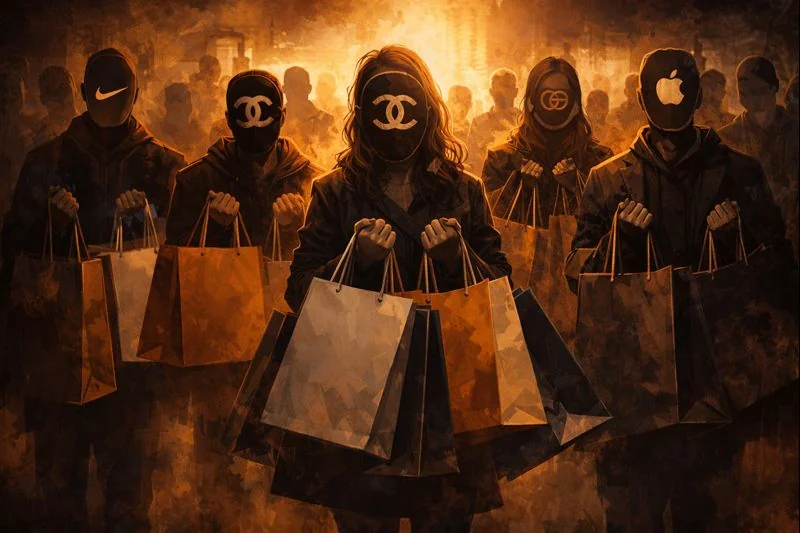
Consumption today functions as more than an economic exchange between money and goods; it has become a social "language" in which people write their in-group selves. What we buy, what we display, and what we repeat as daily habits turn into shorthand signals that tell others: Who am I? Where do I stand? With the rise of platforms, belonging is no longer built solely through lineage, profession, and education, but through seemingly simple details: your phone, your shoes, your favorite coffee shop, and your travel style.Buying becomes synonymous with membership in a "taste group" or "lifestyle group," and the brand becomes a badge of identification, not just quality or price.
Brands perform a subtle symbolic function: they give their owner a "ready-made identity" that can be read quickly. A shirt with a recognizable logo does not just say "I bought a shirt", it says: "I am close to a certain taste, a certain quality standard, and a social world where signals are exchanged." In this sense, brands become a soft classification system: not necessary to fulfill a need, but necessary to determine "status" within a network of relationships.Even devices, supposedly practical tools, become part of the story of belonging: the type of phone, laptop, and headphones is no longer a technical preference, but an implicit declaration of purchasing power, "ability to keep up," and proximity to a certain digital culture. This is why periodic updating of devices becomes part of a social ritual: not because the old device does not work, but because the signal it sends has become "outdated."
McKinsey's data on consumer behavior across multiple markets shows that the use of social media for product research has increased to 32% (from 27% in 2023), meaning that the purchase decision is becoming more about the digital social landscape rather than just need (McKinsey&Company, 2025).In a Capgemini Research Institute survey, 46% of Gen Z consumers said they have already purchased products via a social media platform, accelerating the transition from "wanting to belong" to "buying on the spot so I don't miss out" (Capgemini Research Institute, 2024).The result is that in-group status is not only based on money, but also on the ability to read codes, present them at the right time, and avoid being "out of the picture"; this is precisely the essence of soft stratification: a disparity that appears to be a personal choice, but functions as a continuous social evaluation system.
This logic extends to restaurants and travel. A restaurant is no longer just a place to eat, but a theater of belonging: choosing a particular restaurant or café declares taste, class, and identification with a particular world. Travel, especially when turned into content, also reproduces status through images and experiences that carry a message: I have time, money, and freedom of movement, and I am part of a circle that sees the world this way.This is the "soft class": it doesn't explicitly tell you that you are less or more, but it makes you feel that way when you notice that certain places and things "fit" one group and not another.
The power of consumption as an identity is further reinforced by the pressure of "keeping up". The issue is not only the existence of symbolic goods, but the speed with which they change. Digital fashion races itself: new trend, new restaurant, new gadget, new destination. Those who do not catch up feel out of context, as if they have lost part of their social language.This is where consumption turns from a choice to an unspoken duty: to remain visible in your group, you have to buy sometimes what you don't need, or maintain a facade of "modernization." As superficial as this may seem, it is linked to deep needs: fear of isolation, the desire for recognition, and the quest for security within a group that gives you meaning.
What happens when your status becomes tied to what you own? Relationships become more fragile, because they are based on interchangeable signals, and the self becomes vulnerable, because belonging becomes conditional on the ability to keep up.On the other hand, this awareness opens a door to daily resistance: to distinguish between "my need" and "my signal", between a purchase that solves an issue and a purchase that solves a feeling. When we understand that consumption is a language, we can ask before each purchase: "Am I buying something, or am I buying a place in the community?
Comments