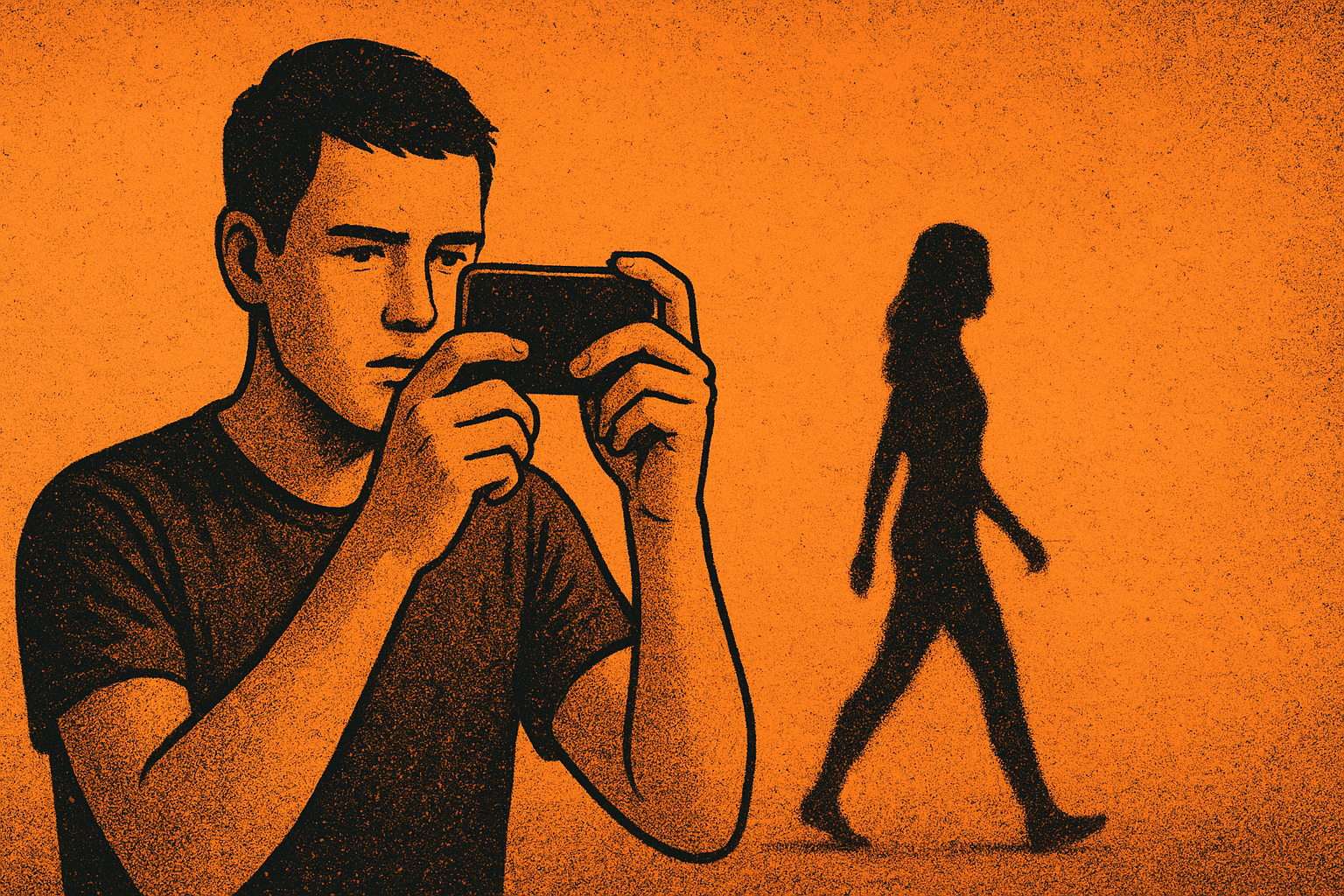
The question "Are we living our lives or showing them?" has changed from a philosophical reflection to a concrete social issue in a time when the camera is attached to the body through the phone, and communication platforms are part of almost daily breathing. The latest statistics indicate that the number of social media users reached about 5.41 billion users in mid-2025, approximately 65-68% of the global population, with an average daily usage of approximately 2 hours and 21 minutes per person, with a continuous increase in the number of platforms that a single user moves between.In this dense digital context, a "moment" is no longer measured only by its sensation and meaning, but by its ability to be documented and shared, and by the interaction and likes it achieves. We have moved from a stage where photos are taken to preserve personal and family memory, to a stage where moments are created to be filmed and published, so that living itself becomes conditioned by the possibility of being transformed into "content" that can be consumed on a small screen.
This cultural shift from living the experience to documenting it is linked to several interlocking circles: the digital economy, display culture, and the way the brain works in an environment of constant notifications. "Attention economy" theories argue that digital platforms build their profits on capturing user attention for as long as possible, so interfaces and algorithms are designed to make us take a picture, post it, and come back again and again to see how others react to it.Each like or comment acts as a "small reward" to the brain via the dopamine system responsible for learning by pleasure and reinforcement; psychologists who study digital addiction point out that each notification or "like" releases a small burst of dopamine, and with repetition, a compulsive behavioral pattern is formed that makes us return to the apps without full awareness, looking for a new dose of social gratification.In this framework, the image becomes not just a way to remember the moment, but a mechanism to gain recognition, acceptance, and belonging. The evaluation of the experience shifts from "How did I feel?" to "How will it look to others?" and "How much interaction will this post get?
However, photography cannot be reduced to being the enemy of the moment; psychological research on photo-taking provides a more complex picture. Multiple field and experimental studies have shown that photography can increase the enjoyment of an experience when it is a tool to increase attention and engagement; that is, when a person directs his lens to see details that he might have otherwise overlooked, increasing his focus on what he is experiencing and increasing his enjoyment and recall of the moment later on.But this benefit is contingent on two things: that the experience is not already so "overstimulating" that photography becomes an additional burden that distracts rather than enhances attention, and that the act of photographing does not become a practice entirely oriented toward the gaze of others and future judgment.When one moves from the position of "documenting what I see to evoke the moment later" to "creating a moment that suits the audience's taste", the camera becomes a mediator that breaks the natural connection between the self and its experience, and the moment becomes a carefully directed scene that requires repetition, adjusting the lighting, choosing the angle, and perhaps eliminating some people or real-life chaos for a "cleaner frame", thus sacrificing part of the spontaneity of life in favor of the beauty of the image.
From here, the second axis emerges, related to the psychological and social effects of making life in the form of content.When the self becomes a "presentable product" and daily life becomes a series of polished clips to be uploaded to platforms, a pattern of chronic image anxiety is formed:How do I look? How is my life read from the outside? Do I look successful and happy enough? Numerous studies on media and mental health show a recurring - albeit complex - correlation between the intensity of platform use and higher symptoms of depression and anxiety in adolescents and young adults, noting that the greatest risk lies not only in the "duration" but in the pattern of use itself: constant social comparisons, following the "filtered" lives of others, and the constant search for external evaluation.Recent longitudinal studies that followed thousands of children and adolescents in the United States found that increased time spent on social media at a young age was associated with a subsequent rise in depressive symptoms, even after controlling for income, family, and other personal factors. This does not mean that everyone who uses the platforms will develop depression, but it does suggest that a lifestyle of constant exposure increases mental health vulnerability in the most sensitive groups.
A large part of this burden is related to what psychologists call "upward social comparisons," the constant looking at those we see as "better than us" in terms of beauty, wealth, or success. Social media amplifies this pattern; the user is exposed to a stream of carefully selected snapshots of others' lives, seeing perfect vacations, successive professional achievements, and bodies enhanced with lenses and filters, and compares this to their daily life full of chaos, fatigue, and contradictions.The latest research on young people shows that too much exposure to idealized content from others, combined with a tendency for negative interpretations of the self, is associated with lower self-esteem and higher depressive symptoms, and that part of the impact of media on mental health is explained precisely by this pathway: upward comparison followed by feelings of inadequacy. When a person's value is linked in their consciousness to the number of followers, the quality of photos and the number of impressions, the self is always at risk of losing value if engagement wanes or "better versions" appear in the vast marketplace of photos and stories.
Moreover, this pattern strikes at the roots of authenticity in identity. An individual who is used to thinking of themselves as a "personal brand" constantly needs to manage the impression: "What do I post? What do I hide? What aspect of my personality is worth showing?" There is a growing distance between "me as I live" and "me as I present myself," and as this distance accumulates, it becomes more and more difficult to return to the authentic self.Many describe a strange feeling after capturing a beautiful moment: they go back to review the video or photo immediately, as if they need to see the moment from the outside to believe they lived it; as if the experience is not complete until it is relived on the screen.Research on mindfulness and smartphone use shows that mindful multitasking (paying attention to the moment, the camera, and imagining the audience simultaneously) impairs the ability to immerse oneself in the experience and increases feelings of distraction and detachment. The question becomes not only about mental health, but also about the quality of awareness with which we live our lives: are we present in the event, or are we busy acting it out and thinking about how it will be received later?
A family that only gathers when there is an "Instagram-worthy birthday" subconsciously begins to organize its moments according to the logic of the camera: arranging the table to fit the photo more than the seating, dressing the children in accordance with the video, and perhaps creating superficial moments of celebration just to provide content.Friends who meet for a "sweet shot" and then dive into their phones seconds later embody an inverted relationship: instead of photography being a continuation of the shared experience, the whole experience becomes an excuse for a photo.Although digital networks give the impression of constant connectivity, a number of studies suggest that heavy media use may be associated with increased feelings of loneliness in some groups, especially when screen interaction replaces face-to-face intimacy, or when an individual feels more "present in other people's lives" than in their own.Recent studies that have followed thousands of children and adolescents show a correlation between increased media use and a decline in the ability to concentrate and increased symptoms of distractibility over time, reflecting how a culture of swiping and constant switching between platforms can reshape attention habits in the long run.
It is not enough to ask people to "put down their phones" or stop filming; this ignores the fact that platforms are structurally designed to engage us, and that filming itself has positive functions associated with memory, nostalgia, and belonging.The deeper question is: How can we restore the balance between living and documenting, redefining the meaning of "the moment" in line with the dignity of human experience, without denying the role of the image in our modern lives? The starting point here is to understand our true motivations for photographing:Are we photographing to prove to others that we are happy, or to preserve a personal trace of what we are experiencing? When we are honest with ourselves about these motives, we can set simple but effective rules for ourselves: live the event first and then document it, postpone posting photos until after the end of the meeting, or set "camera-free periods" at family gatherings for laughter and conversation without a lens watching everyone.
The "mindfulness" literature in the context of technology offers a promising approach to this balance; it does not call for abandoning phones but for mindful use. Recent systematic reviews and meta-analyses have shown that developing mindfulness skills-the ability to observe the present without judgment and to pay deliberate attention to what we do-is associated with a significant reduction in addictive smartphone-related behaviors and is an effective tool in "digital wellness" programs for students and youth.In this light, our relationship with photography can be redesigned through practices such as "mindful photography": to take fewer photos but to savor the moment; to allow oneself to live the moment fully without any attempt to freeze it in a frame; to treat the photo as a reminder to help recall meaning, not as a document to convince the audience that one is living a meaning.
On a broader social level, it must be recognized that the platforms themselves have an economic interest in pushing us towards constant viewing, and that rebalancing is not the sole responsibility of individuals. We are seeing today an escalating political and regulatory debate about the limits of what should be left to corporate algorithms and what should be legally regulated, especially with regard to the protection of children and young people.Some countries have already begun to impose strict age restrictions on the use of platforms, or to discuss formulas for holding companies responsible for the psychological impact of their services on vulnerable groups; these policies-whatever we disagree about the details-reflect a collective realization that leaving "how we live the moment" to the platform economy alone actually means handing over the definition of the moment to the logic of advertising and algorithms (Reuters, 2024). However, even the strictest laws will not restore our presence if individuals continue to measure themselves by the likes meter.
In the end, it doesn't look like platforms will stop pushing us to perform, nor will cameras leave our pockets, but what can change is the way we legitimize the moment and ourselves. Each of us can rearrange the scale of values: evaluate moments by personal criteria-depth of emotion, quality of communication, internal impact-not by platform criteria, and build our self-image based on real experiences rather than digital feedback.Only then can images become an extension of life rather than a substitute for it, and we can regain the ability to live more than we photograph, and allow some moments to live only in memory, without a lens, to remind us that human beings are not reduced to a rectangular frame on a screen, no matter how beautiful or engaging that frame may be.
Comments