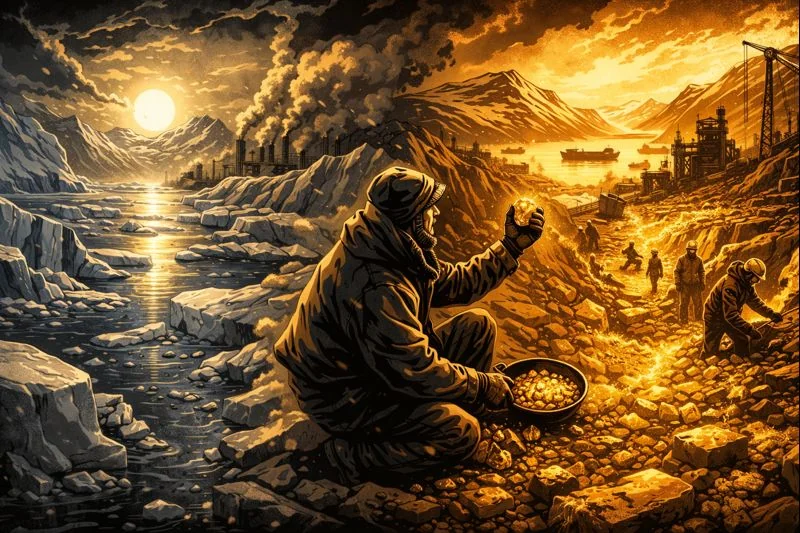
In past decades, Greenland was conjured up in the global imagination as an isolated ice mass at the edge of the map, far from the centers of economics and politics. But accelerating climate change has turned this image upside down. The melting of the ice, usually seen as a pure environmental disaster, has opened a new door of geopolitical and economic competition, transforming the island from a frozen fringe to a "global treasure" where the interests of major countries intersect.
Greenland has the second largest ice cap in the world after Antarctica. As temperatures in the Arctic rise faster than the rest of the planet, this cap has begun to recede, revealing large areas of land that have been closed for thousands of years. This recession means not only losing ice, but gradually revealing huge natural resources: rare minerals, strategic elements in batteries and green technologies, and oil and gas prospects that were previously economically unexploitable.
Rare minerals, in particular, have made the island a global focus. These minerals form the backbone of the energy transition economy: electric cars, wind turbines, smartphones. As global demand grows, Greenland is being read as a strategic stockpile that could reduce industrialized countries' reliance on limited and politicized supply chains. The melting ice has made it possible to extract these resources, turning a climate catastrophe into an investment opportunity.
Greenland is classified as a potential reservoir of materials critical to energy transition and supply chains for batteries and permanent magnets. CSIS estimates Greenland's rare earth element reserves at 1.5 million tons (ranked eighth globally), with deposits that are among the largest in the world in their category.On a broader level, reports linked to GEUS surveys indicate that a large number of minerals classified as "critical" in Europe are located in Greenland, which explains the growing European and American interest.A practical example of "treasure" moving from idea to license: In December 2025, Greenland was granted a 30-year exploitation license for a European-backed graphite project, with a production plan of approximately 80,000 tons per year of graphite concentrate, a key mineral for lithium-ion battery cores.
Greenland's location in the heart of the Arctic gives it increasing strategic value as new shipping routes open up as a result of melting sea ice. These routes shorten distances between Asia, Europe, and North America, redrawing global trade maps. In this context, the island becomes a military and logistical fulcrum, transforming from a peripheral space to a node in a web of silent international competition, as major powers watch each other from the edges of the melting ice.
The wealth that made Greenland a "treasure" is itself the product of a phenomenon that threatens the balance of the planet. Every ton of melting ice brings the world closer to deeper climate crises, from rising seas to disrupted ecosystems. The central question arises: can what is happening in Greenland be considered an economic success story, or a stark example of how a crisis can be turned into an opportunity for a few international actors?
However, the climate transformation of Greenland into a "global treasure" carries a cruel paradox: the same melting that facilitates access also exacerbates environmental risks and global sea level threats. Mining and infrastructure in a polar environment is costly and complex, requiring a strict balance between development and the protection of a local economy heavily dependent on fishing, along with considerations of sovereignty and social justice.Greenland today is "ice to gold" in the geo-economic sense: a space where the climate crisis, the race for critical minerals, and the redistribution of power in the Arctic intersect - but its real success will be determined by its ability to turn this abundance into sustainable gains rather than a deferred price.
At the local level, this shift adds another layer of complexity. Greenlanders, mostly from indigenous communities, find themselves between two contradictory promises: potential economic prosperity versus environmental and cultural risks that threaten their traditional way of life. The development that comes with investments may mean jobs and infrastructure, but it may also mean losing control over land and resources, turning the island into a battleground for external interests.
From ice to gold, its story reveals how climate change is not only reshaping the environment, but also redistributing power, wealth, and meaning. It is not just an island that is melting, but a living laboratory for an era in which opportunities are made out of crises, and the real question becomes not what is revealed under the ice, but who will have the right to decide the fate of what is revealed, and at what price.
Comments