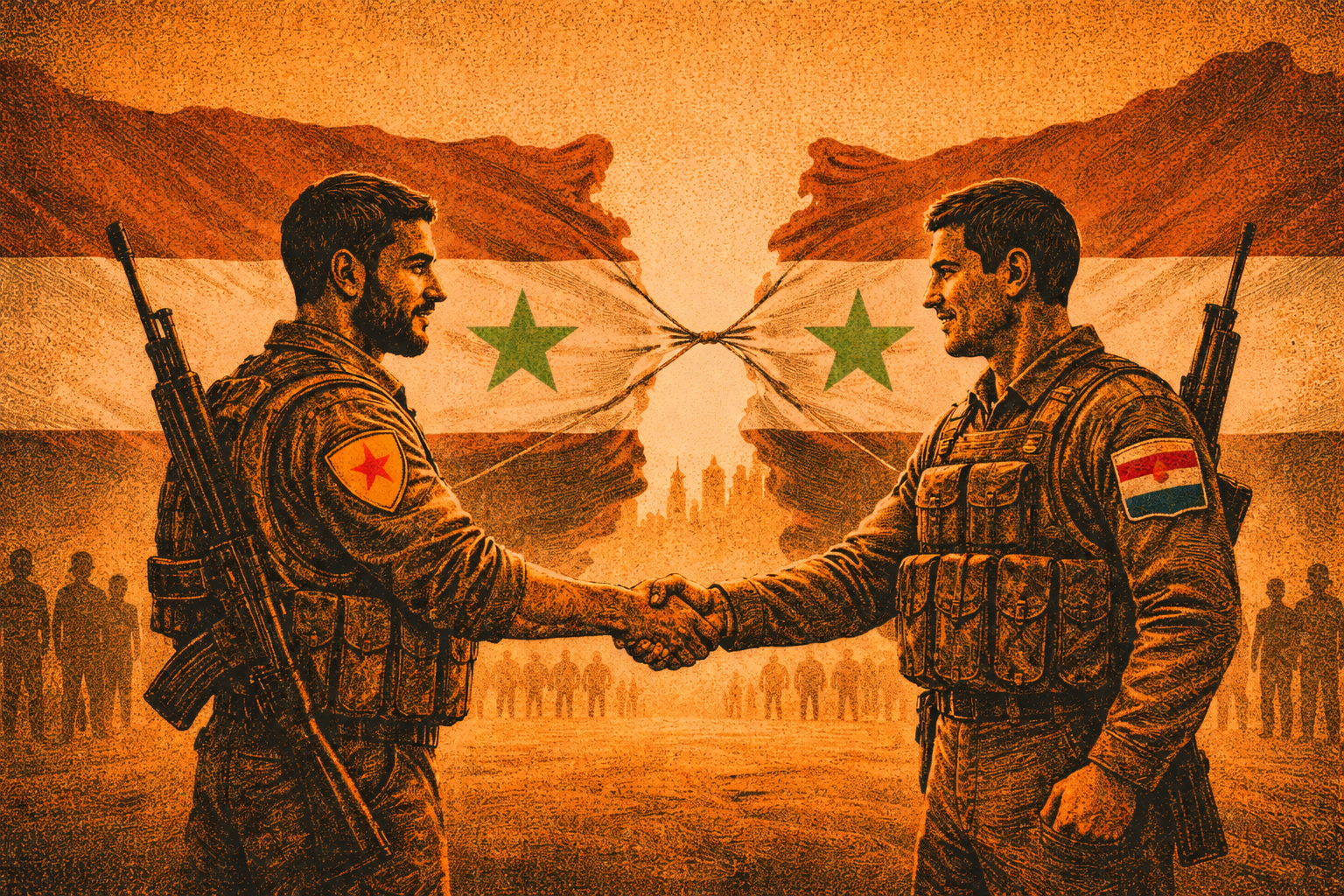
The Syrian arena is witnessing an undeclared political race before the end of the year, revolving around one question: how does Damascus regain control of the northeast, which has been run by the Syrian Democratic Forces (SDF) for years?
The region is no longer just an area outside the authority of the center, but a complete administrative, security, and economic entity with armed forces, local police, school curricula, municipalities, and oil resources, which has gradually transformed the SDF from a partner in the fight against ISIS to a de facto authority parallel to the Syrian state.
This military and administrative expansion has created a triple dilemma:
Damascus wants to restore sovereignty.
Washington is looking for a "political breakthrough" that will allow it to reduce its military presence without chaos.
Turkey is threatening to act if any agreement is seen as an attempt to reproduce a Kurdish force on its borders.
Because time has become an element of pressure, the parties are treating the end of the year as a political deadline that cannot be easily exceeded. Postponement means that a quarter of the Syrian geography will remain in a "half-state" state, neither a full part of the center nor an independent project, while Damascus' ability to stabilize its borders and economic policies is diminished.
The proposals circulating about integrating the SDF into the army are not just military arrangements, but a redefinition of authority. The talk is not about dismantling the force or distributing its elements to different units, but rather combining it into three northern divisions under a centralized command.
This model retains the core of the military force but strips it of the right to independent command and opens the door to a "security screening" that excludes non-Syrian elements or those associated with organizations that Damascus does not accept.
The Autonomous Administration considers the recognition of the Kurdish language and local curricula to be part of the "political dividend," while the interim Syrian constitution only recognizes Arabic.
Any integration without clear constitutional provisions could relegate the Kurdish language to the realm of "temporary administrative tolerance," which the Kurds consider more of an existential threat than the redistribution of guns.
The most sensitive factor remains oil, especially after the supply of approximately 5,000 barrels per day to the Homs refinery began in February 2025.
This figure is economically modest but politically huge because it announces the transfer of part of the wealth to the central state and tests whether the merger is an "economic partnership" or a "financial annexation" without a clear distributive guarantee.
In the background, Turkey remains extremely influential; it considers any settlement that maintains the SDF structure, even under a new name, a direct threat and uses the language of "impatience" to force the parties to hurry up:
Retreat before Damascus and lose a local base.
Political resistance and giving Turkey a military pretext.
If the deadline expires without an agreement, the most likely scenario is not a quick explosion, but an ambiguous negotiated extension or a gradual escalation on oil lines and borders. The integration of the SDF does not mean a technical settlement, but rather a determination of the shape of Syrian sovereignty and who holds the decision in "post-war Syria."
To view the video and read the full analytical paper, please scroll down.
Comments