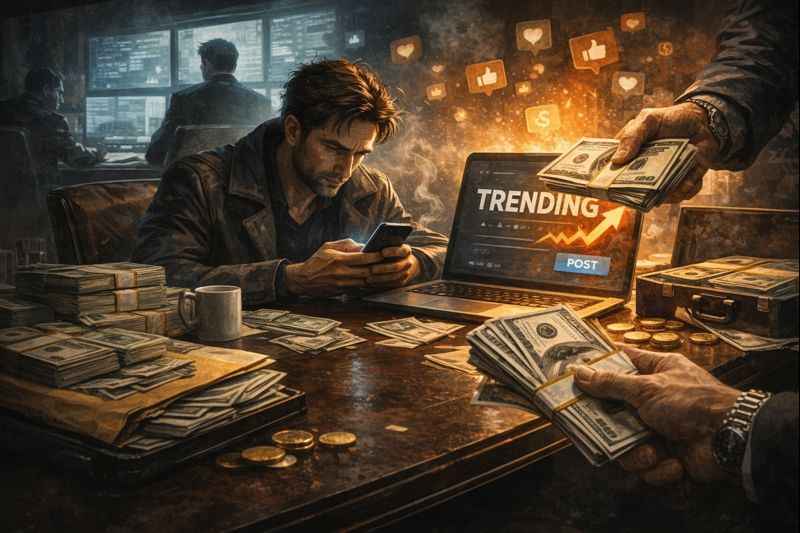
Trending is no longer a spontaneous moment from the street to the screen, but the result of careful engineering within an entire power economy: a market where one party pays to gain something intangible but extremely valuable: attention, acceptance, and symbolic prestige. The real question arises: who pays whom and why?
At the center of this economy is the platform as a non-neutral intermediary. It doesn't just "offer" content, it prices it through algorithms: whoever gets more exposure has a greater chance of earning more, whoever earns more buys more exposure tools, and the cycle goes on.The advertiser pays the platform through ads, and the platform distributes attention according to "performance" indicators that seem technical, but in depth redefine public taste: what is worth watching is what prolongs browsing time and increases interaction, not what adds meaning. In this sense, the algorithm becomes a marketplace for selling "visual" and "impactful", while the user pays the price with his time, awareness and taste.
The second party in the payment chain is content creators and influencers, but they are not always the biggest beneficiaries. While they do generate income from advertisements and sponsorships, they also operate within a system that turns identity into a commodity: style of speech, lifestyle, attitudes, and even "spontaneity" itself is turned into a marketable product.Companies don't just buy advertising; they buy ready-made social credibility and psychological proximity to an audience that trusts a person more than an institution. The company pays the influencer, and the influencer in turn pays "part of their identity" to the brand by adapting their content, softening their stances and changing their language to remain algorithmically and pastorally desirable.
Then there is a third, less obvious layer: indirect payment networks. Reposting pages, paid fan accounts, promotional groups, buying engagement, and reputation management services. Here, money is not paid to buy a product, but to buy a "social signal": a like, a comment, a share, an appearance on a trend page.These signals are the currency of taste and identity today: if you see something going viral, you assume it's important, if you see someone following, you assume they're worth listening to.
When values become purchasable, our relationship to identity changes: instead of asking "Who am I?" we ask "What do I look like?"; instead of taste being shaped by experience and knowledge, it is shaped by repeated signals produced by algorithms; trend becomes not a mirror of society, but a tool for reshaping it.
Therefore, "Who pays to make you a trend?" is not just a question about money, but about power. Whoever pays buys a position in your consciousness: it determines what you remember, what you consider beautiful, what you see as possible. In the economy of influence, the most dangerous deal is the one you don't feel: when you, every day, pay with your time and your identity for a fleeting sense of belonging.
Comments