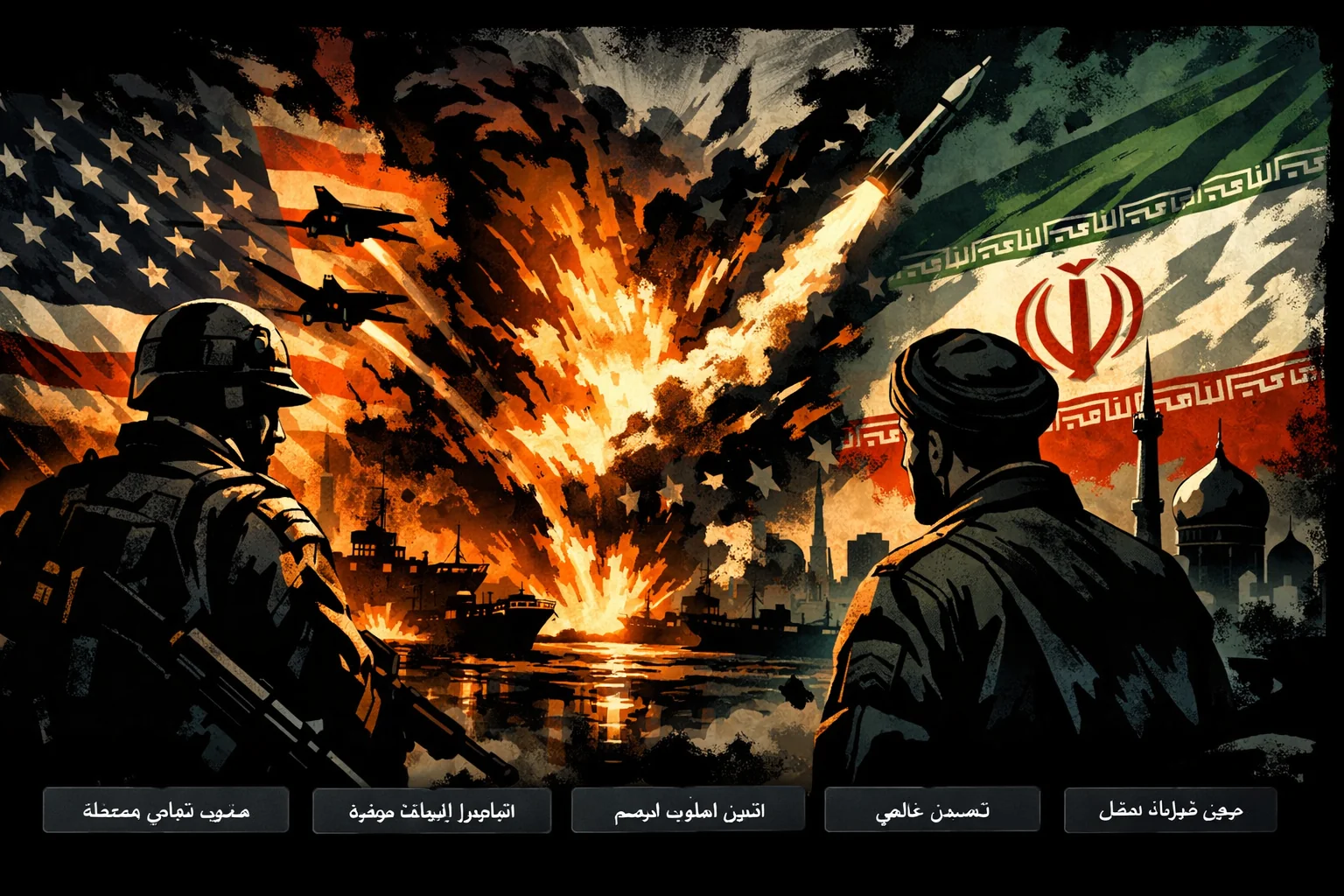
As of Tuesday morning, March 10, 2026, the latest credible developments in the course of the US attack on Iran centered around four simultaneous tracks: The escalation of mutual threats between Washington and Tehran over oil and the Strait of Hormuz, new Iranian attacks on Gulf states, the continued spread of the clash to Iraq, and countries and companies taking emergency measures due to the disruption of energy and regional security.
In the latest political and military development, Reuters reported that Iran's Revolutionary Guard announced on Tuesday that it will not allow "one liter of oil" to leave the Middle East if US and Israeli attacks continue, while US President Donald Trump responded with a direct warning that Iran will be hit "20 times harder" if it stops the flow of oil through the Strait of Hormuz. "We're going to hit them so hard that it won't be possible for them or anyone who helps them to take that part of the world back," Reuters quoted Trump as saying. "We will determine the end of this war," a Revolutionary Guards spokesman was quoted as saying. Meanwhile, Iranian Foreign Minister Abbas Araqchi said that resuming negotiations with the US is "no longer on the agenda" after what he described as a bitter experience with previous talks.
On the regional scene, the Associated Press reported that sirens sounded Tuesday morning in Dubai, UAE, and Bahrain, while Saudi Arabia announced the destruction of two drones over its Eastern Province oil region and Kuwait's National Guard said it shot down six drones. In addition to firing missiles and drones at Israel and US bases in the region, Iran also continues to target energy infrastructure, which has kept tensions high in the Gulf, the agency said. The agency also quoted Trump as saying that war would be a "short-term operation," while Kamal Kharrazi, foreign policy adviser to the Office of the Leader, told CNN on Monday that Iran is prepared for a "long war" and sees "no room for diplomacy anymore" unless other parties intervene to stop what he described as aggression.
In Iraq, the Associated Press reported that an airstrike on Tuesday dawned on the 40th Brigade of the Popular Mobilization Forces in Kirkuk, killing at least five and wounding four others, although the perpetrator was not immediately known. The strike puts Iraq back into the realm of indirect war-related engagement, as pro-Iranian factions have launched attacks on US bases inside the country since the beginning of the war.
Regarding the death toll that was circulating with updates on the morning of March 10, the Associated Press said the death toll was 1,230 in Iran, 397 in Lebanon, 11 in Israel, and seven U.S. military personnel. In another update, Reuters, citing Iran's ambassador to the United Nations, said that at least 1,332 Iranian civilians had been killed and thousands more injured since the US and Israeli strikes began at the end of February. This disparity reflects the different update points between news organizations and the official sources they relied on.
In terms of infrastructure inside Iran, Reuters reported that an oil refinery in Tehran was hit, sending thick black smoke billowing over the capital, in a new escalation that affects Iran's domestic energy supply. The World Health Organization Director-General Tedros Adhanom Ghebreyesus warned that the fire could lead to contamination of food, water and air. In a related military development, Reuters reported that Turkey reported that NATO air defenses shot down a ballistic missile that entered its airspace from Iran, the second such incident during the war, with no immediate Iranian comment.
In markets and fuel, Reuters and the Associated Press confirmed that fears of supply disruptions pushed Brent crude on Monday close to $120 before retreating on Tuesday morning. Reuters reported that Brent fell in one trade to $94.79 per barrel, while WTI fell to $90.96, after Trump's comments minimized fears of a prolonged war. But the agency emphasized that the price decline does not mean the risk is gone, as Middle East crude scores remained above $100 in some indices, while Iranian threats linked to the Strait of Hormuz continued.
Under the pressure of the energy disruption, several governments and companies took direct action on March 10. In Vietnam, Reuters reported that the Ministry of Commerce called on businesses to encourage home working to reduce commuting and fuel consumption, quoting an official statement as saying: "Encourage home working whenever possible to reduce the need for travel and commuting." Reuters also reported from Tokyo that Mitsui Chemicals has started cutting ethylene production in Japan due to reduced feedstock supplies following the closure of the Strait of Hormuz, Mitsubishi Chemical has also cut production, while Formosa Petrochemical in Taiwan has issued a force majeure notice on some supplies. Japan relies on the Middle East for about 95% of its oil imports and may consider using its emergency stockpiles in coordination with G7 countries.
In diplomatic and security developments, Reuters reports that Germany has temporarily withdrawn staff from its embassy in Baghdad due to escalating security risks, with the embassy remaining accessible but with severely limited legal and consular services. "The staff of the German embassy in Baghdad has been temporarily relocated out of Iraq due to the security situation and threats," the agency quoted a German Foreign Ministry spokesperson as saying. It added that German Foreign Minister Johann Fadivoll discussed the situation with US Secretary of State Marco Rubio, and that both sides condemned what the German minister described as Iranian "indiscriminate attacks" on countries in the region.
Comments