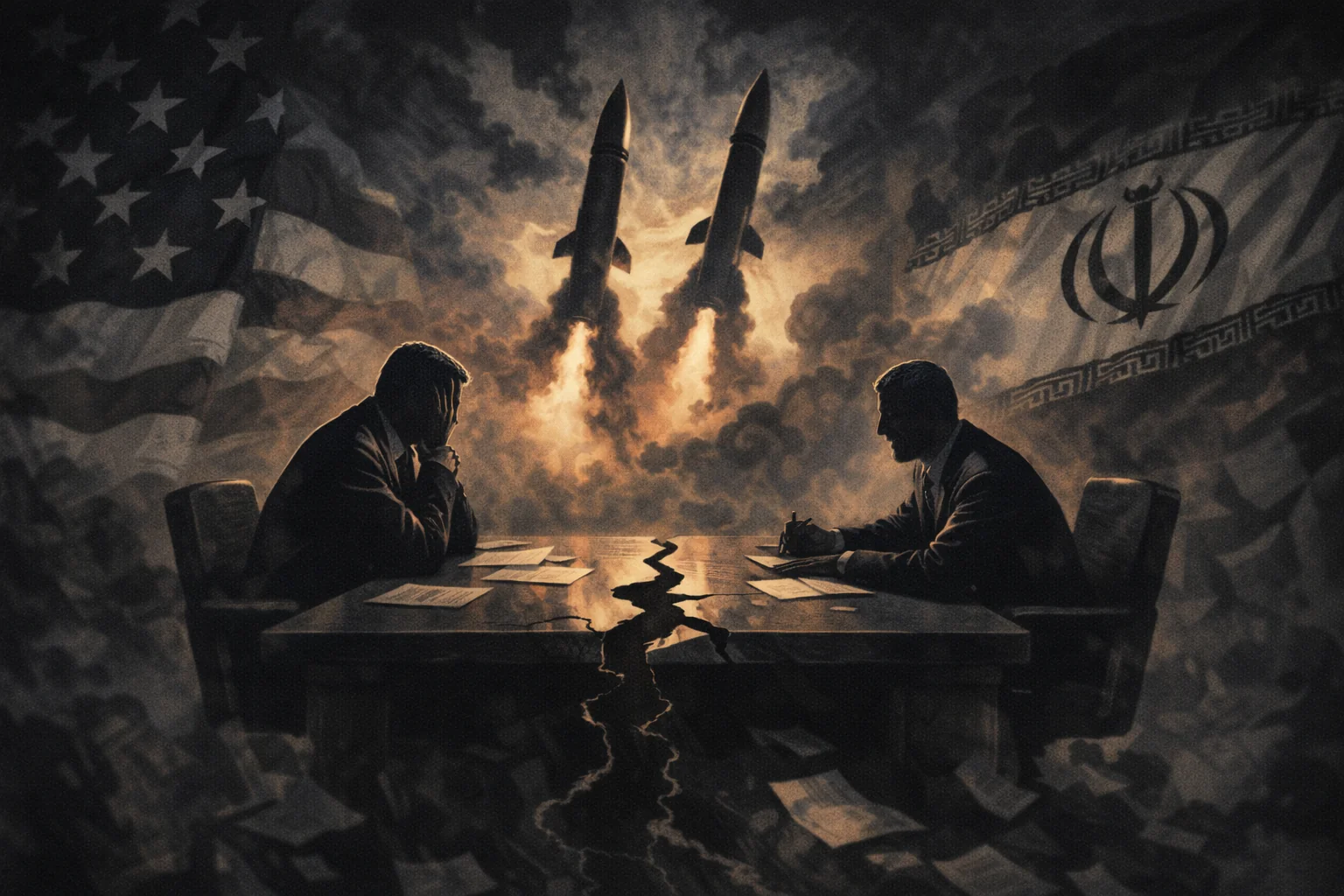
On the morning of February 28, 2026, the U.S. attack on Iran came not as a sudden, isolated incident, but as the conclusion of an escalating process that combined repeated negotiating failures, public time pressure from the White House, advanced military coordination with Israel, and a growing conviction within the administration that the window for a "de-escalation agreement" was rapidly closing.What distinguishes this moment is that Washington presented the strike not as a mere tactical response, but as a transition to "major combat operations" in an operation called "EPIC FURY," with direct links to two objectives: curbing Iran's nuclear program and missile ambitions, and reducing its ability to threaten vital forces and corridors in the region.
The first reason that emerges clearly in today's coverage is that the latest negotiations have reached a stalemate on substantive issues, not minor details. The last round of indirect talks in Geneva on February 26 ended without agreement despite the Omani mediator's talk of "significant progress" and "positive exchanges of ideas." There were two sessions on the same day.There were two sessions on the same day, in which delegations led by Iranian Foreign Minister Abbas Araqchi participated on one side, and on the Washington side, envoys including Steve Witkoff and Jared Kushner, with Omani management of the process, but the words "progress" did not turn into a breakthrough announcement, because the parties did not overcome the major points of disagreement.
The details of these negotiations reveal why today's attack seemed "justified" in the White House rhetoric: Washington wanted a radical change in elements that the West considers a direct threat, while Tehran wanted an agreement that guarantees the lifting of sanctions and recognizes its right to peaceful nuclear activity, including enrichment.On the same day, Araqchi stated that "there is agreement on some issues and differences on others," which means that the structure exists but the political ceiling is not complete. The most sensitive point of disagreement was "the lifting of sanctions and recognizing Tehran's right to peaceful nuclear activity, including enrichment."
The most sensitive point of contention was "enrichment." From Washington's perspective, enrichment is not just a civilian technology, but a "latent capability" that can turn into a military path if the political decision changes. It was clearly stated that Washington wants Iran to give up "all uranium enrichment," while Iran rejects this and insists that its program is peaceful and that it wants recognition of its right to enrich.Interestingly, Iran's foreign minister said on February 20 that the United States "did not ask for zero enrichment" during the Geneva talks that week, while the White House said in response that Iran "cannot enrich" if it wants to prevent a weapons capability. This discrepancy between "what is said in the room" and "what is announced to the public" fueled mistrust and made it easier to justify the move from diplomacy to force.
The second point of contention was linking the nuclear issue to two issues that Washington considers part of the "threat package": the ballistic missile program and support for armed groups in the region. The Trump administration reportedly insisted on including missiles and regional support in the negotiations, while Iranian officials warned against mixing "nuclear and non-nuclear issues" and considered that progress is possible if Washington separates the two tracks.In this context, US Secretary of State Marco Rubio described Iran's refusal to discuss missiles as a "big issue" that must be dealt with. When missiles become a "negotiating condition" rather than a "subsequent topic," the agreement becomes more difficult, because Tehran sees the missile program as part of deterrence and regime survival, not an item that can be easily waived.
The third reason for today's attack is related to the time pressure that Washington has created for itself. On February 19, it was said that Iran should "reach an agreement in 10 to 15 days" with a warning of "very bad things" if not, then on February 27 he showed in statements that patience is running out, saying he is not satisfied that Iran "does not want to say the key words: 'We will not get a nuclear weapon'" and that "sometimes force must be used." In other words, the president has publicly tied the success of the missile program to a "negotiating condition" rather than "an afterthought.In other words, the president publicly linked the success of the negotiation to a symbolic political phrase, and then considered its absence as evidence of lack of seriousness, which made the strike option marketable as a "forced" alternative rather than a first choice.
The fourth reason was military-administrative: building a ready-to-implement capability and then using it. It was said that the United States had mobilized a large force in the region, including two aircraft carrier groups, and that this was awaiting the decision to implement it. When a force is on standby, not using it also becomes a costly political decision if negotiations fail. It was also indicated that the operation was "planned for months" in coordination with Israel, which means that the strike option existed as a complete plan even before the collapse of the Geneva process.
The "details of what happened today" help to understand what Washington considered a direct cause: the talk was about a large US-Israeli attack targeting Iranian military capabilities, targeting missile systems and naval forces, with a warning about the possibility of American casualties, a call for the Revolutionary Guard to surrender with promises of immunity for those who surrender, and a call for Iranians to "take back their country." The Iranian response, on the other hand, was said to include an invitation to the Revolutionary Guard to surrender.On the other hand, it was said that the Iranian response included missiles and marches targeting Israel and US assets in the region, making it clear that the US calculation was not a "strike without response", but a prior acceptance of the risks of response and escalation.
For Washington, preventing Iran from acquiring a nuclear "capability" and developing missiles capable of threatening troops and allies is the essence of regional security and credible deterrence. For Tehran, enrichment is the symbol of a "strike without retaliation," and for Washington, preventing Iran from acquiring a nuclear "capability" and developing missiles capable of threatening troops and allies is the essence of regional security and credible deterrence.For Tehran, enrichment is a symbol of a sovereign right and national program, lifting sanctions is an economic and political condition, and missiles are a pillar of deterrence it considers necessary to survive in a hostile environment. When these elements are indivisible, negotiations become extremely fragile: "general principles" and "confidence building measures" can be agreed upon, but turning them into specific commitments hangs on the question: Who concedes first? Who guarantees after the concession?
The Omani mediation, despite its role in keeping the channel open, seemed unable to bridge the trust gap between the "language of reassurance" and the "language of guarantees." It was said that progress had been made and that technical talks were supposed to be held in Vienna the following week, but at the same time no details were provided about overcoming the obstacles. On the other hand, the administration was pessimistic about the chances of reaching an agreement, which makes today's "power move" understandable as a translation of that pessimism into a decision.
To summarize, the reasons for the US attack today are not summarized in a single reason, but in the superposition of three axes: negotiations without a breakthrough on enrichment, missiles and lifting sanctions, time and rhetorical pressure that made failure politically costly, and advanced military readiness that matured into a decision to implement in coordination with Israel.The details of the recent negotiations reveal that the disagreement was not over "the size of a small concession," but over the definition of what is "peaceful" in a nuclear program, what is "non-negotiable" in deterrence capabilities, and who wins first: lifting sanctions or permanent restrictions. As much as Geneva was a space for "positive" ideas and "guidelines," it was also a final stop that showed that the two sides have not yet met on a single formula for security and guarantee.
Comments