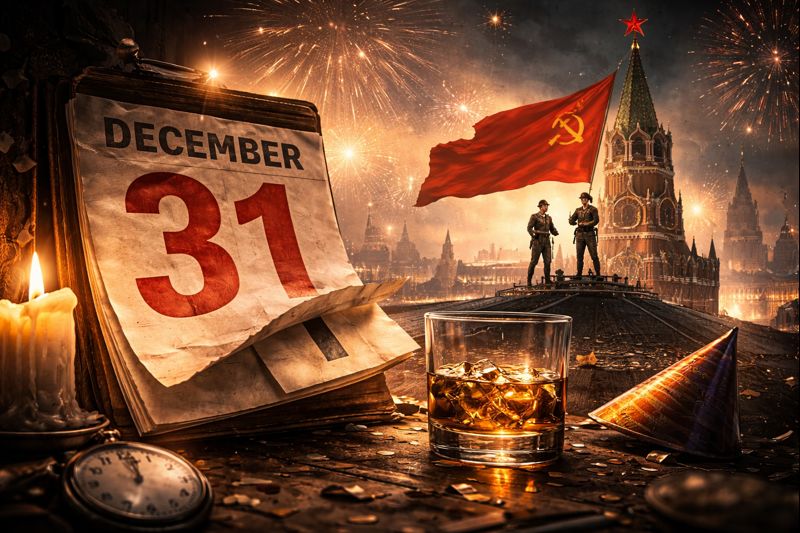
On this day, December 31, 1991, the world was not only watching the "news of a collapse", but also the official date of the end of a country that for decades was a pole parallel to the West. The value of this date is not that it created a transformation from nothing, but that it put the seal on a process that was accelerating: republics declaring their independence, a center losing control, and governance and economic structures disintegrating in front of the eyes of the world.In an instant, the international scene was no longer clearly bipolar, and the redistribution of power began: Who represents the "heir?" Who owns strategic weapons? Who manages foreign relations that used to be issued from one capital? The winter of 1991 became the birth of the post-Cold War order: a giant federal state disappeared, and 15 independent states emerged, with questions of borders, debt, nuclear security, political identity, and a market economy.
On December 25, Mikhail Gorbachev resigned and the Soviet flag was lowered from the Kremlin, in a symbolic scene that the world captured as the end of an era.In the following days, state files were practically transferred: embassies became Russian, Russia inherited the permanent seat on the Security Council, while the CIS was trying to manage a quick political divorce between republics that previously moved within one center. In international politics, the moment of legitimacy transfer is the moment of birth: Who represents? Who signs? Who holds the keys to the decision?
Within a few days, Russia moved to present itself as the successor state in sensitive international representation files, which the United Nations documented by referring to a letter dated December 24, 1991 from Russian President Boris Yeltsin informing the Secretary-General that Russia would continue the Soviet Union's membership in the organization.In parallel, the US State Department Historian's Office explains that December 25 witnessed Gorbachev's resignation and the removal of the hammer and sickle flag from the Kremlin and its replacement with the Russian flag, in a symbolic scene that made the "peaceful separation" seem like the birth of a new international order in front of asinglescreen.
Economically, the birth of the new order meant the dismantling of a planned economy into multiple transitional economies, which were interconnected within a single union and then found themselves negotiating a currency, borders, debts, and supply chains. In this context, the "center" declined and countries with markets of different capacities and speed of transformation emerged, which reshaped the map of investment and trade: companies looking for privatization, countries rewriting property laws, and societies facing inflation and social unrest.At the level of the international system, the absence of a rival pole opened up more space for the dominance of market economy models and global financial institutions, and "transition" became part of the globalization narrative in the 1990s, not just a local event.
As for energy, this is where disintegration becomes a global event: vast oil and gas resources are no longer under a single federal administration, but between new states, new borders, and Soviet-era transportation structures.A recent U.S. Energy Information Administration report on the Caspian region shows how some oil and gas fields remained dependent on "inherited" export lines that passed through Russia or connected to old pipeline infrastructure, making the geopolitics of energy after 1991 dependent not only on who owned the resources, but who owned the corridor. Thus, on December 31, not only did a political entity end; a new map of influence began: influence through international recognition, influence through market rules, and influence through pipelines, contracts, and export routes.
Comments