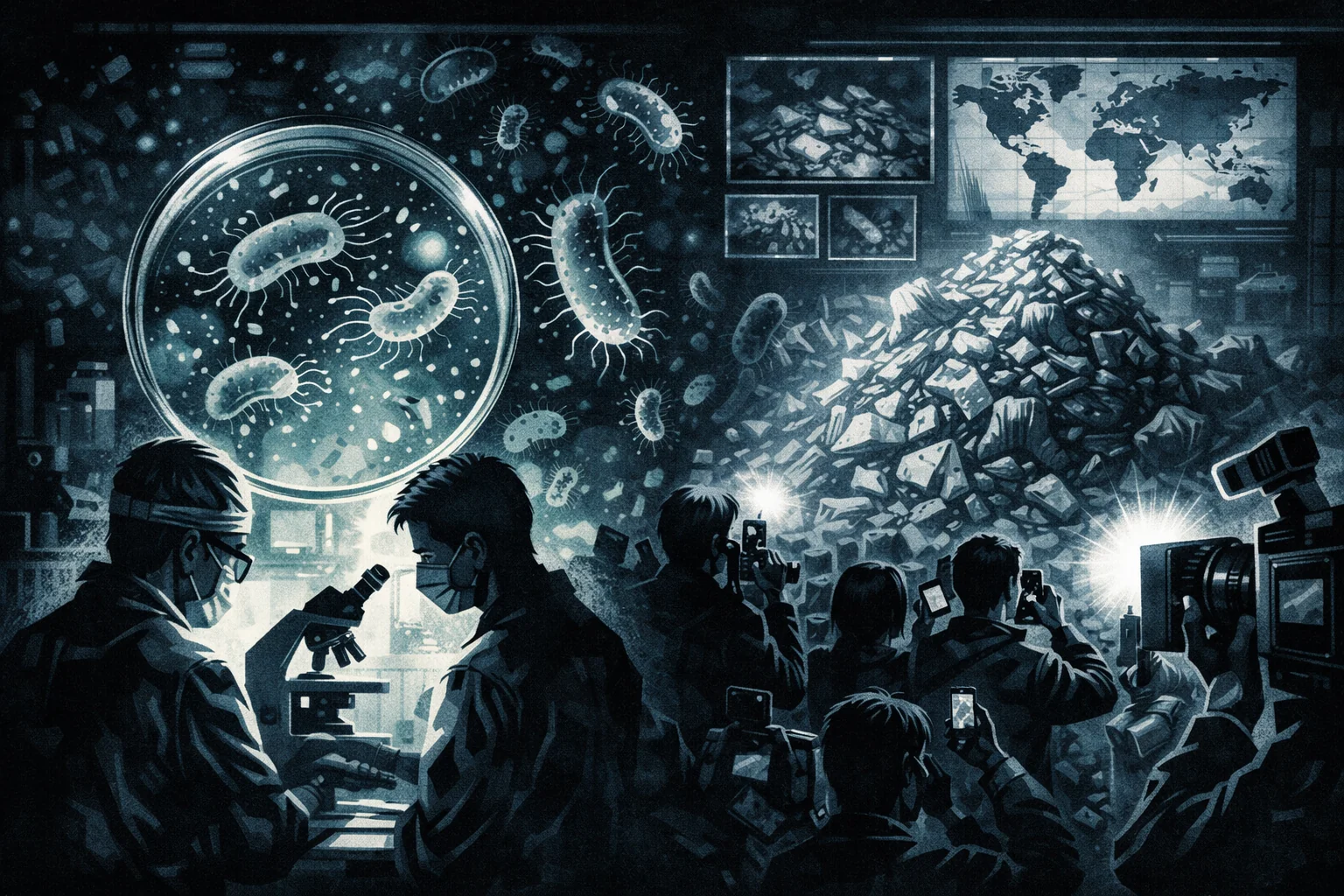
The discovery of bacteria or enzymes that can eat plastic has been in the news for years. It is often presented as a breakthrough that could end the plastic pollution crisis, but a calm scientific reading reveals that the issue is much more complex.The discoveries are indeed real, but they do not automatically mean that the world is close to a quick and comprehensive solution. The most important question is not whether there are bacteria that break down plastic, but what kind of plastic, how fast, under what conditions, and can this be transferred from the lab to a large-scale, economically viable factory?
The most famous discovery in this field dates back to 2016, when a Japanese team led by Shusuke Yoshida published a description of a bacterium called Ideonella sakaiensis found at a plastic bottle recycling site.It turned out that this bacterium can use PET plastic, a common plastic in beverage bottles and some textiles, as a source of carbon and energy, via two key enzymes, PETase and MHETase, which convert the polymer into simpler units such as terephthalic acid and ethylene glycol. This was an important scientific discovery because it proved that biodegrading some types of plastics is not impossible.
What was discovered is not a magical bacteria that devours all the plastic waste in the environment, but a microorganism that deals with a relatively specific type of plastic under specific conditions.The target plastic is often PET, a polymer with ester bonds that enzymes can attack, unlike other highly resistant types such as PE and PP, which dominate much of the global waste stream and are much more difficult to biodegrade. Some recent studies have even cautioned against rushing to label certain enzymes as directly effective against PE, emphasizing that proving true degradation is still complex and difficult to verify.
The real development began after 2016: the focus was no longer on natural bacteria, but on engineering the enzymes to make them faster, more stable, and able to work at temperatures and conditions closer to industry. Recent scientific reviews in 2024 and 2025 confirm that recent years have seen clear progress in designing improved versions of PETase and other enzymes that are more efficient at breaking down PET, especially when processing shredded and pre-prepared materials.But these same reviews also emphasize that the enzymes are not yet economically and industrially ideal, and that many of the lab's results are still based on controlled plastic samples and conditions that do not fully reflect the reality of mixed and soiled waste in the real world.
In the laboratory, plastics can be cleaned, accurately sorted, shredded, crystallized, and controlled for temperature, pH, and reaction time. In industry, the issue is quite different: plastic waste is often mixed-colored, multi-layered, contaminated with food residues, and laced with dyes and enhancers that impede degradation or make the process costly.One of the key issues highlighted by recent studies is the lack of standardization in enzyme testing, which makes some lab results difficult to compare and increases the risk of overestimating their industrial readiness. Recent reviews also confirm that high crystalline zones in PET remain a major challenge, often requiring energy- and cost-consuming pretreatment.
French company Carbios, for example, announced in 2024 the groundbreaking of what it described as the first industrial-scale PET bio-recycling plant in France, and in 2025 it confirmed its continued goal of building the plant with a revised timeline.This means that the idea has moved out of the confines of a scientific paper and into the realm of investment and industrialization. But even here we must be careful: the talk is still about PET, about specialized facilities, and about a recycling sector directed mostly to bottles and polyester textiles, not about a comprehensive solution to all forms of plastic pollution in the seas and landfills.
Economically and environmentally, even the success of these technologies will not eliminate the need for sorting, reducing consumption, reuse, and mechanical and chemical recycling. Recent reports and reviews on recycling technologies imply that the plastics crisis is not only a technical issue, but also an issue of infrastructure, policies, markets, and prices for oil-based virgin materials. Even the best enzymes alone will not solve the waste stream if new plastic remains cheaper than recycled plastic, or if collection and sorting systems remain weak.
The bottom line is that we are not yet facing a full-fledged environmental revolution, but we are also not facing empty hyperbole. The scientific discovery is real, the development is ongoing, and some initial industrial applications are starting to take shape, especially in the PET field, but the gap between laboratory success and a comprehensive environmental solution is still large.Therefore, the more scientifically accurate claim is this: Plastic-degrading bacteria and enzymes represent a very promising tool in a package of solutions, but they have not yet turned into a general industrial remedy for the global plastics crisis. The potential revolution is there, but its success will depend on its ability to go beyond the laboratory and enter a real, scalable economy
Comments