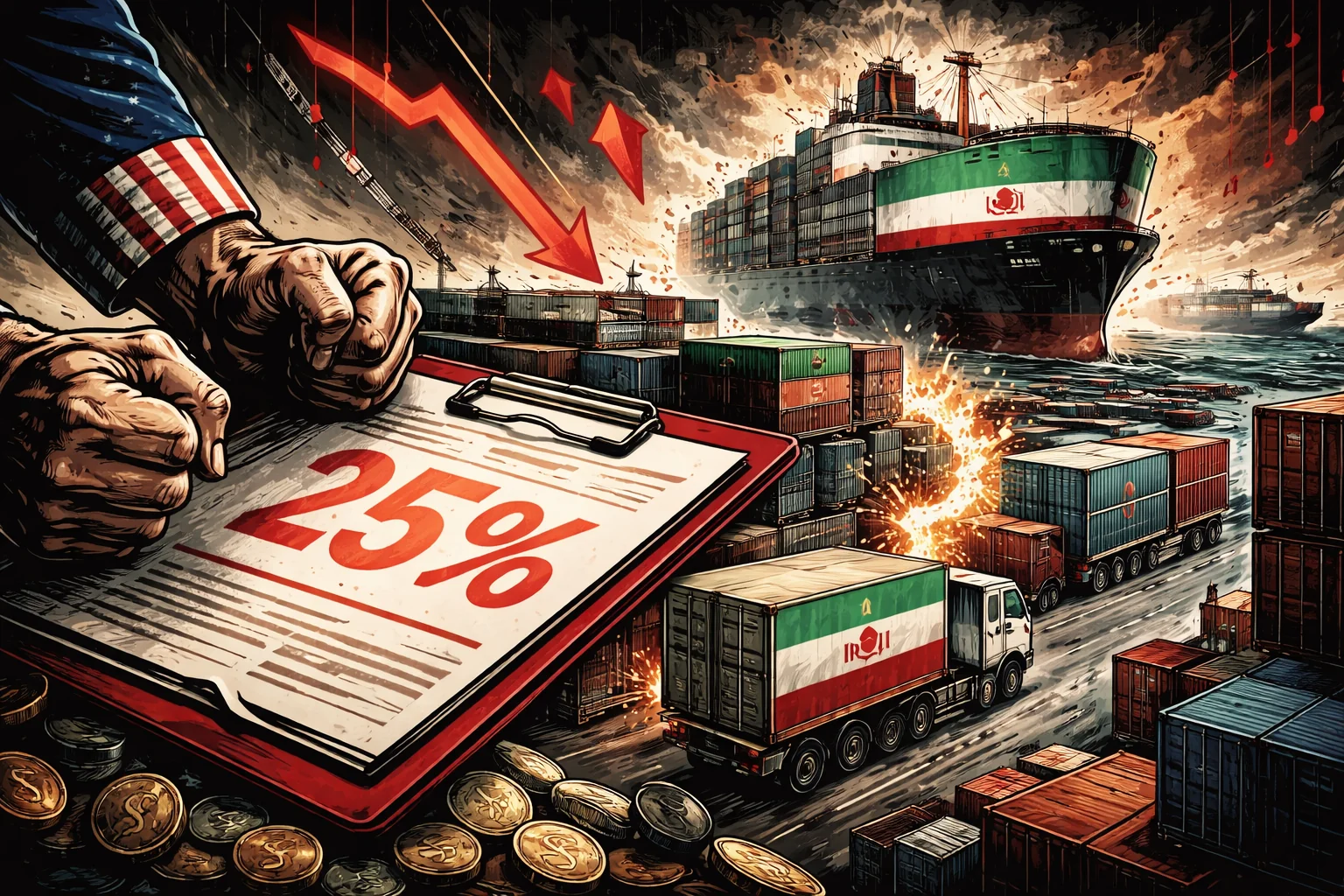
In mid-January 2026, former US President Donald Trump announced the imposition of a 25 percent tariff on any country that trades with Iran. The decision was not presented as a traditional economic measure, but rather as a direct political pressure tool, making it different in nature and impact from any previous tariff. Instead of targeting a single country, the decision opened the door to chain effects that affected intermediary countries, global companies, and markets far from Iran itself.
The danger in this tariff lies not only in its high percentage, but in its logic: any business dealings with Iran could expose the country or company to a comprehensive sanction on its trade with the U.S. Thus, access to the U.S. market was transformed from an economic advantage to a tool of political deterrence, and trade entered a new phase in which geopolitical risks are managed as much as financial calculations.
The ambiguity that accompanied the announcement added to the shock. The statements were firm without clarifying implementation mechanisms or exceptions, prompting global companies to immediately adjust their behavior, not in anticipation of the law, but for fear of losing the US market. This kind of intentional ambiguity makes the decision more impactful than its actual implementation, because it changes expectations before the rules change.
China has been at the center of the sphere of influence, accounting in 2025 for more than 90 percent of Iran's oil exports. With the new tariffs, total duties on some Chinese goods could rise to around 45 percent from the previous 20 percent, putting global supply chains in real disarray and increasing the likelihood that the cost will be passed on to the end consumer.
Trade between the UAE and Iran reached $6.07 billion in 2024, while non-oil trade reached about $27 billion as of March 2025. Any pressure on these channels does not stop at the borders of the two countries, but is transmitted through re-exports to regional and international markets, generating what can be described as price contagion.
Previous experiences have shown that trade tariffs can raise the costs of entire sectors, such as in Saudi Arabia's construction sector, where costs rose between 3.4% and 7% in two years due to indirect charges on inputs. With a 25% tariff, these effects become broader and more complex.
The end result is the redrawing of global supply chains. Companies are no longer just afraid of dealing directly with Iran, but of so-called "origin tainting": a single component linked to Iran could be enough to exclude an entire supplier from the US market. Companies are changing suppliers, shipping routes, and even production sites to avoid being penalized.
In this sense, the 25% tariff is no longer just an economic decision, but a new paradigm in the management of international conflict, where trade is weaponized and prices and supply chains are reshaped by politics rather than the market.
To view the video and read the full analytical paper, please scroll down.
Comments