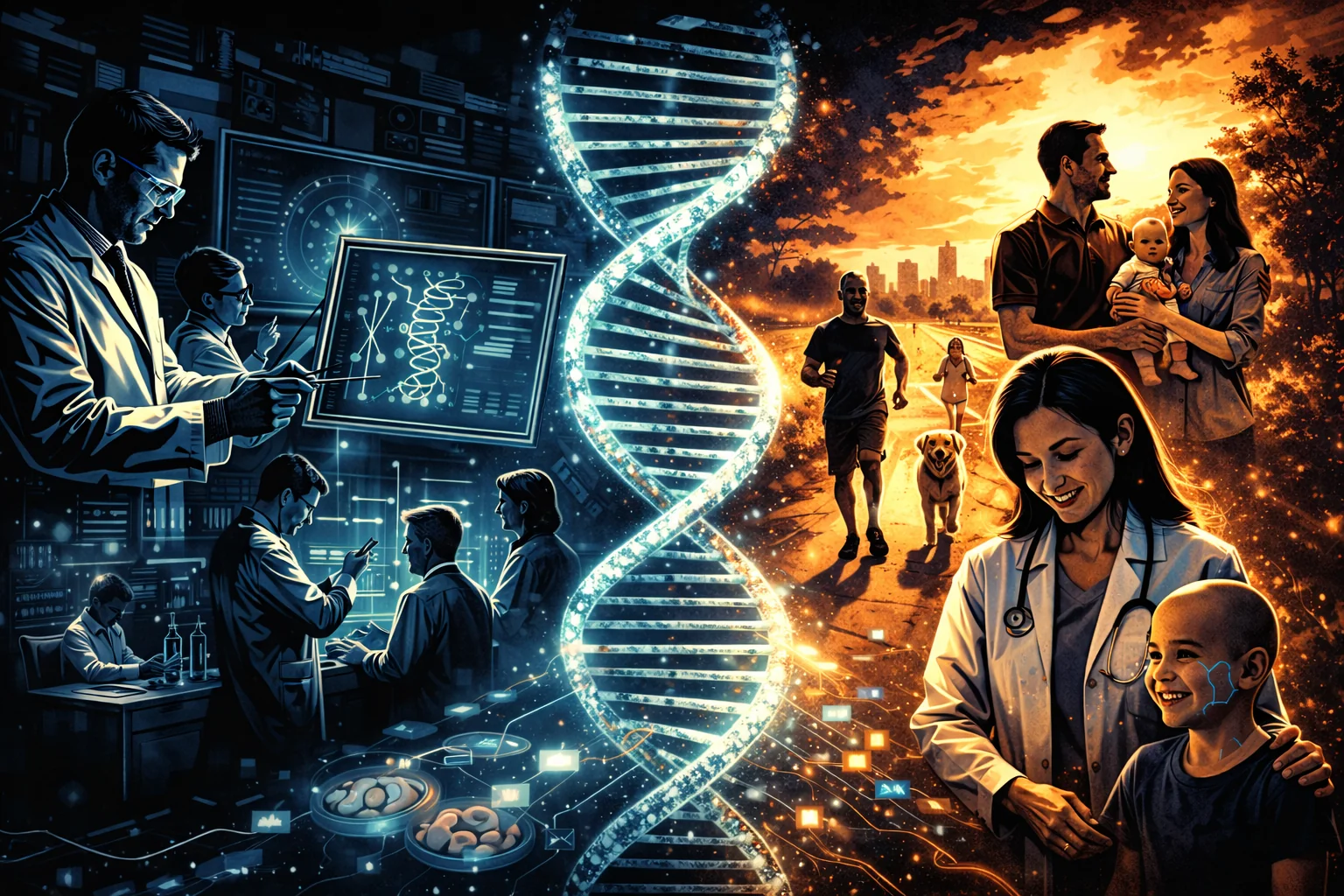
A few years ago, "gene editing" seemed like a distant idea from a science fiction movie. Today, the same idea is gradually becoming a realistic therapeutic path: modifying a specific piece of DNA inside human cells to treat a genetic disease, disable a gene that causes an issue, or fix a small but devastating genetic error.This is the essence of gene editing: a precise intervention (as much as possible) in the "text" of the genome, like a text editor changing a letter or a line instead of rewriting the whole book. As we enter 2026, the question is no longer just "Can it be done?" but "Where has it worked? What are its limits? Who will have access to it?
Gene editing differs from traditional "gene therapy" that adds a copy of a gene or carries a "new instruction" to a cell. Gene editing attempts to modify what is already there. The most famous is CRISPR-Cas9: a tool that cuts DNA at a specific location, then the cell utilizes its natural repair system to make the desired modification.While the idea sounds simple, the real challenge is: How do we get to the right position? How do we minimize side errors? How do we ensure that the "repair" doesn't cause an unintended change? These questions are not just technical; they are questions of safety, trust, regulation, and cost.
The breakthrough that makes 2026 an important milestone is the transition of gene editing from "scientific proof" to "therapeutic product" in some cases. At the end of 2023, the U.S. Food and Drug Administration (FDA) approved the first CRISPR gene editing therapy for sickle cell anemia, a historic moment because it is the first approval of a CRISPR-based therapy in the U.S. (U.S. Food and Drug Administration, 2023).In Europe, the European Medicines Agency (EMA) issued its official report on the same therapy for two genetic blood diseases (sickle cell anemia and transfusion-dependent beta-thalassemia) for those aged 12 years and older, reflecting the technology's transition to a stable regulatory path (European Medicines Agency, 2023). In the Arab world, the UAE announced in January 2026 that the first dose of gene therapy of this type was administered to treat inherited blood disorders, symbolically marking the region's official entry into the era of modern gene therapies (WAM, 2026; The National, 2026).
But CRISPR itself is no longer the "classic" form that cuts DNA and leaves it to the cell to repair. One of the most notable developments in the new wave is so-called base editing: instead of cutting the chain, the tool changes one DNA "letter" to another within the cell, which is important because many diseases are caused by a single letter error.Specialized companies are currently working on this type of editing to target the PCSK9 gene associated with cholesterol levels and heart disease, aiming to "turn off" the gene or modify its function for long-term cholesterol lowering after a single dose. Reports indicate that this pathway shows significant reductions in blood lipid markers, turning the idea of chronic treatment (pills for life) into a "single intervention" that lasts (Verve Therapeutics, 2025).
The most sensitive development in 2026 is the transition from extracorporeal to intracorporeal editing. In the former case, doctors take cells from the patient (such as blood stem cells), perform editing in the lab, and then return them to the body after medical conditioning.In vivo editing means that the treatment is administered directly to target a specific organ (such as the liver), via vectors such as lipid nanoparticles or viral vectors. This method brings editing closer to a "drug" form, but poses more complex challenges such as precise delivery, immune response, and the potential for off-target effects.
One of the most important examples is a therapy that targeted the TTR gene to treat a hereditary form of amyloidosis. Results published in the New England Journal of Medicine showed a profound reduction in TTR protein levels after a single dose, promoting the idea of "permanent modification" rather than repeated treatment (New England Journal of Medicine, 2025). This success was not without risk; safety issues were later reported in some advanced clinical trials, reflecting the staggered nature of progress in this field (CGTLive, 2025).Looking at the big picture, the big question becomes: what does all this mean for our daily lives? It means that medicine is moving from treating symptoms to treating the genetic root of the issue. For example, in December 2025, the US Food and Drug Administration announced its approval of a new gene therapy for the rare immune disease Wiskott-Aldrich Syndrome, confirming the expansion of the "era of gene therapies" simultaneously with gene editing (Reuters, 2025).
Some of these treatments cost more than a million dollars per case (Financial Times, 2024), raising deep ethical and political questions about who deserves treatment and who has access to it. In the Arab region, where health systems and purchasing power vary, this question becomes even more sensitive: can "gene therapy" become a luxury only for the rich, or a universal human right?
As 2026 begins, gene editing seems to be moving in three parallel directions: first, expanding the list of targeted diseases using more precise tools (basal and primary editing and neural tissue targeting); second, improving delivery tools within the body to reduce doses and increase safety; and third, evolving regulatory and oversight frameworks that attempt to balance accelerating innovation with ensuring public safety. Ultimately, gene editing in 2026 is not a "magic wand," but it is also no longer a deferred promise.It is a scientific field that is proving itself step by step: clear successes in hematology, promising beginnings in in vivo editing, conceptual leaps towards greater precision, and, in turn, open questions about long-term safety, cost, and justice. It is not only a revolution in medicine, but a renegotiation between science, market, state, and ethics around a fundamental question: when we are able to edit the "code of life", who decides where to use this ability...and for whose benefit?
Comments