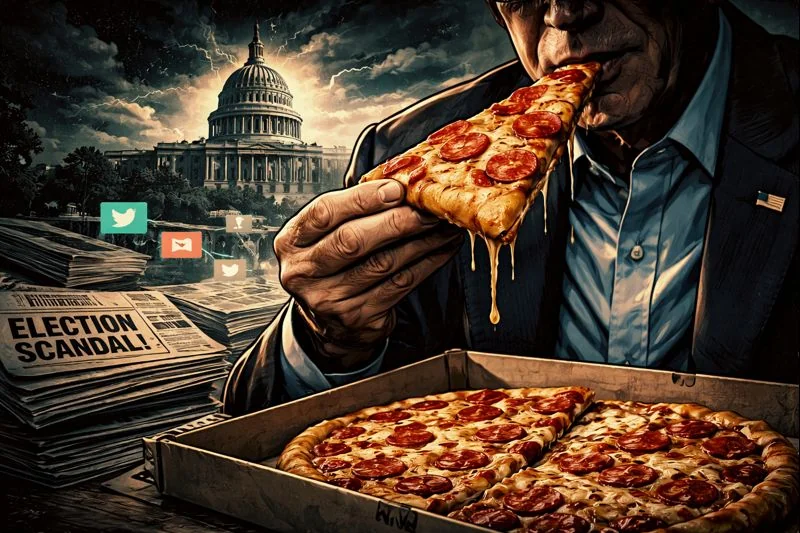
On a December evening in 2016, a man armed with an AR-15 semi-automatic rifle entered a Washington DC pizzeria, intent on "investigating" allegations of a secret criminal network run by prominent politicians. The man fired at least one shot and wouldn't give up until he confirmed for himself that no children were being held captive in the restaurant.This incident was the culmination of a bizarre story that circulated online during the 2016 US election campaign, a story dubbed "PizzaGate," which alleged a child trafficking and abuse ring run by those close to presidential candidate Hillary Clinton, allegedly located in the basement of a Washington pizzeria.
I. The Shaping of the Pizza Story in Digital Space
In late October 2016, WikiLeaks published thousands of hacked emails of Hillary Clinton's campaign chairman, John Podesta. A group of users on the notoriously obscure 4chan forum began mining the emails for hidden clues. Simultaneously, a rumor spread on Twitter by an anonymous account that another email investigation (Anthony Weiner's) had uncovered a sexual exploitation network linked to Hillary Clinton. The claim received thousands of retweets and sparked a series of interpretations.
Internet users found an email between Hillary Clinton's campaign chairman and the restaurant's owner, James Alevens, discussing a fundraiser. Although the content of the email was standard, some decided to read it symbolically: the restaurant was immediately linked to allegations of a child trafficking ring run by figures in the Democratic Party.Promoters of the story relied on multiple digital sources to craft their narrative: published emails that included words like "pizza" and "pasta," photos and social media posts of the restaurant and its owner and friends, logos and cartographic symbols such as the logo of a neighboring restaurant, descriptions of alleged locations, and even linguistic cues that were considered secret codes.
For example, ordinary vocabulary in Podesta's messages-such as the reference to "pizza"-was interpreted as code for horrific child exploitation. Some went so far as to claim that there was a secret basement under the restaurant where child trafficking victims were held, even though the restaurant did not have a basement.They also circulated images of logos with spirals or hearts that appeared in nearby storefronts as satanic symbols or signs of child grooming, including the logo of a neighboring pizzeria that they claimed was a symbol of child exploitation. Separate threads-political email, a family restaurant, and fleeting images-were woven into one seemingly coherent story.
The rhetoric of the story was characterized by a sharp moral tone and an almost apocalyptic depiction of events. Proponents of the theory used terms such as "child slave ring," "satanic rituals," and "corrupt elite" to describe the supposed antagonists.Right-wing host Alex Jones went so far as to publicly accuse Hillary Clinton of having "killed children herself" in the course of addressing these allegations. Such outrageous accusatory language-supported by a vocabulary of waking up to the truth ("Wake up!The truth is being revealed")-gave the narrative the feel of a scandalous revelation or what its believers called an "awakening" against hidden evil. Promoters of the story presented themselves as having a moral mission to expose corruption and protect children, earning the narrative sympathy in some quarters that saw it as a battle between good and evil. One slogan on Twitter at the time was: "Don't back down...Pizzagate everywhere"-a reference to the need to continue relentlessly spreading the so-called truth.
Within two weeks of its emergence, digital communities dedicated to the theory began to form. Believers created private forums such as /r/pizzagate on Reddit to discuss "evidence" and share speculation. Within these closed "echo chambers," users repeatedly recycled the narrative and added new details, solidifying the collective conviction that the story was true.When Reddit shut down the pizzagate forum on November 22, 2016 under the pretext of preventing the posting of personal information and incitement to violence, fans saw it as a deliberate censorship attempt and turned to alternative platforms like Voat to continue the discussion.For some, this action reinforced the sense that "an invisible hand is trying to silence the truth." The closure became further proof of the credibility of what they believe in. Similarly, when Facebook and Twitter began removing posts or closing accounts for policy violations, believers became increasingly convinced that they were being subjected to an organized silencing campaign.
At first, major newspapers treated the story cautiously as a malicious rumor worthy of refutation. On November 21, 2016, the New York Times published an investigative report refuting Pizzagate's claims, explaining that employees at Comet and Elephants had received a flood of threats based on unfounded allegations.The coverage focused on showing the obvious inconsistencies in the narrative: there was no basement at the restaurant, no direct connection between Alifsants and Hillary Clinton, and no criminal investigations into the allegations. However, the paper's tone was cautious, describing the story as "disinformation" without engaging in finger-pointing. At that point, the coverage was explanatory-seeking to explain the phenomenon and contextualize it within the wave of fake news that swept across social media platforms during the election.
The major turning point came in early December 2016, when the story spiraled completely out of control into reality. On December 4, 2016, 28-year-old Edgar Madison Welsh from North Carolina walked into a Comet restaurant armed with a semi-automatic rifle, intent on "personally investigating" what he had heard and read online.Welch fired two shots inside the restaurant, causing panic among customers and employees, before surrendering to the police. He later told authorities that he came to "save the children" after what he had read convinced him that there were victims trapped under the restaurant.The story went from a digital rumor to a public opinion issue to be discussed at news and security analysis tables. News coverage highlighted the incident as a serious result of a disinformation campaign and detailed the incident, explaining that there were no victims or evidence at the scene.It is interesting to note that some reports at the time used the term "fake news story" to describe Pizzagate, while others simply called it a ridiculous "conspiracy theory." It is also interesting to note that some reports at the time used the term "fake news story" to describe Pizzagate, while others simply called it a ridiculous "conspiracy theory.
Second: Investigative findings and counter-narrative:
In early 2017, a number of major media outlets published investigative reports concluding that the theory was completely unfounded. The Washington Post report, for example, asserted that the allegations were "completely fabricated" according to the Metropolitan Police investigation, and the New York Times report highlighted that it started as an online rumor and developed through episodes of deception. Law enforcement agencies also issued statements denying any actual investigation into the matter, except the investigation of the gunman who broke into the restaurant.In the face of these facts, some who promoted the story backed off or changed their position.For example, Alex Jones - one of the most prominent propagators of the PizzaGate theory - was forced to publish a public apology in March 2017 for his role in promoting the story, after the threat of legal action against him.This public retraction from an influential figure in the conspiracy camp was seen by some as a victory for the truth and evidence of the shaky foundation of the allegations. In a subsequent documentary, CNN described this case as an example of how "ordinary people can be radicalized by crazy content on the internet."
Conclusion
In the end, the "pizza" story that rocked the 2016 election reveals a complex phenomenon that goes beyond a fleeting online rumor. It was a digital narrative that grew and took shape in an unprecedented environment of information diffusion, where the role of the average user and the role of the newsmaker overlapped.This story combined the elements of a thrilling folktale - hidden symbols, alleged villains, heroes seeking to uncover the truth - with the tools of the digital age that allowed it to spread like wildfire across social platforms. In turn, journalistic institutions and professional investigative tracks took a parallel position to provide documented explanations and investigations, to clarify facts and separate reality from fiction.
The "pizza story" was not just a traditional rumor that could be quickly debunked, but became a revealing moment for the nature of our media age. It highlights how an undocumented narrative can take on a life of its own and become part of the public debate, driven by a segment of the population's trust in their own "knowledge" as opposed to their skepticism of traditional sources.At the same time, it shows the importance of the role of investigative journalism in presenting a parallel narrative based on evidence and verification, without slipping into a rhetoric of victimization or antagonism. After all, the popular Pizzagate narrative and the investigative journalism coexisted for a while and became part of each other's story: the popular conspiracy persisted despite official denials, and the investigative journalism itself became a subject of debate and interpretation for conspiracy theorists.
Years later, the effects of this incident remain in the collective memory. "Pizzagate" has become a lesson in the danger of fake news and how media phenomena in the digital age are formed without any factual basis. It is a story that combines a popular narrative that dreams of justice from outside the system with a journalistic investigation that seeks to bring facts to light from within institutions - and in this tension, society realized that truth itself can become a victim if we are not critically aware of what we read and hear.
Comments