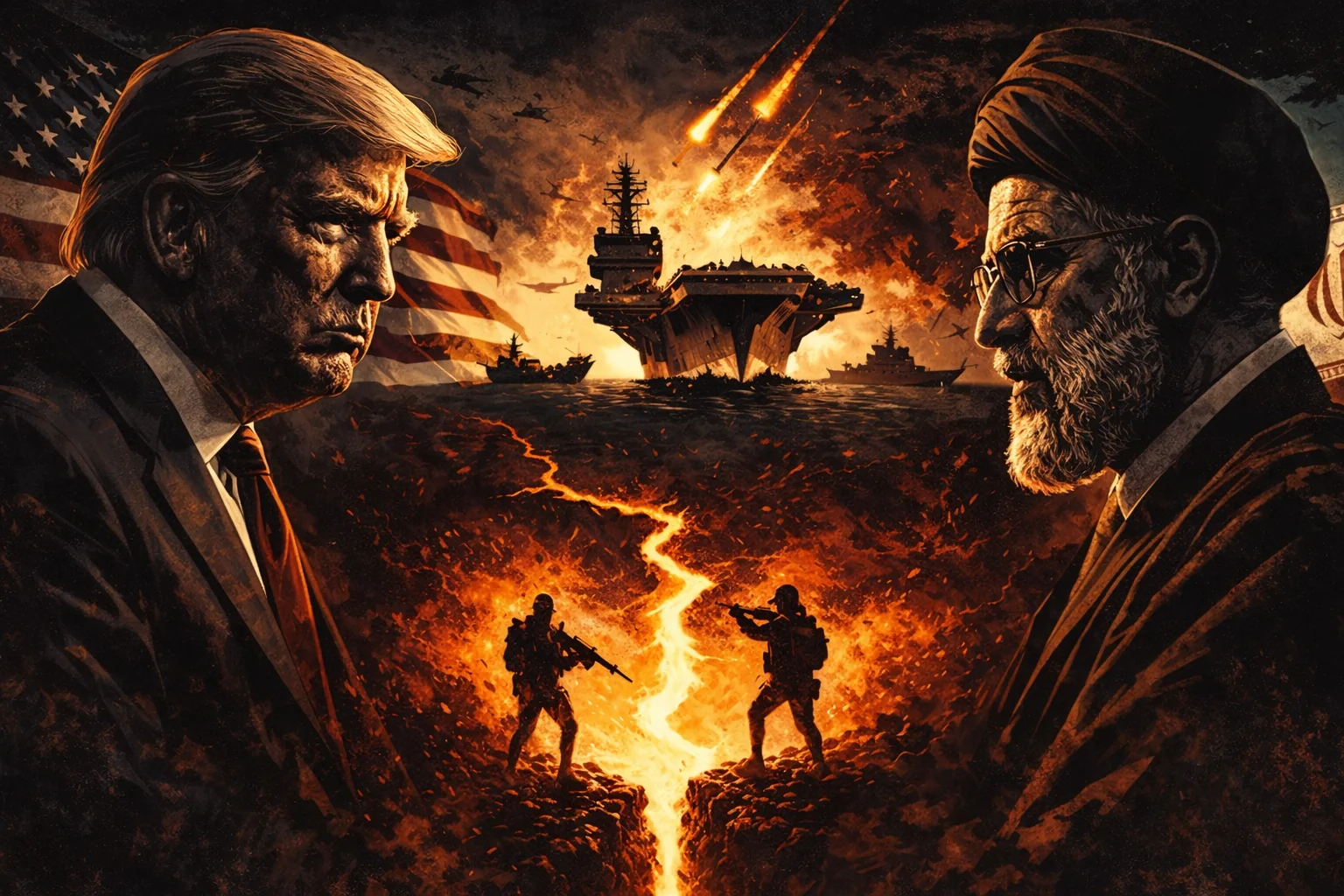
The US-Iranian escalation in February 2026 seems closer to a "decision crisis" than a decisive military event, because what appears on the surface of the coverage is a deliberate marriage between overt military pressure and a fragile negotiating process, so that each side tries to raise the cost of refusal for the other without automatically pushing to the point of no return.In this type of crisis, military movements turn from mere field preparations into multi-layered political messages: a message of deterrence to the opponent, a message of reassurance to allies, an internal message to public opinion, and a negotiating message that says "we have other options."Therefore, when today's platforms talk about "readiness for strikes within days" and "unprecedented mobilizations and movements," the most accurate analysis is to understand them as part of managing risks and cards at the negotiating table, not as a definite deadline, with the possibility of slippage remaining if the channels of appeasement fail or a field incident occurs that imposes sequential responses.
The latest reliable reports indicate that the United States has strengthened its military positioning in the region through naval and air assets, increasing the readiness to implement limited or broader options if a political decision is issued, with repeated confirmation in the same reports that the decision to strike has not yet been decided. This detail is important: readiness is one thing, and the political decision is another, and between them is usually a large bargaining space related to the calculations of the Iranian response, protection of deployed forces, cohesion of alliances, impact on the global economy, and the possibility of spreading the flare-up to more than one arena.On the other hand, it appears from today's coverage that Tehran is also seeking to send signals of strength, through maneuvers and naval coordination with Russia in the Gulf of Oman and the Indian Ocean, a classic pattern to raise the ceiling of deterrent messages and emphasize that any military action will not be a "free cost."
In this scene, the nuclear negotiations play the role of a "knife edge." When talks are on hold or progressing slowly, the military parade becomes a way to adjust the balance of concessions: Washington wants to convince Tehran that the cost of stalling could rise quickly, and Tehran wants to convince Washington that the cost of pressure could rise as well.The analysis provided by some specialized readings today indicates that the "red lines" of the two sides make it difficult to reach a comprehensive deal, but this does not exclude the possibility of interim arrangements or partial understandings that ease tension and prevent explosion, which explains why diplomatic signals continue even as the pace of mobilization increases.
Russia, which has a strategic partnership with Iran and has a direct interest in preventing a wide war near shipping and energy lines, publicly called for restraint and urged diplomatic solutions, while distinguishing between "planned" naval maneuvers and accelerated developments in tension. This position is not just a principled speech, but a reflection of an assessment of the cost of a war that may reshuffle the cards in energy markets, open proxy confrontations and push the parties to further polarization.
As for why talk of "military action within days" is escalating specifically, here two factors should be read together: the first is the logic of the "time window" that often appears in leaks and reports, where the phrase "within days" is used to create negotiating pressure and raise seriousness without committing to a deadline, and the second is that the density of deployed military assets automatically creates a feeling that the option of a strike is closer, even if the real goal is to deter and fortify the negotiating position. Press reports today indicated that security officials informed the US president that the military is "ready" to carry out strikes as soon as possible, while the final decision remains undecided. This puts us in front of a common scenario: operational readiness to strengthen the political hand, not a declaration of war.
However, the risks of slippage cannot be underestimated. The most dangerous thing about "brinkmanship" crises is that each side tries to appear unblackmailable, which can lead to high-risk symbolic steps.In this particular case, there are three paths that could lead to a rapid escalation even if unintended: misjudging the other party's intentions due to the blurring of messages, a field incident at sea or in the air that requires immediate responses to preserve "credibility," or the collapse of the negotiating process in a sudden way that makes one party see escalation as the only alternative to prevent a domestic political loss.
The region is the most sensitive link in the calculations of escalation, because any strike - even if it is designed as "limited" - carries the possibility of responses that extend along multiple paths: This is precisely why some reports focus on repositioning forces, raising the readiness of air and missile defenses, and reducing the exposure of personnel, which are signs that planners are not only looking at the moment of the strike, but also at the "next day" and the possibilities of response.
Economically, even the mere escalation of speculation leaves its impact through a "risk premium" on energy, shipping and insurance, and affects investors' appetite for risk, and increases the sensitivity of markets to any news about straits, targeting ships or disrupting supply lines. That is why we notice that global economic coverage today links the state of global markets to this tension, not because war is certain, but because markets react to the possibility, and specifically to uncertainty.
According to today's data, three likely scenarios can be built without going into operational details: a "pressure without hitting" scenario where mobilization continues while opening the door to an interim understanding that prevents explosion and saves face; a "limited strike" scenario that aims to change the calculations of negotiations and deter specific steps, but carries the risk of mutual retaliation and widening the flames; and a "rapid deterioration" scenario due to an incident or a sudden political decision that leads to a series of responses that are difficult to curb.The likelihood of any scenario depends on near-term indicators such as: the language of official rhetoric in the coming hours, the nature of international mediation, any announcement of a new round of negotiations or its suspension, and the extent of protection measures for troops and civilians at the points of contact.
In summary, the February 19, 2026 escalation is a moment of fragile balance between deterrence and diplomacy, in which force is used as a means of negotiation as much as a last option. The "immediacy" of the event does not mean that war is inevitable, but it does mean that the margin of error is smaller, and that any uncalculated step may turn the tension from political pressure to confrontation.As long as the final decision is not announced and the channels of negotiation are not completely closed, the scene remains open to multiple possibilities, the most dangerous of which is an unintended slide, and the most rational of which is an interim settlement that prevents the explosion and postpones the resolution to a new round of negotiations." The "immediacy" of the event does not mean war is inevitable, but it does mean that the margin for error is smaller, and that any uncalculated step may turn the tension into political pressure and delay the resolution until a new round of negotiations.
Comments