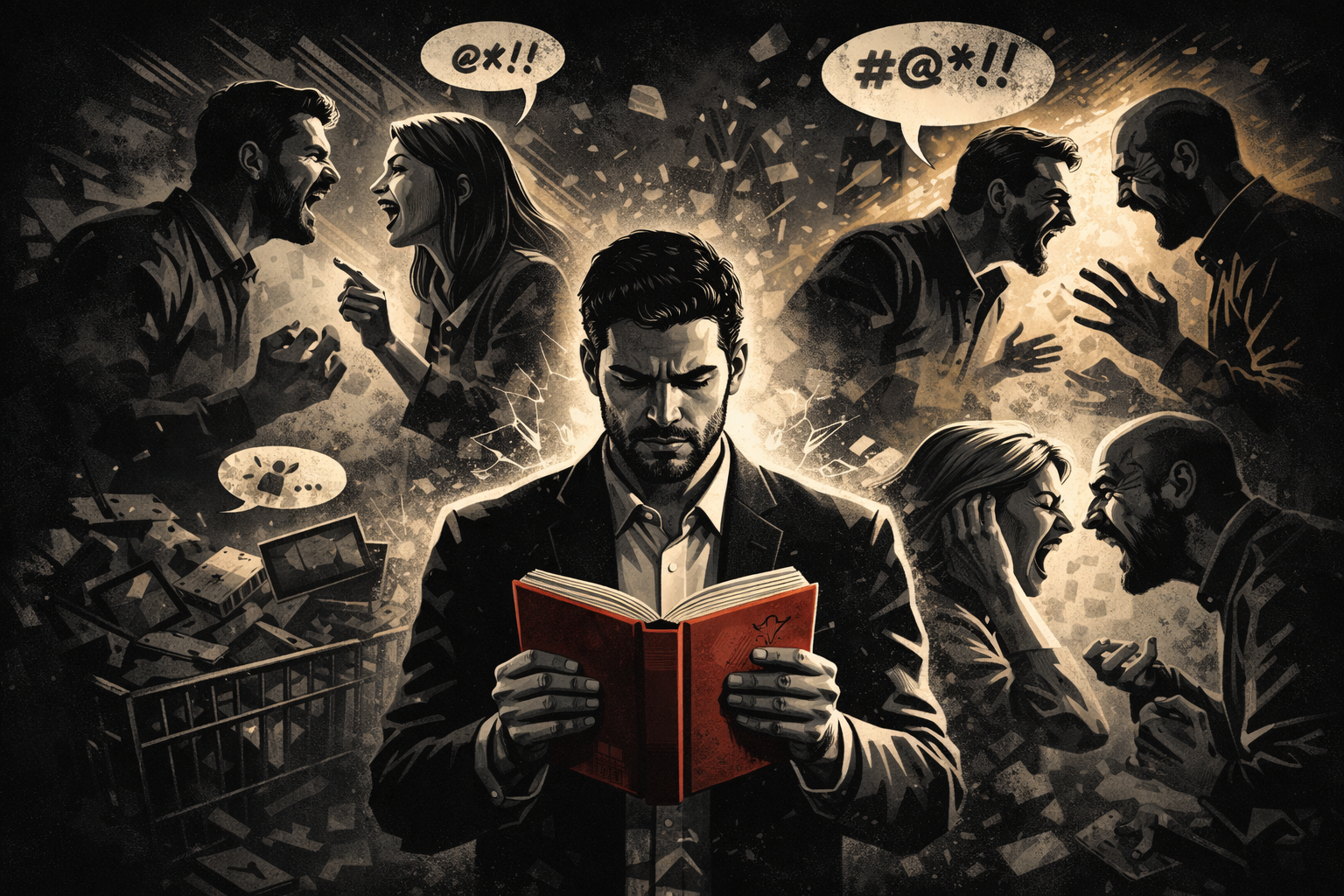
In every work environment, in every family, in almost every social circle, the same feeling recurs: Why do other people seem so illogical? Why do they make decisions we don't understand and behave in ways that surprise or frustrate us? Thomas Ericsson's Surrounded by Idiots takes this provocative question and turns it on its head.The issue, he suggests, is not the intelligence or lack thereof of others, but their different patterns of thinking and behavior. We are not surrounded by idiots, but by different types of people, each with their own logic and way of interpreting the world.
Erickson relies on a simple behavioral model that divides people into four main patterns, each representing a different color, to explain how misunderstandings arise in communication and why personalities clash at work and in relationships. The central idea of the book is not so much to categorize people as to train the reader to adjust their style to suit who they are talking to.Through this framework, difference is transformed from a source of tension to a source of understanding, and from a hindrance to a tool for strengthening relationships. It is an invitation to reconsider our assumptions about "normal" and "logical" and to understand that behavioral diversity is not a flaw, but a basic human reality.
Thomas Erickson's Surrounded by Idiots is a bold popular attempt to reinterpret human misunderstandings through a simplified behavioral model based on classifying people into four color patterns. The provocative title does not literally mean that others are idiots, but rather reflects the common feeling we have when we encounter patterns of thinking and behavior that are not like us.Erickson starts from a simple but effective premise: most issues in relationships and work stem not from ill will, but from differences in communication styles and interpretation of behavior. We tend to assume that our way of thinking and acting is "normal" and that others are either illogical, exaggerated, slow, or aggressive. The author attempts to dismantle this illusion by providing a framework through which these differences can be understood rather than demonized.
Erickson relies on the DISC model, a relatively old framework in applied psychology, which divides behavior into four main patterns: red for assertiveness, dominance, and quick decision-making; yellow for vitality, communication, and emotional impulsiveness; green for stability, calmness, and the desire for harmony; and blue for analysis, accuracy, and attention to detail.The core idea is not that people are absolutely one color, but that they have behavioral tendencies that tend to follow a certain pattern, and that these tendencies affect the way they receive information, respond to pressure, and communicate with others. "Difference" becomes understandable, because what red sees as unwarranted slowness may be seen by blue as a concern for accuracy, and what blue sees as impulsiveness may be seen by red as needed decisiveness.
Erickson uses many real-life examples to show how misunderstandings arise between these styles. A red person may speak with direct clarity and an assertive voice, and their behavior is interpreted by the green as harshness or lack of empathy, while in their own eyes they are a practical person who wants to get to the result quickly. Yellow may jump between ideas, talk excitedly and promise many things, and the blue sees them as messy and disorganized, while the red sees them as a motivational person and a source of energy for the team.Green may prefer to slow down and avoid confrontation, Red sees him as indecisive, Yellow sees him as insufficiently engaged, while Blue sees him as stabilizing. Blue may require more data and verification before making a decision, Red sees him as impeding progress, while Green sees him as reassuring because he does not rush. This difference in perception is what sometimes makes people feel "surrounded by idiots," when the truth is that each party is coming from a different place.
The book focuses heavily on the idea that effective communication is not about speaking in one's own preferred way, but about speaking in a way that the other person understands. This point represents the fundamental conceptual shift in the book. Rather than asking others to adapt to us, Erikson invites us to be more flexible ourselves.If you are talking to a red person, be brief, direct, and focus on results rather than details. With yellow, use enthusiastic language and give them space to express, and with green, be calm and reassuring and avoid sharp confrontation. This adaptation does not mean abandoning oneself, but recognizing that effective communication depends as much on the receiver as on the sender.
From a more analytical point of view, the book reflects a pragmatic approach to understanding personality. It does not seek to build a comprehensive psychological theory about personality formation, nor does it delve into neurological or genetic complexities, but rather offers a practical tool for everyday use. This simplicity is the secret of its appeal and the reason for its wide circulation, but it is also the source of its criticism.The division into four colors may tempt the reader to stereotype people, which may lead to a kind of stereotyping or reductionism. Humans are too complex to be reduced to a single color, and individual behavior may change depending on context, culture, age and experience. However, Erickson argues that the goal is not to put labels on people, but to use the model as a rough compass to understand general trends in behavior.
One important dimension of the book is its focus on the work environment. Erickson shows how many professional conflicts arise because of differences in styles rather than lack of competence. A red manager may see a green employee as uninitiative, when in fact that employee may be trying to avoid mistakes and keep everyone happy.A yellow-dominated team may thrive on brainstorming but fail to execute if there is no blue element organizing the process. From this perspective, behavioral diversity becomes a source of strength if managed properly, and a source of tension if not understood. The model helps leaders distribute tasks in line with individuals' inclinations, which increases satisfaction and productivity.
On a personal level, the book calls for a kind of self-awareness. Before you try to understand others, you need to understand yourself. What is your dominant color? How do your tendencies affect your interpretation of others' behavior? Do you tend to rush? To overanalyze? To avoid conflict? To seek admiration? This self-reflection opens the door to modifying behavior rather than simply blaming others. In this context, the book can be seen as an exercise in cognitive empathy, the ability to see the world from a different perspective without necessarily agreeing with it.
An important part of the book's strength lies in its narrative style. Erickson writes in direct language, full of stories and everyday situations, making theoretical ideas visualizable. This style makes the reader see themselves and others in the examples given, transforming the concept from a mere classification to a personal experience. The shocking title serves a marketing purpose, but deep down it tries to create a cognitive shock: perhaps the issue is not the "stupidity" of others, but our lack of understanding of their difference.
From a philosophical perspective, the book can be read as a call for behavioral relativism. What we consider right in communication is not a universal standard, but a reflection of our personal preferences. Acknowledging this relativity mitigates the tendency to make absolute judgments. In a multicultural and multimodal world, understanding difference becomes an essential skill for survival and success. The color model, despite its simplicity, reminds us that humans do not all process information, express emotions, or make decisions the same way.
Ultimately, Surrounded by Idiots offers a practical tool for understanding behavioral differences, rather than a comprehensive scientific theory of personality. Its strength lies in its simplicity and applicability, and its weakness lies in its potential to reduce human complexity.Instead of feeling surrounded by idiots, we may discover that we are surrounded by different types, each with their own internal logic, and that mutual understanding is not impossible, but only requires greater awareness and flexibility." The book's strength lies in its simplicity and applicability, and its weakness lies in its potential to reduce human complexity.
To download the book and video, please scroll down
Comments