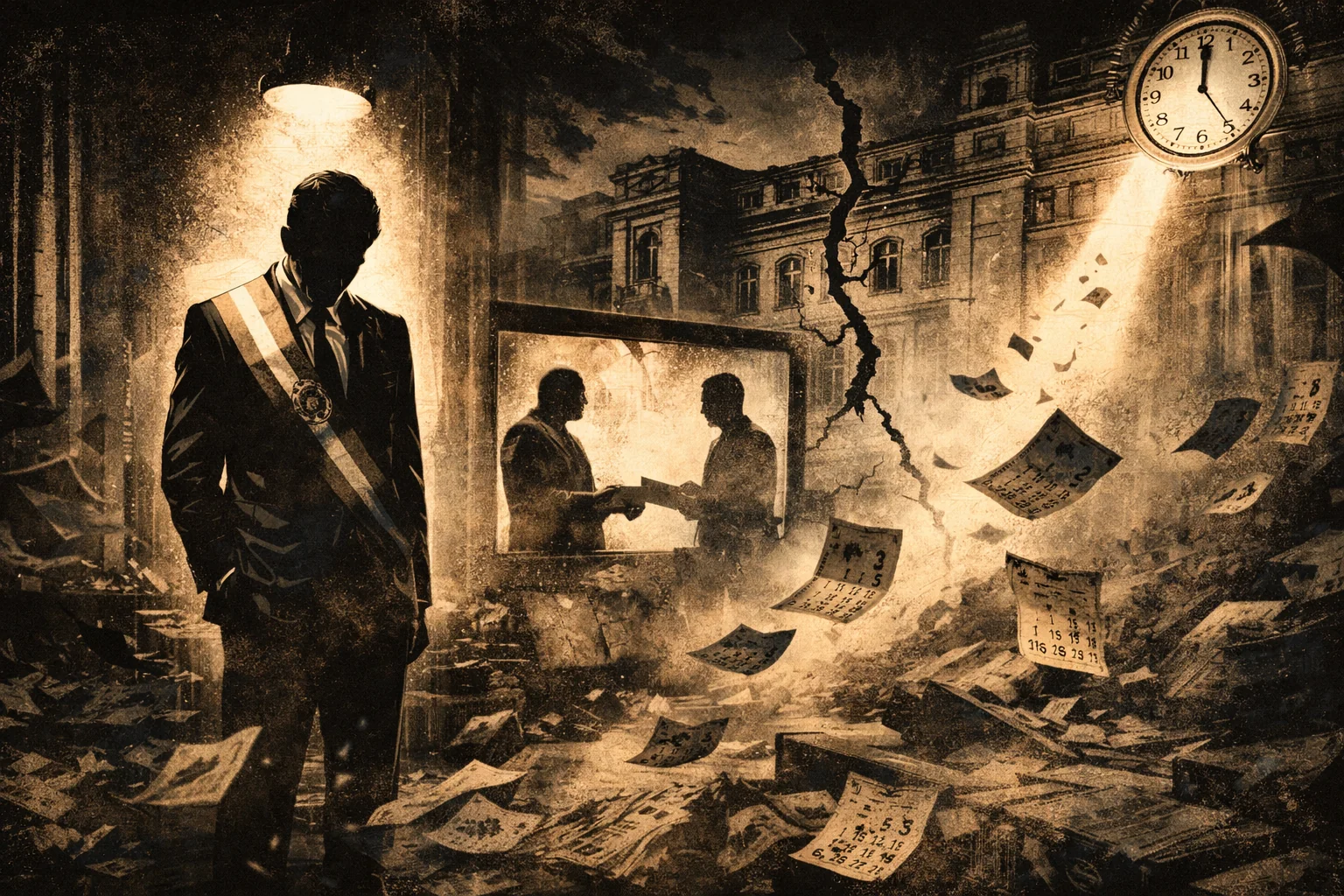
In one of the fastest removals of a head of state in modern times, the Peruvian Congress decided on February 17, 2026, to remove interim President José Jiri after less than four months in office, in an incident that sent shockwaves inside and outside Peru.This decision came amid a wide political scandal known locally as "Chifagate" - after leaks, photos and clips that showed the president conducting secret meetings with Chinese businessmen outside official records and without prior announcement, raising suspicions of corruption and abuse of influence that led to urgent investigations and his impeachment under the "moral impotence" clause of the Peruvian Congress.These dramatic political shifts were not just an isolated incident, but a manifestation of a deeper crisis in Peru's political institutions, which has been experiencing a recurring cycle of government upheaval and successive impeachments for many years. But it is the details of this scandal, how the meetings were leaked, and the substance of the accusations that have made it one of Peru's most dramatic political crises just weeks before the general elections scheduled for April 12, 2026.
When former President Dina Polwarte was impeached on October 10, 2025 for "moral incapacity" and had no vice president, Khairi assumed the role of interim president of Peru as president of Congress in accordance with the constitutional order.While his term was expected to be short, expectations were soon upended by reports of undisclosed meetings between him and Chinese businessmen that sparked widespread controversy within Peru's political and media circles. The story began in late December 2025 when reports of undisclosed meetings between Khairi and Chinese businessmen surfaced, sparking widespread controversy within Peru's political and media circles.
The story began in late December 2025 when photos and videos were leaked, some from security cameras, showing Khairy entering a Chinese restaurant late at night wearing a hood and mask to meet a Chinese businessman named Zhihua Yang at a place locally known as "chifa," a Peruvian Chinese restaurant. These meetings were not listed in the official records of the presidency, nor were they announced in the public meeting schedule, raising many question marks about why they were held, who attended them, and what was discussed.According to local media reports, Yang was a businessman with concessions in energy and telecommunications projects who had previously been named in a circle related to government tenders and business networks close to power. The press and public affairs observers also noted that one of the attendees at another meeting was Ji Wu Xiaodong, a person linked to illegal timber trading networks who was under house arrest.
At first, he tried to downplay the meetings, saying they were "spontaneous" or "fortuitous circumstances," even describing them as part of the planning for cultural events such as Peru-China Friendship Day.However, initial investigations initiated by Peruvian judicial authorities pointed to suspicions of influence peddling and interference that may be linked to the awarding of government concessions or contracts, a form of serious political corruption, especially when it comes to relationships with businessmen with interests in large infrastructure projects in the country. It also appeared that the controversy over these meetings escalated against the background of diplomatic tension between the United States and China, as Peru is an important economic partner for China, especially in port and energy projects, making these meetings a politically and diplomatically sensitive topic at the same time.
More controversially, these meetings were not recorded in the official records of the presidency, nor were they announced in the published agenda of presidential visits. This led Khairy's critics to accuse him of covering up meetings that could have personal or undisclosed interests, a very serious accusation for a president who is supposed to be transparent in running the state. The local press published photos and clips showing Khairy entering closed places at unusual times, reinforcing the narrative that he had something to hide from the public and Congress.
By February 17, Congress concluded that Khairy's actions amounted to "moral incapacity," a constitutional term used in Peru to impeach the president when he loses confidence or engages in practices that harm public trust. In a heated session, parliament voted 75 votes in favor, 24 against, and 3 abstentions, showing a clear majority against the interim president.It should be noted that the process was not used through the traditional impeachment mechanism based on Article 113 of the constitution, which requires a special majority, but was organized as a vote of no confidence in his abilities as president of Congress, which automatically stripped him of presidential power in accordance with the constitutional procedures for transitions.
Congress quickly selected José María Balcázar as the new interim president until the general election in April 2026, but this choice in turn sparked a wide political debate within Peru due to the past positions of some parliamentarians, adding a new layer of polarization. The secret meetings scandal goes deeper than just the title of loss of office; it revealed a thorny web of relationships between politicians and businessmen with significant interests in strategic projects such as energy and ports, with a delicate balance of power.
The scandal reflects Peru's larger challenges in dealing with transparency, the powers of parliament, and the role of businessmen in the political process. The secret meetings that were neither recorded nor made public, and their explanation by the president as normal circumstances, showed a clear gap between public expectations of leadership and the behavior of some officials. The timing, weeks before crucial elections, makes this case a political event with an extended impact, not only on Khiry's personality, but on public confidence in Peru's democratic institutions that face a real test in maintaining the integrity of governance and testing the limits of economic influence within political decisions.
Observers of public affairs in Peru do not stop at the fall of a transitional president after four months, but see the "Chifagate" scandal as an example of a deeper crisis in the political structure, where corruption, economic influence, international interests, and weak institutions converge in a scene that perpetuates distrust in ruling elites and casts a shadow over the upcoming elections. It is a stark reminder that transparency in dealing with international economic powers and questions about loyalty and the public interest remain among the biggest challenges facing modern democratic regimes in Peru, and perhaps in the entire region.
Comments