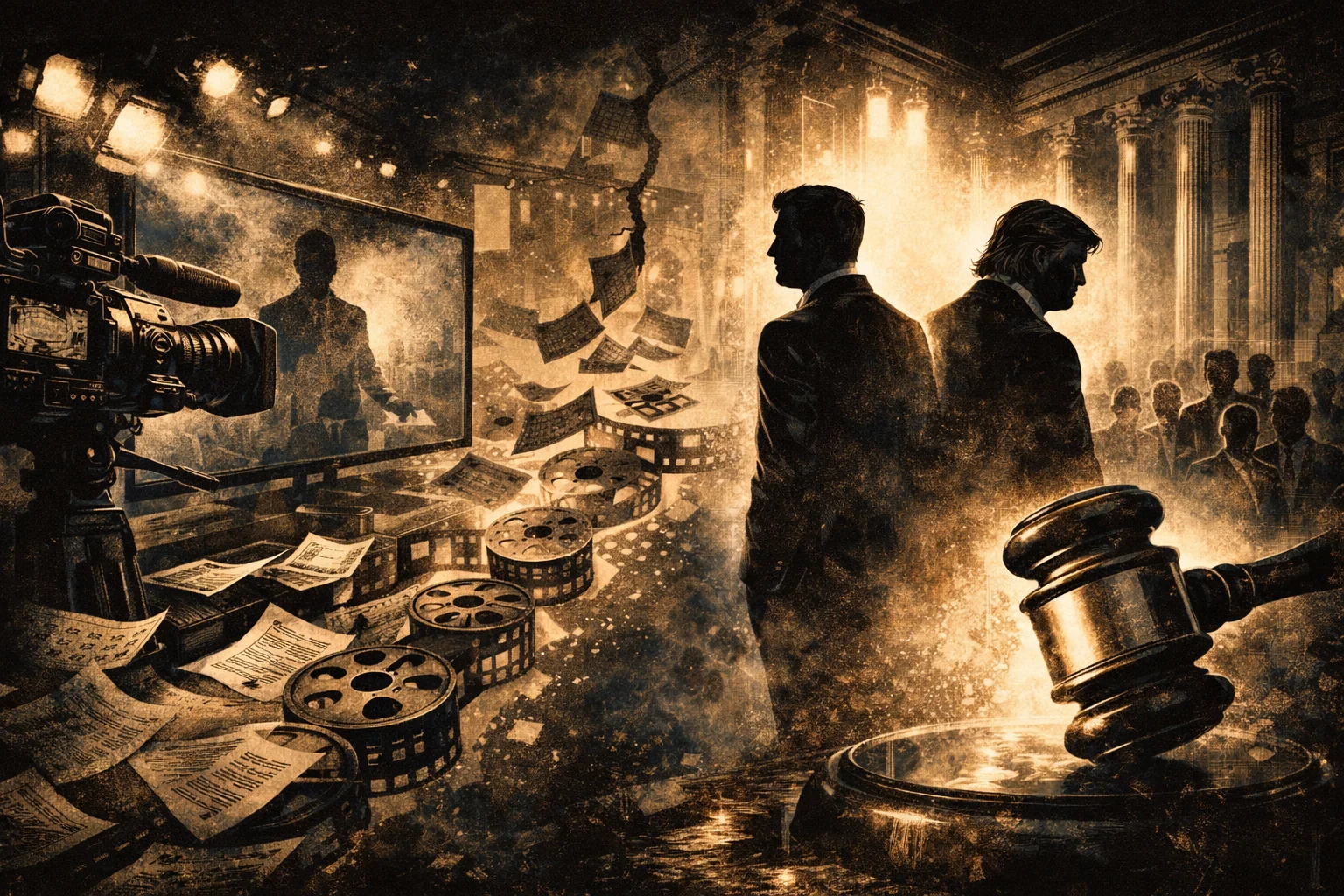
In recent weeks, a complex legal-media issue has emerged in which journalistic editing intersects with U.S. constitutional law and a highly sensitive political context: A $10 billion defamation lawsuit filed by US President Donald Trump against the British Broadcasting Corporation (BBC) over a documentary that aired before his return to the White House. The case represents a professional-legal dispute over how a documentary was edited, and whether an editing error can amount to legal defamation.
What is the case:
The dispute has its roots in a BBC documentary titled "Trump: A Second Chance?" which aired before the election in which Trump returned to the presidency. At the center of the dispute is how a clip from a speech Trump gave on January 6, 2021 was edited. According to the lawsuit, the documentary used an edited version of the speech that highlighted phrases such as "fight like hell," while the reference to protesting "peacefully" was omitted. Trump argued that the editing misrepresented his speech and damaged his reputation by suggesting that he had encouraged the storming of the Capitol. The BBC has apologized for the editorial style, but denies that it amounts to legal defamation and requires billions in damages.
Trump is seeking $10 billion in damages, divided into two parts: 5 billion for the defamation suit, and 5 billion under Florida's Unfair or Deceptive Trade Practices Act. The inclusion of this statute is notable, as it is rarely used in the context of media publishing, but it expands the claim to include a claim that the misleading editing was not only a professional error, but also conduct constituting a deceptive trade practice.
Recent procedural developments:
The BBC has announced its intention to file a motion to dismiss in a federal court in Miami. Its primary argument is that Trump "failed to plead sufficient allegations" to establish the elements of defamation or to prove a violation of the Florida Commercial Code. It also intends to argue that the court may not have proper jurisdiction, either under state rules or under the "due process" requirements of the U.S. Constitution.
Earlier, a US judge rejected the BBC's request to suspend the discovery phase of the trial until the dismissal motions are resolved. The judge deemed the request for a stay premature and unsubstantiated. This point is important because the discovery phase allows both parties to request internal documents, editorial correspondence and testimony, meaning the dispute could extend to a detailed examination of the BBC's editorial decision-making mechanisms.
The court has set a two-week trial for February 2027, meaning the dispute is likely to drag on for a long time, with procedural battles likely to continue throughout 2026. The court has also set a March deadline for submitting relevant applications to dismiss the case.
One of the points the BBC raises is that Trump will have a hard time proving actual harm, because the documentary aired before he won a second term, weakening the argument of direct political harm. This is not a decisive argument per se, as defamation cases can arise even without electoral loss, but it is used to undermine the massive damages claim by casting doubt on the existence of measurable harm of this magnitude.
The case touches on one of the pillars of US public figure defamation law, the "actual malice" standard, which requires proof that the publisher knew the information was false or recklessly disregarded the truth. The BBC argues that Trump cannot reasonably prove this requirement, a key element in cases brought by public figures against the media.
The crisis has not been limited to the judicial track. The fallout from the documentary led to changes within the organization, including the departure of senior officials in November after the editorial controversy escalated. This reflects that the institution treated the incident as a professional lapse with an internal cost, even as it refuses to legally characterize it as defamation.
Political-media dimensions:
Although the case is ostensibly legal, it has broader political and media dimensions. A US president is suing a British public broadcaster in a US court for billions of dollars, in a dispute over how the events of January 6, 2021 should be narrated. This brings to the forefront the question of the relationship between media and political criticism, and the limits of editorial responsibility when it comes to public figures. It also raises questions about the risks of cross-border litigation for international media organizations.
We are faced with a dispute that started with a documentary editing issue and ended up in a complex multi-track court battle: Jurisdictional defenses, strict defamation standards, claims for billions, and a discovery phase that may reveal insider details about the content industry. What will determine the direction of the case going forward is not the political debate, but the ability of each party to meet the requirements of the law: Will the BBC succeed in getting the case dismissed early, or will the case progress to a full trial in which a jury will be asked to assess whether the montage crossed the line between editorial error and legal defamation?
The judicial process is still in its infancy, but recent developments suggest that the case will turn out to be an important test of the limits of editorial freedom in the face of defamation claims from the highest political level.
Bibliography:
Reuters.(2026, February 18).BBC to argue Trump failed to show he was defamed in documentary.
Reuters.(2026, February 12).U.S. judge rejects BBC's stay application in Trump defamation case.
Reuters.(2025,December 16).Trump sues the BBC for $10 billion over speech edit.
Reuters.(2026, January 13).BBC seeks to have Trump's $10 billion lawsuit dismissed.
Associated Press.(2026).Trump's defamation lawsuit against the BBC is set to go to trial in 2027,US judge says.
Comments