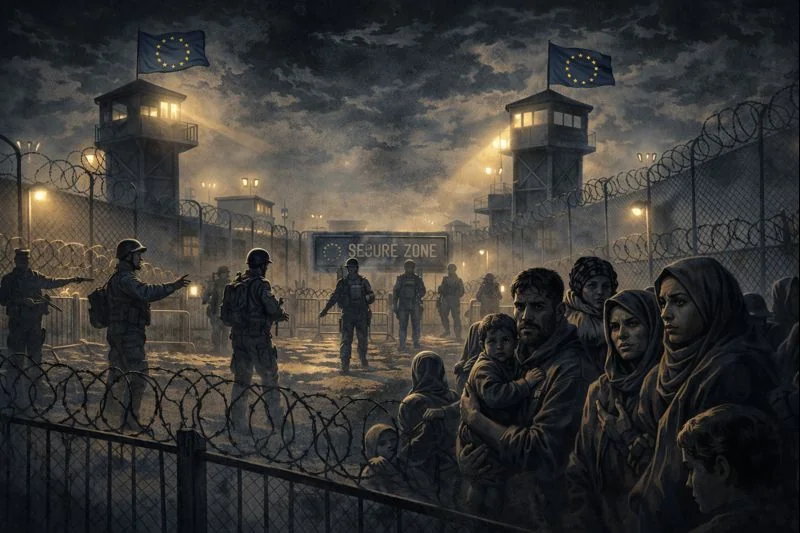
In the last decade, Europe's asylum policy is no longer presented as an exceptional humanitarian response to individual cases of risk, but as a permanent management system for human flows. The most obvious shift in this process is the transition from the logic of "right to protection" to that of "safe countries", where the first question upon arrival becomes: "Where do you come from?" ratherthan "What areyoufleeingfrom?".This shift culminated with the adoption of the European Migration and Asylum Package in June 2024, entering a two-year transitional period, with full implementation beginning on June 12, 2026. In this sense, it is no longer a passing political trend, but a comprehensive re-engineering of the EU's asylum gateway.
The essence of the idea of "safe countries of origin" is based on a presupposition: if a certain country is classified as "safe" in Europe, asylum applications from that country are considered to have a low chance of success and are automatically referred to accelerated procedures, which may be carried out at the border or in transit areas. What is new here is not the principle itself, but its European standardization.In December 2025, the Council of the European Union and the European Parliament reached an agreement on the first unified European list of safe countries of origin: Bangladesh, Colombia, Egypt, India, Kosovo, Morocco and Tunisia, with candidate countries considered "safe" as well, except in specific cases such as armed conflict, the imposition of European sanctions, or a high acceptance rate of asylum applications above 20%.
Officially, the classification is issued by joint legislation by the Council and Parliament, with a monitoring role for the European Commission, which can suspend a country or part of its territory or certain categories if circumstances change. The door remains open to appeal to the European Court of Justice.But human rights organizations believe that this legal framework does not solve the fundamental issue: safety is not a general political description, but an individual experience. A country may be "safe" for the majority of its population, but dangerous for journalists, dissidents, or specific minorities, which makes rapid mass screening on the basis of nationality in constant conflict with human rights standards.
The answer lies in numbers and political pressure. In 2024, the EU registered 911,960 first-time asylum seekers, a figure that decreased by 13% compared to 2023. Despite this relative decline, pressure remained high in frontline countries such as Greece, Italy, and Spain, especially if the number of asylum seekers is measured by population.This contradiction - a decrease in the overall numbers but a continued sense of pressure - has created a political climate in which governments believe that "speed" is more important than "depth" and that speeding up procedures has become an electoral necessity as much as an administrative choice.
In this context, the exception becomes the rule. What was supposed to be used only in limited cases becomes a broad pathway for entire categories of nationalities. With the full implementation of the migration and asylum package in June 2026, expedited procedures and border procedures will become a structural part of the Single European System, not just an emergency tool. Some elements of this logic have already begun before 2026, such as linking the use of expedited border procedures to low recognition rates of less than 20% for certain nationalities.
The impact of this shift does not stop at the entry gate, but extends directly to the return policy. From the EU Council's perspective, faster rejection of applications means faster return of people whose applications have been rejected.Partnerships with non-EU countries - countries of origin or transit - to ensure that their nationals are accepted for return, whether through formal agreements or practical arrangements, have become a central part of European policy, especially as the EU seeks to make returns more "effective" after years of poor implementation.
However, human rights organizations warn that this path carries obvious risks. Reducing the length of procedures may weaken the ability of asylum seekers to present sufficient evidence or obtain effective legal assistance. Expanding the use of "safe countries" lists may turn a shifting political classification into a fixed procedural reality. As an increasing portion of policing responsibility is transferred to countries outside the Union, additional questions arise about the level of protection and human rights standards in those countries.
Between June 2024 and June 2026, a system that makes rapid screening and early return centralized tools is taking shape. Protection remains a legal principle, but the path to it has become shorter, tighter, and more restricted. The question that will govern the post-2026 period is whether this new balance will preserve the essence of the right to asylum or make its reduction the silent rule in Europe's future policy.
Comments