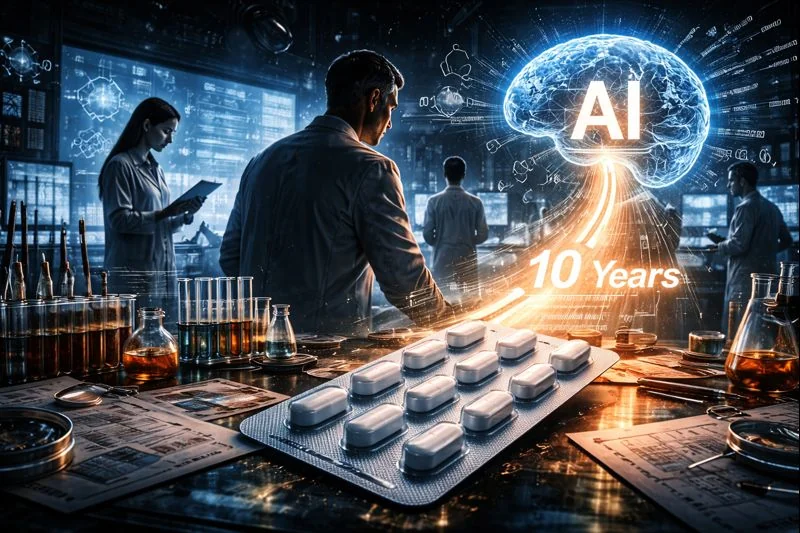
Drug discovery has long been one of the slowest and most expensive scientific paths in modern history. Taking just one treatment from early discovery to final regulatory approval required, on average, ten to fifteen years of continuous work, often at a cost of between one and two billion dollars, with the shocking fact that less than 10% of drug candidates that enter clinical trials make it to market(Dermawan&Alotaiq, 2025).For decades, these figures were not just industry indicators, but the cultural foundation upon which the pharmaceutical industry was built: long time as a requirement for science, and slow accumulation as a guarantee of safety. However, this perception is being radically shaken as AI enters the center of the drug discovery process, not as a utility tool, but as a mode of thinking that redefines the relationship between knowledge and time.
In the traditional model, drug discovery begins with the identification of a potential biological target, such as a protein or cellular receptor associated with a particular disease. High-throughput laboratory screening processes then test hundreds of thousands, sometimes millions, of chemical compounds in search of a limited number of promising candidates. This phase alone can take three to five years, before moving into preclinical studies that typically span another one to three years, where the compound is redesigned multiple times due to toxicity issues or poor efficacy. Then comes human clinical trials, which span three stages and can take another five to seven years.
AI has introduced a completely different logic: instead of testing every possibility in the lab, algorithms can be used to narrow the search space from the start. Machine learning models are able to analyze huge genomic, chemical and clinical databases, with millions of records, to extract hidden patterns linking genes, diseases and pharmaceutical compounds.One example is what happened during the COVID-19 pandemic, when an AI platform was able to suggest repurposing an existing drug as a potential treatment within just 72 hours of analyzing the data, a feat that reflects a huge time gap compared to the months of traditional human research(Zoccoli et al., 2025).).Here, the acceleration was not just a reduction in time, but a change in the nature of scientific understanding itself, where understanding is no longer based on reading studies one by one, but on the automated linking of all of them at once.
The most profound shift came from an area that has been a bottleneck in drug development for decades: predicting the three-dimensional structure of proteins. Designing an effective drug relies on accurate knowledge of the shape of the target protein, a task that has historically taken years of experimental work using expensive and complex techniques. This challenge was radically transformed withDeepMind'sAlphaFoldsystem, which could predict protein structures with near laboratory accuracy, solving an issue that had eluded scientists for more than fifty years(Kavout, 2024).The practical impact of this breakthrough was unprecedented: a database of more than 200 million protein structures was made freely available to researchers around the world. Suddenly, understanding protein structure was no longer a slow, halfway point, but an almost instantaneous stepping stone, allowing entire drug discovery projects to be accelerated from years to months.
This structural acceleration paved the way for an even more radical shift: from "discovering" pharmaceutical compounds to "designing" them. Using generative modeling, algorithms are able to create entirely new molecules that meet precise conditions of efficacy, toxicity, and pharmacokinetics.The most dramatic example cited in the paper is that of InsilicoMedicine, which announced in 2019 that it had designed an experimental drug compound in just 46 days from the start of the project, and brought the first drug discovered through its platform to clinical candidacy in about 18 months, compared to a traditional average of four to six years(Insilico Medicine, 2025).Most strikingly, the stated cost to reach a candidate ready for preclinical studies was only about $150,000, a tiny fraction of the tens of millions typically spent at this stage.
Exscientia, in collaboration with a Japanese pharmaceutical company, was able todesign a drug for obsessive-compulsive disorder(OCD) and get it into clinical trials in less than 12 months, a path that traditionally took four to five years(Zoccoli et al., 2025).RecursionPharmaceuticalsshowedanotherexample ofthis shift, moving from target identification to preclinical studies ready for human trials in less than 18 months, compared to an industry average of 42 months. These numbers clearly indicate that AI is not only speeding up steps, but rearranging them entirely.
The quantifiable impact of this shift is clearly measurable. Recent studies indicate that the use of AI can compress preclinical time by 60-75%, with significantly higher success rates in early clinical phases(Dermawan&Alotaiq, 2025).While traditional Phase I success rates have traditionally ranged between 40-65%, data from 39 AI-driven companies shows that this figure has risen to between 80-90% on average. This improvement means not only faster medicines, but fewer resources wasted on failed projects that would have been stopped at later, costly stages.
From an economic perspective, this acceleration translates into huge savings. Every year shaved off the development path means hundreds of millions of dollars not spent on failed experiments or long-term infrastructure. Industry reports indicate that 2024 alone saw more than $3.3 billion invested in AI companies and platforms.(Drug Target Review, 2025).Major pharmaceuticalcompaniessuch as Pfizer,Novartis, and GSK have also entered intostrategic partnerships with AI companies or created specialized in-house teams, a tacit recognition that the traditional model is no longer sufficient.
But the deeper impact of this shift goes beyond numbers and companies to the patient and society. Shorter times means faster access to treatment, especially for rare or incurable diseases that were previously neglected due to poor economic viability. Lower costs also open the door to developing personalized treatments, based on the genetic and biological characteristics of each patient group, rather than relying on a "one-size-fits-all" model. Here, AI moves from an industrial accelerator to a potential factor in redistributing therapeutic justice.
AI does not eliminate the need for clinical trials or human expertise, nor does it exempt organizations from strict regulatory requirements. But it does redefine the role of the researcher from an executor of an endless series of experiments to an engineer who asks the right questions and guides the algorithm toward higher probabilities. In this convergence of lab and algorithm, a new model of discovery is taking shape, less dependent on chance and more based on prediction.
In the end, what we are witnessing today is a shift in our relationship with scientific time itself. If a decade was the traditional benchmark for the discovery of a new drug, accumulating evidence suggests that it could be reduced to a few years in the near future. Not because diseases have become simpler, but because the tools of understanding have become deeper and more capable of dealing with complexity.In this sense, AI is not just an accelerating technology, but a cultural discovery in itself: the discovery that slowness was not a condition of science, but a limit imposed by the tools of the past, and that an algorithm, when it enters the laboratory, not only shortens time, but rewrites the rules of discovery from the ground up.
Comments