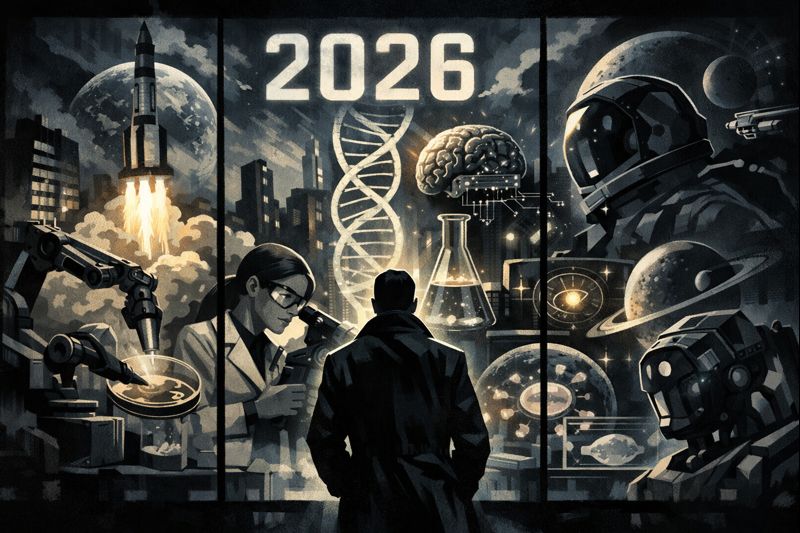
The "taste for science" is no longer slowly changing as in previous decades; we are facing a new rhythm of knowledge, created by data platforms, supercomputing, and artificial intelligence tools that are advancing from the periphery to the heart of the laboratory.What Nature suggests in its 2026 trends reading is that the center of gravity is shifting from a "scientist who reads and experiments" to a "research ecosystem" in which humans partner with an "AI scientist" capable of proposing hypotheses, planning experiments, and analyzing results faster than traditional human capacity.At the same time, gene editing is approaching a more precise and personalized stage, not as a general future promise, but as a clinical capability that can be recreated for a single patient within months. In parallel, big projects are returning: space missions, new telescopes, and drilling deep into the ocean floor in an attempt to reach "original" questions about crust formation and plate movement.This trifecta (AI in the lab, a more accurate genome, greater exploration) means not only more discoveries, but a change in "who decides" what is worthy of becoming science, and how an idea reaches a publishable result, and then a market or public policy.
If we want to measure how the "AI world" has become a reality rather than a slogan, we need only look at the behavior of researchers themselves. Nature reports that in a survey of nearly 1,600 academics in 111 countries, "more than 50%" used AI tools during peer review, often beyond or ahead of the guidelines of some journals (Naddaf, 2025).This is not a small administrative detail; it is a sign that AI is no longer just a tool for writing manuscripts, but has become part of the "scientific decision-making architecture" itself:How do we understand a paper? How do we summarize? How do we examine arguments and statistics? As the idea expands, a new class of "AI scientists" or "agents" is forming who not only provide linguistic assistance but act as an auxiliary research mind: suggesting angles, linking disparate literature, and generating experimental designs.The impact on the pace of discovery is obvious: reducing the initial search space, which used to take months of reading and reviewing, and accelerating hypothesis-experiment-analysis cycles through automated or semi-automated labs.But it also carries its own risks: if the algorithm directs attention to what is "modelable" or "available data," publication biases may increase towards questions served by ready-made data, at the expense of questions that require field observation or long archives. The key question in 2026 therefore becomes not: "Do we use AI?" but "Who sets the rules for use, how do we ensure transparent reasoning, and who takes responsibility for error when the decision chain is a mixture of humans and models?
On the medical side, the 2026 trajectory suggests that gene editing is moving away from "general technologies" towards "highly personalized medicine." Nature magazine reported a "record" of a "detailed" gene-editing treatment on a single patient in about six months, a time that years ago seemed unrealistic given the manufacturing, testing, and approval chains (Nature, 2025a).The significance of this figure is not the six months per se, but what it means: the therapeutic innovation cycle could become shorter, and the idea of a "single-patient drug" could move from the exception to a model for which laboratories and funders compete.As precision advances, questions of ethics and health policy change: Who pays for a specific treatment? How is its safety measured against a widely used treatment? How to prevent the gap between those with access to genetic infrastructure and those without? In 2026 we will also see that "precision" is not just technology, but data organization and longitudinal follow-up, linking lab, clinic and sequencing networks, meaning that universities with AI without clinical capacity, or clinical capacity without data infrastructure, will remain on the sidelines unless they build the bridge between them.
The "megaprojects" that Nature has on its radar for 2026 are a reminder that science doesn't just move inside servers, but sometimes requires huge machines, international collaboration, and long-term budgets.In preventive medicine, for example, Britain awaits the results of the crucial phase of the NHS-Galleri trial, the largest prospective trial of its kind to test for early detection of multiple cancers through a blood test; NHS England indicates that "more than 140,000" people between 50 and 77 years old will participate, and that the test targets signals associated with "more than 50 types" of cancer, with baseline targets to be evaluated in 2026 (NHS England, 2024).In space, NASA plans to send four astronauts in Artemis II on a "10-day" lunar flyby mission, with a launch "no later than April 2026," according to the official mission page (NASA, n. d.).Europe is also putting the PLATO telescope on track for a "late 2026" launch with "26 cameras," which will aim to survey "more than 200,000 stars" to search for Earth-like planets and understand stellar vibrations (ESA, n.d.; DLR, n.d.).
On land, China is trying to push ocean floor drilling to a new level with the Meng Xiang, designed to drill "11 kilometers" into the oceanic crust to collect samples that will bring scientists closer to understanding ocean floor formation and plate dynamics, with 2026 expected to be the first gateway to its scientific mission (CGS, 2025; Xinhua, 2024).These three examples (a population blood test, a manned lunar mission, and ocean floor drilling) share a common logic: expanding the scope of data and measurement to previously unattainable limits, and then turning that into scientific decisions, public policies, and industries.
The question for Middle Eastern universities and laboratories is: How do we enter this wave instead of just watching it? The opportunity here is not to directly "compete" to build drilling ships or rockets, but to choose the smart entry points that the AI world specifically offers.The first opportunity is to build "data labs" related to regional issues: public health (diabetes, heart disease, common cancers), climate and water, emergencies and disasters, languages and digital identity. When data is organized and usable, AI can multiply the value of a small research team: prediction models, early detection tools, or simulation platforms.The second opportunity is to enter through "partnerships" with global open programs: space and ocean missions don't just need to launch, they need to analyze, infer, and develop algorithms for images, spectra, and signals. The third opportunity is to localize a culture of "transparency and verification": the use of AI in writing, arbitration, and analysis will increase, but those who build clear policies for documentation, disclosure, and reproduction will prevail, as trust will become a scarce currency in an age of rapidly generated text and images.In this context, the mere fact that more than half of the world's referees now use AI (Naddaf, 2025) means that universities that do not establish training and ethical guidelines early on may pay the price later, both in reputation and research quality.
The bottom line of "Science 2026" as seen in Nature's readings and follow-ups is that the world is moving towards faster science, more data-driven, and more intertwined between lab, algorithm and institution. The "AI world" may change the pace of discovery by compressing the time between idea and result, but only if the scientific question remains the property of the human being and not the captive of easy metrics. Precise gene editing opens a door to personalized medicine that may upend the concept of medicine itself, but poses questions of fairness, cost, and regulation.Major projects, from PLATO to Artemis II to drilling the oceanic crust, remind us that exploration still requires institutional courage, funding, and patience. In the end, the region's greatest opportunity is not to imitate the same path, but to seize the points of convergence: meaningful local data, global analytical partnerships, and scientific integrity policies that make us part of the production of knowledge, not just consumers of it.
Comments