Introduction
The phrase "no coverage" has become part of the daily lives of many in the Middle East: a truck driver crossing a long desert road, a fisherman far from the coast, a traveler between two towns separated by mountains or valleys, or a family living on the outskirts of a city where network towers are still far away. This communication void is no longer a daily inconvenience, but a risk factor in traffic safety, logistics, ambulance and emergency services, and even the digital economy that assumes constant connectivity.
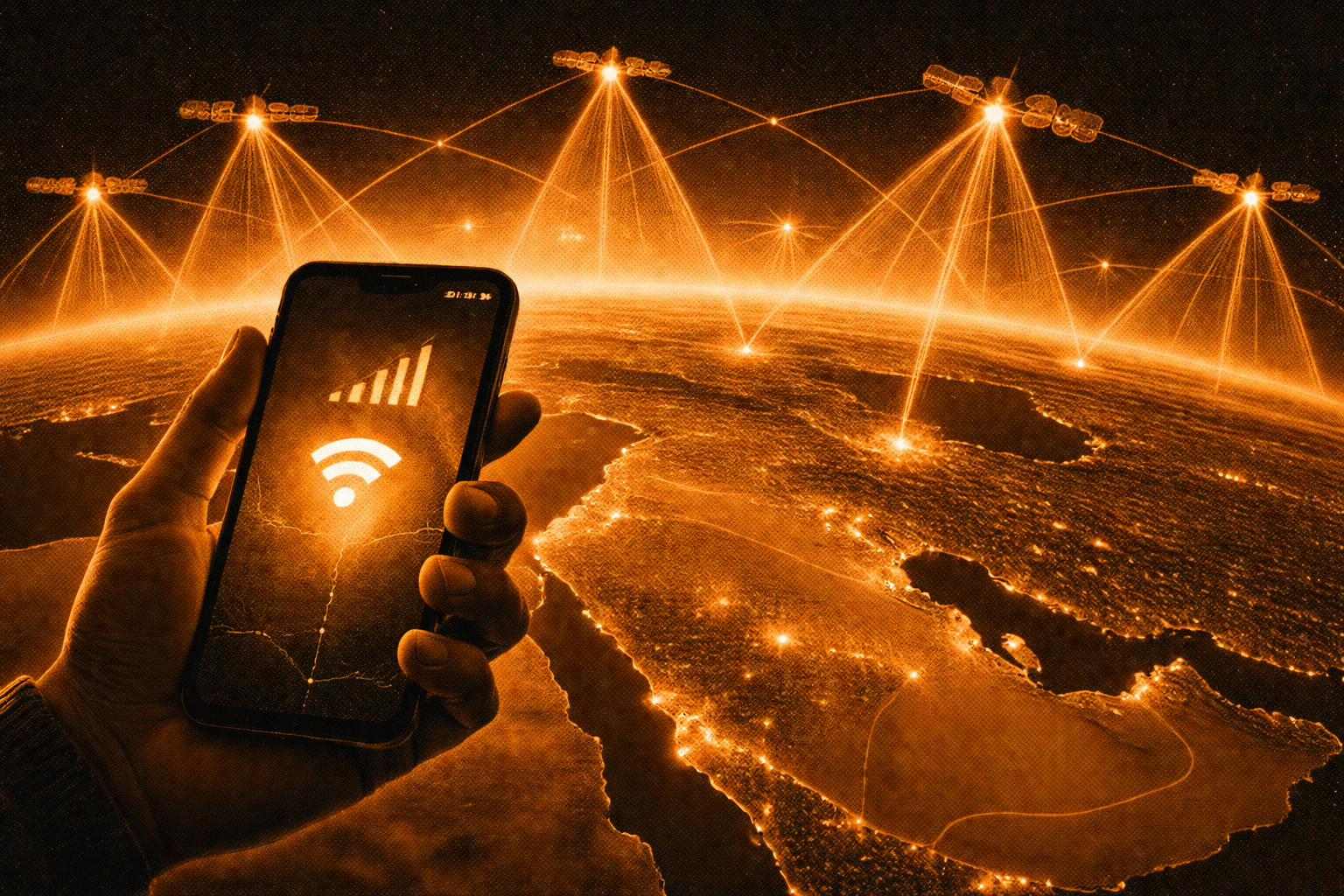
In this context, a new technological path has emerged that promises to change the norm: direct-to-cell/direct-to-device technologies, where a phone connects to a low-orbiting satellite without an additional device, initially for messaging and later for broader services.Reuters reported that T-Mobile will commercially launch Starlink's phone service in July 2025 at $15 per month, in an effort to reduce dead zones outside of tower coverage. In parallel, Starlink is expanding this path through partnership deals with major telecom companies, including a broad agreement with VEON Group to deploy the service across its subsidiaries and begin a gradual rollout from late 2025 through 2026 (Reuters, 2025b).
As Arab countries combine vast deserts, cross-border roads, long coastlines, and areas subject to political shocks and disasters, the question is not only about the technology, but who owns the terms of entry, regulation, and pricing. Lebanon's granting of a license to Starlink in September 2025 reflects that the Internet from space is beginning to be regulated and marketed in the region, but also opens up a debate about governance and the ability to make the service fair and accessible (Reuters, 2025c).
Theme 1: From network tower to Earth orbit - how does direct-to-cell work and what are its real limits?
To understand the new promise, it must be contextualized within the evolution of telecom standards. The idea here is not for satellites to become public WiFi, but to become part of the cellular ecosystem via what the industry calls NTN (non-terrestrial networks).3GPP explains that NTNs are parts of networks that use high-altitude platforms or satellites as relay nodes or base stations to extend coverage and improve resilience, and that standards updates now treat NTNs as an integration path.
In practice, Direct-to-Cell often works as a partnership model between a satellite provider and a mobile operator with licensed spectrum and a relationship with subscribers. The satellite carries a radio payload that behaves like a very large cell compared to a ground tower, transmitting and receiving across spectrum bands associated with the partner operator, so that an unmodified phone in specific cases and with supported hardware can send basic signals without a dish or modem. This is why most early launches focus on text messages and alerts, as they are less capacity consuming and more tolerant of channel fluctuations.Reuters noted an announced commercial launch by T-Mobile and Starlink in 2025 with clear pricing and direct targeting of non-tower areas (Reuters, 2025). In Ukraine, Reuters confirmed that Kyivstar started the service with SMS with a plan to later expand it to voice and data (Reuters, 2025). This phasing is not just marketing, but a reflection of physical and economic constraints: the higher the data volume, the greater the pressure on capacity, scheduling resources, and transmission capacity in the phone and satellite.
First, capacity: A satellite cell covers a much larger area than a tower cell, which means that resources are spread over a wider area, so the service is better suited for basic connectivity in underutilized areas, rather than for heavy consumption in cities.This is confirmed by Nokia in its paper comparing satellite services to terrestrial networks, concluding that terrestrial networks are superior in capacity density and cost per user where there is coverage, while the value of satellite is greater in remote areas or as a back-up resilience layer during outages (Nokia, 2025).Second, conditions of use: Direct connectivity often requires relatively open skies, and may degrade inside buildings or in deep valleys, making the service initially more akin to outdoor emergency coverage than a full replacement for the network inside homes and offices. Third, continuity: Even with large constellations, coverage in some areas may be spotty depending on satellite density and trajectories, before improving as the number of satellites and payloads increase.
Fourth, spectrum and interference: This is the knot that may determine the speed of deployment more than the technology itself. When satellites use spectrum bands originally allocated for terrestrial service, preventing interference with terrestrial networks becomes a requirement for investment sustainability and user satisfaction. Reuters reported that in March 2025, the US Federal Communications Commission approved higher power levels for Starlink's direct phone service in partnership with T-Mobile despite objections from competitors, but imposed conditions to protect terrestrial operations and an obligation to address any interference (Reuters, 2025).Reuters then reported in April 2025 that the FCC opened a review of satellite spectrum sharing rules to support stronger satellite communications, with a parallel debate about protecting terrestrial investments (Reuters, 2025). Similarly, regulators in Europe are moving toward strict licensing frameworks before widespread expansion.Britain's Ofcom released a decision document in December 2025 explaining how D2D services will be licensed in cellular spectrum bands, with a clear assertion that they increase outdoor coverage and provide back-up service during outages, but within controls to prevent damage to existing networks (Ofcom, 2025).
Reuters described Starlink's deal with Veon in November 2025 as a major global direct-to-cell deal with launch plans in Ukraine in late 2025 and in other markets in 2026, noting that the race is open between multiple providers (Reuters, 2025). With Airtel Africa's announcement in December 2025 of a partnership to cover 14 markets starting in 2026, it is clear that operational models are moving more towards partnering with operators than towards independent operation (Reuters, 2025).
The Geopolitics of Connectivity - How is direct-to-cell redrawing the map of who is inside the connected world in the Middle East?
When connectivity becomes a satellite layer that connects directly to the phone, public policy questions change from where to build towers to who owns the right to operate the sky above the network. In terrestrial networks, regulatory sovereignty is relatively clear: the state grants licenses, manages spectrum, enforces coverage obligations, and sets security and privacy standards.In direct-to-device, three circles are intertwined: a satellite provider that owns the constellation and orbit management, a mobile operator that owns the spectrum and the relationship with subscribers, and a state that wants to ensure that the service does not become an ungoverned channel. This is why in September 2025 the GSMA released a policy paper on spectrum considerations for D2D services, emphasizing the need for balanced regulation that enables innovation, prevents damage to terrestrial networks, and clearly defines responsibilities between the parties (GSMA, 2025).
The Middle East offers a dense test case due to three characteristics. First, the vastness of the sparsely populated geography: deserts, cross-border roads and maritime spaces, where the cost of towers is high and the return is low, making a sky layer attractive to minimize outdoor coverage gaps and improve road safety, freight and energy services.Second, the sensitivity of sovereignty and security: many countries in the region treat telecommunications as a sovereignty issue due to security and political considerations, making any satellite channel a subject of control and scaling. Third, the disparity in infrastructure between very rich countries and countries suffering from chronic crises, which determines how the service is introduced: as an emergency solution to relieve a bottleneck, or as a deliberate integration layer within a national telecommunications strategy?
In Lebanon, developments provide an example of entry through a window of need and reform. Reuters reported that the Lebanese cabinet granted a license to Starlink to provide satellite internet services in September 2025 (Reuters, 2025). The Associated Press linked the move to the reality of deteriorating infrastructure, electricity and internet crises, and the context of regulatory measures such as the appointment of regulatory bodies for sectors that have been neglected for years (AP News, 2025).This model reveals the logic of connectivity as a social necessity: when a service becomes a means of alleviating a structural breakdown, the logic of a quick alternative may take precedence over the logic of a long land investment, but it also raises questions of governance: competition, pricing, data protection, and who ensures that the alternative does not turn into a new monopoly.
In Saudi Arabia, the picture seems closer to an orderly merger model than an emergency alternative. A Business Wire release in October 2025 announced a ten-year commercial agreement between stc and AST SpaceMobile to develop direct-to-phone connectivity, presented as part of a strategy to expand access and invest in next generation (Business Wire, 2025).The launch of commercial services is expected in Q4 2026 and is linked to regulatory pathways (Satellite Today, 2025). This pathway means that some countries in the region may prefer that the sky passes through the gateway of the national operator and the regulatory body, so that the service remains within the local spectrum, security and compliance rules, rather than outside them.
At the international level, there is a trend towards space sovereignty in the context of direct-to-device, a trend that may affect the region via regulation and security models. Reuters reported in November 2025 that Vodafone and AST SpaceMobile plan to form a European-led constellation with a European operations center and a command switch for oversight and security considerations (Reuters, 2025).Vodafone's statement explained that the command switch supports European oversight and modernization of encryption keys and satellite control. The idea here is as political as it is technical: if Europe is moving towards ensuring a sovereign key for control and security, Middle Eastern countries are likely to ask similar questions, especially when it comes to sensitive public services such as emergency or government use.
The example of Ukraine illustrates how direct-to-cell is used as a backup network when infrastructure is damaged. Reuters reported that the launch of Kyivstar in November 2025 was aimed at maintaining connectivity during large-scale outages, with uses related to emergency and humanitarian operations (Reuters, 2025). This experience is relevant to the Middle East because the region is experiencing natural and political shocks that disrupt infrastructure, making a backup communication layer a factor to minimize the cost of outages to society and the economy.
Axis III: From the digital divide to the personal coverage map - Who actually benefits from satellite internet to the phone?
Even if regulation permits and the technology matures, the question of real-world utility for the public remains: What will actually change in people's lives and sectors? The most accurate answer is that direct-to-device does not eliminate the role of terrestrial networks, but it does change the value of connectivity at the edge: long roads, coasts, agricultural areas, project sites, and emergency conditions.Here, the most important utility is not streaming HD video, but the ability to send a message, share a location, receive an alert, or call for help. Text messaging seems a logical entry point, as seen in the 2025 launches that started with SMS and then talked about subsequent expansion (Reuters, 2025).
Reuters quoted a published monthly price for T-Mobile/Starlink, giving an indication that the service may be introduced as an add-on to phone packages (Reuters, 2025). In the Middle East, where income disparities are wide, this could lead to a new divide: those who pay get a communications safety net on trips and terminals, and those who don't are still vulnerable to interruptions.This is where public policy and regulators come into play: do they leave the service as a free market and turn no coverage into a class issue, or do they incorporate a minimum level of universal service obligations, especially for emergency messages and alerts? This point intersects with the ITU's 2025 messages that the digital divide is about quality, reliability, and affordability, not just whether or not there is a network (ITU, 2025).
Conclusion
The path from space to your phone signals a shift in coverage philosophy: instead of expanding the network only via fixed towers, a celestial layer is added that is capable of bridging external coverage gaps and providing emergency resilience.Between February and December 2025, it is clear that the technology has moved from promise to market and regulation: an announced commercial launch in the US, a practical European launch in Ukraine starting with SMS, expanding global partnerships like the Veon 2025 deal, and broad deployment trends like the Airtel Africa partnership. In the Middle East, cases like the Lebanon license (Reuters, 2025; AP News, 2025) and stc's agreement with AST reflect that the region is moving between a logic of necessary alternative and a logic of orderly inclusion.
The most realistic outcome in 2026-2028 is not for the ferry to disappear altogether, but for its footprint to narrow: no less frequent coverage on roads and peripheries, with limits related to capacity, sky visibility and spectrum governance. The real success criterion in the Middle East will be: basic connectivity that is affordable, regulated and protects terrestrial networks, not just an elitist service that adds another layer to the digital divide.
Comments