Introduction
In recent decades, populist discourse has gone from a marginal phenomenon that emerges in moments of crisis to one of the world's most widespread and influential political products. What was once seen as an incidental deviation from "rational politics" is now an integral part of election campaigns, public moods, and narratives that reshape the relationship between citizens and the state. The rise of populism is due to a profound shift in the social, economic, and cultural structure of the modern era: people live in a world where economic crises abound, uncertainty surges, trust in traditional institutions wanes, and platforms dominate.
In this turbulent landscape, populism seems more like a carefully crafted political product than an angry reaction. It offers people what they need psychologically: simple narratives for a complex world, a clear adversary to hold accountable, and quick fixes that promise salvation without cost.At the same time, they capitalize on the public's cognitive fatigue, information overload, and the need for identity certainty that reduces the world to an "us" versus "them" binary. As primitive as these prescriptions may seem, their effectiveness reveals the fragility of contemporary democratic systems and their inability to address citizens in a language capable of creating meaning and restoring trust.
This paper aims to analyze populism as a full-fledged political product that uses specific mechanisms to create the "easy enemy" and the "simple solution." It then explores why resisting these tools has become extremely difficult at a time when the power of institutions is declining and the power of emotional narratives is increasing. By deconstructing this phenomenon, we try to understand how populism has become one of the most important keys to reading politics in the twenty-first century.
Where does the power of populism come from? Its psychosocial roots in a turbulent world
In political psychology, "need for cognitive closure" research shows that certain conditions (fear, uncertainty, time pressure, chaos) cause people to "grab" a quick explanation and then "freeze" it as the truth, even if the explanation is simplistic or biased.In the logic of "compensating for loss of control", when personal control over life is reduced (turbulent economy, threatened jobs, rapid cultural changes), there is a tendency to seek "order" and meaning by adopting narratives that emphasize someone responsible for the chaos, or by supporting systems/symbols that seem capable of restoring order (Kay et al., 2009).).
Here, populism functions as a psychological response rather than an ideological choice: it offers "cognitive comfort" rather than a "governance plan", giving the individual a simple map of reality: Who is at fault? Who is innocent? What are we doing now? Who is leading us? When uncertainty grows, the need for a solid identity is nurtured:We are "the people" versus "the other," a dynamic that converges with uncertainty-identity theory, which explains how subjective anxiety drives some individuals toward groups that offer clear boundaries, strong affiliation, and "assertive" leaders (Hogg, 2013).In this sense, the power of populism is not only in its rhetoric, but in its alignment with psychological needs that are triggered in moments of turmoil.
There is a socio-institutional layer that fuels populist appeal: the accumulated "trust gap." When trust in government, media, and institutions of expertise declines, people are more willing to believe alternative narratives, especially if they come in the form of moralizing stories. In the United States, for example, recent data indicate that public trust in institutions has deteriorated and trust in the federal government has fallen to historic lows (Pew Research Center, 2025).At the global level, the Edelman Trust Report's "Grudge/Dissatisfaction Index" emerges as a factor that imposes a "trust penalty" on institutions: the higher the grudge, the lower the trust across multiple institutions (Edelman, 2025).In such an environment, public debate becomes less an arena of programmatic competition and more of a narrative struggle for meaning and legitimacy: who tells a "story" closer to the citizen's daily experience? Who gives a simple explanation of their suffering? Who determines who is to blame? Here, populism comes not from a vacuum but from an institutional failure to explain and communicate, from a collective feeling that "experts" are not heard or have a language that does not touch everyday realities.
The term "post-truth" gained global prominence when Oxford Dictionaries defined it as a state in which objective facts become less influential in shaping public opinion than appeals to emotion and personal belief (Oxford Languages, 2016). In this climate, the politician gradually becomes an "influencer" selling a compelling narrative rather than a complex policy dossier.As the digital space becomes saturated with content, attention becomes a scarce resource; in an "information-rich world," information overload can turn into attention deficit, making a shorter, clearer message more likely to capture public consciousness (Eppler & Mengis, 2004).When one adds "contemporary brain fatigue" (work pressure, future anxiety, news liquidity), the natural tendency towards brevity and emotion becomes even stronger: people do not always reject complexity, but they often do not have the energy to consume it on a daily basis. Populism thus capitalizes on the condition of the times: information overload + lack of time + low trust = a preference for short categorical messages that seem "decisive".
Axis II: Engineering the "Easy Enemy" and Creating the Simple Solution-How is populism constructed in practice?
If the first axis explains the "demand" for populism, this axis explains the "supply": how populism produces itself as a sellable, replicable, and amplifiable discourse. The first step is to build an "easy enemy": turning complexity into a face. Instead of an economic crisis being a product of global interactions, it becomes the result of a "corrupt elite." Instead of technological transformation being a historical process, it becomes a corporate/media/corporate "conspiracy."This transformation is not an innocent simplification, but a "frame engineering" that identifies the culprit and the victim, and redefines politics as a moral and existential struggle: the enemy is inherently evil, and the dispute is not a difference of policy but a battle for survival. This logic corresponds to the very heart of the populist definition (Mudde, 2004) and produces a powerful psychological effect: when the enemy becomes clear, the audience feels that the world is understandable, even if the understanding is reductive.
Hence the second step: the quick fix. Simple promises of "immediate" impact: we will end the issue by simply "breaking" the establishment, "silencing" the media, "expelling" the cause of the crisis, or "bypassing" legal complexity.Complexity is presented as an elitist trick, institutional constraints are presented as complicity, and the impression is created that "rationality" slows down achievement and "realism" is a form of surrender.
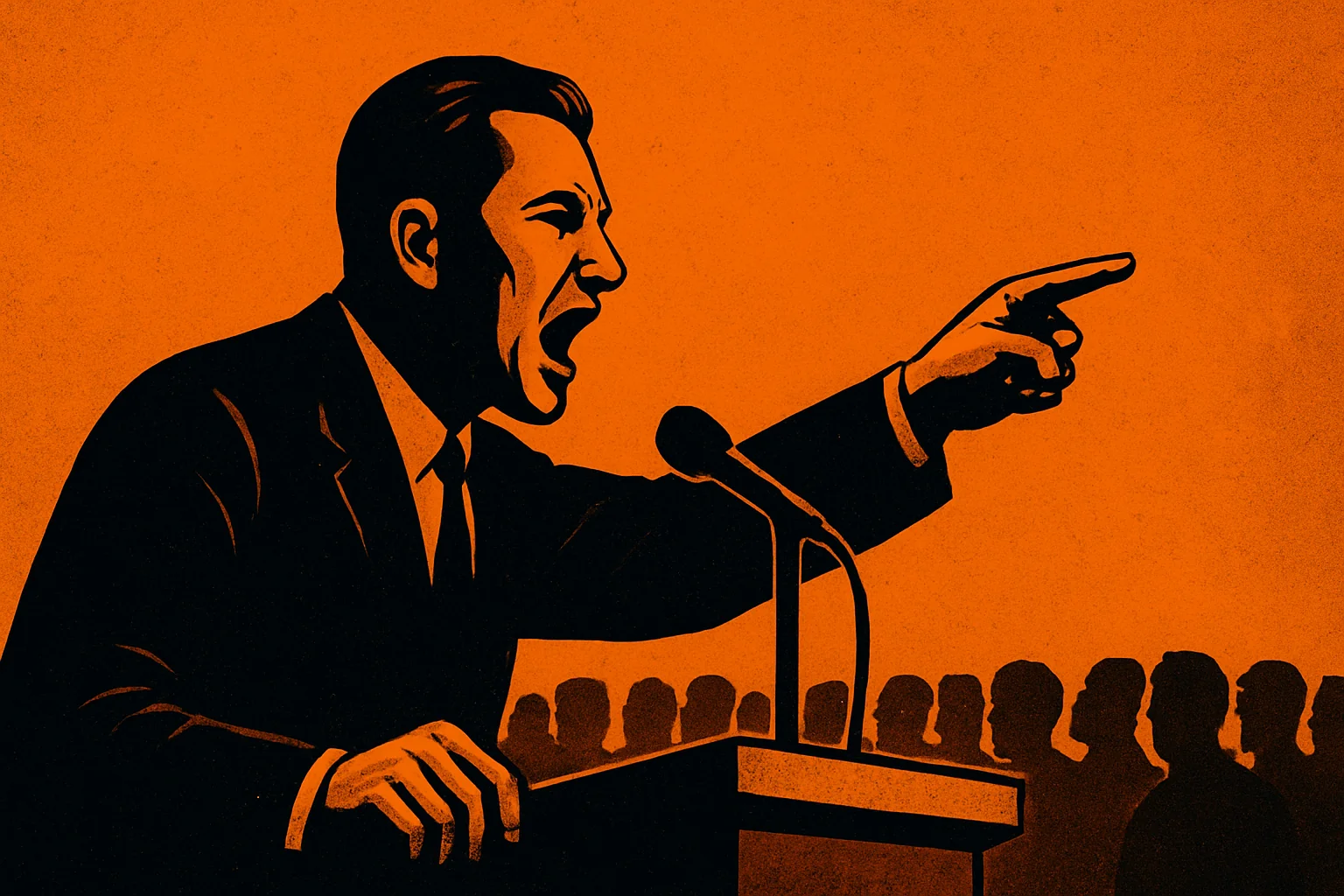
But populism works not only with logic, but with performance. This is where the proposition of "populism as a performed political style" rather than a fixed essence emerges: populism practiced, embodied, and displayed through body language, tone, provocation, and artificial proximity to "the people." In this perspective, the "crisis" becomes a "crisis.Within this perspective, the "crisis" becomes part of the political theater: the crisis does not have to exist to the same degree, but can be "performed" and framed in a way that puts the public in the face of the "latest danger" and justifies strong leadership and direct solutions (Moffitt, 2015).The image of the "savior" versus the "corrupt system" is thus constructed, an image that requires marketing consistency: uniform, dictionary, calculated anger, directness, and a claim to break protocol. Here populism meets the political marketing literature: politics is presented as a product, the leader as a brand, and the public as a consumer looking for quick and clear "value" (Lees-Marshment, 2001).This trend increases when politics intersects with celebrity culture: the politician gains representational legitimacy through a media presence and personalization of the message, not through an institution or a long program (Street, 2004).
Social media does not necessarily reward the most accurate, it rewards the most engaging and interactive, and emotion, surprise, and anger are often the fuel for circulation.Research on the "virality" of content suggests that content that evokes strong emotions tends to go viral. In terms of ethical politics specifically, a large study shows that the presence of "moral-emotional" words in messages increases their prevalence within social networks (Brady et al., 2017).On the other hand, a large-scale analysis of news propagation on Twitter shows that fake news spreads faster, farther, and deeper than true news (Vosoughi et al., 2018).). The phenomenon of "echo chambers" helps to turn opinion into fact within homogeneous groups: users tend to be exposed to content aligned with their preferences as a result of social connections and personalization algorithms.Pariser warns that the "filter bubble" leaves individuals trapped in narrow perspectives that promote polarization (Pariser, 2011). In this landscape, populism is "algorithmically perfect": clear enemy + quick solution + emotional charge + short template = amplifiable content.
Theme 3: Why is populism hard to resist? Institutional failure and the struggle of narratives in a time of fragmentation
Modern democratic institutions are designed to be relatively slow: separation of powers, procedures, checks and balances. This slowness is not a disadvantage, but a safety valve against recklessness. But in an era when the public expects instant results, institutional slowness becomes a communicative weakness, and bureaucracy looks more like "collusion" than control.In contrast, the populist leader offers a performance of speed: instant promises, decisive decisions, direct conflict. When trust is weakened, "mediation" (parliament, judiciary, professional media) turns from a guarantee to an obstacle in the eyes of the public. A dilemma arises: institutions cannot simply abandon their slowness without dismantling themselves, but they lose out narratively to those who promise to bypass them.
The second difficulty is cognitive-communicative: "expert language" often does not compete with "populist product language." Specialized knowledge requires detail, probabilities, and conditions, while populism offers certainty. Cognitive processing research suggests that linguistic complexity may create a negative impression and reduce understanding and trust; even "using unnecessarily long words" can make the recipient evaluate the writer worse (Oppenheimer, 2006).When "cognitive laziness" comes into play, people are more likely to accept sensationalized headlines without scrutiny; research shows that the believability of fake news has more to do with lack of reasoning than with partisan bias (Pennycook & Rand, 2019).This can be linked to the concept of "cognitive inversion": the ability to resist the first intuitive response in favor of slower thinking, a skill that does not work automatically under the pressure of speed and noise (Frederick, 2005). When the competition is in the 20-second space, the odds are in favor of whoever designed their message to win in that space.
The third difficulty is narrative: story trumps statistics. Platforms reward what works: a snapshot, anger, irony, accusation, confession. With "post-truth," emotion becomes the gateway to conviction, and reason comes later to justify it, not create it. This explains why "corrections" campaigns sometimes seem to have limited impact: they enter the battle late and with tools that do not spread as quickly, while studies show that inaccurate information may have a trading advantage (Vosoughi et al., 2018).(Brady et al., 2017; Berger & Milkman, 2012). The conflict is not just between "truth" and "lies", but between two forms of narrative: an easy emotional narrative and a slow, costly, nuanced narrative.
Some scholars argue that populism has become a "spirit of the times" in many democracies, a mode of discourse that has infiltrated the mainstream rather than a mere fringe (Mudde, 2004). Others, like Norris and Inglehart, argue that the rise of authoritarian populism is fueled by a "cultural backlash" between social conservatives and liberals, making the phenomenon renewable (Norris & Inglehart, 2019).If so, resisting populism is not only about attacking its rhetoric, but also about addressing the conditions of its production: rebuilding trust, improving the ability of institutions to communicate in understandable languages without compromising accuracy, and reducing algorithmic incentives that reward anger and misinformation. This requires a shift from "correcting after spread" to "preventing vulnerability": supporting verification skills, simplifying expert discourse without flattening, and creating channels that reconnect politics to the everyday experience of citizens.
Conclusion
Populism wins in a complex world because it does not try to solve complexity but rather transforms it into a simple, tradable meaning: a clear enemy, a straightforward solution, and leadership that can perform well in a fast-paced digital space. Its roots extend from psychological needs (certainty, belonging, compensation for loss of control) to socio-institutional fragility (trust gaps and accumulated grudges) and then to an algorithmic environment that rewards emotion and brevity and favors sensational narratives even when they are inaccurate.Therefore, the real challenge is not to "silence populism" but to make politics itself more capable of reproducing meaning and trust without falling into misleading simplification: a politics that can tell the truth in understandable language and recognize complexity without leaving the citizen alone.
Comments