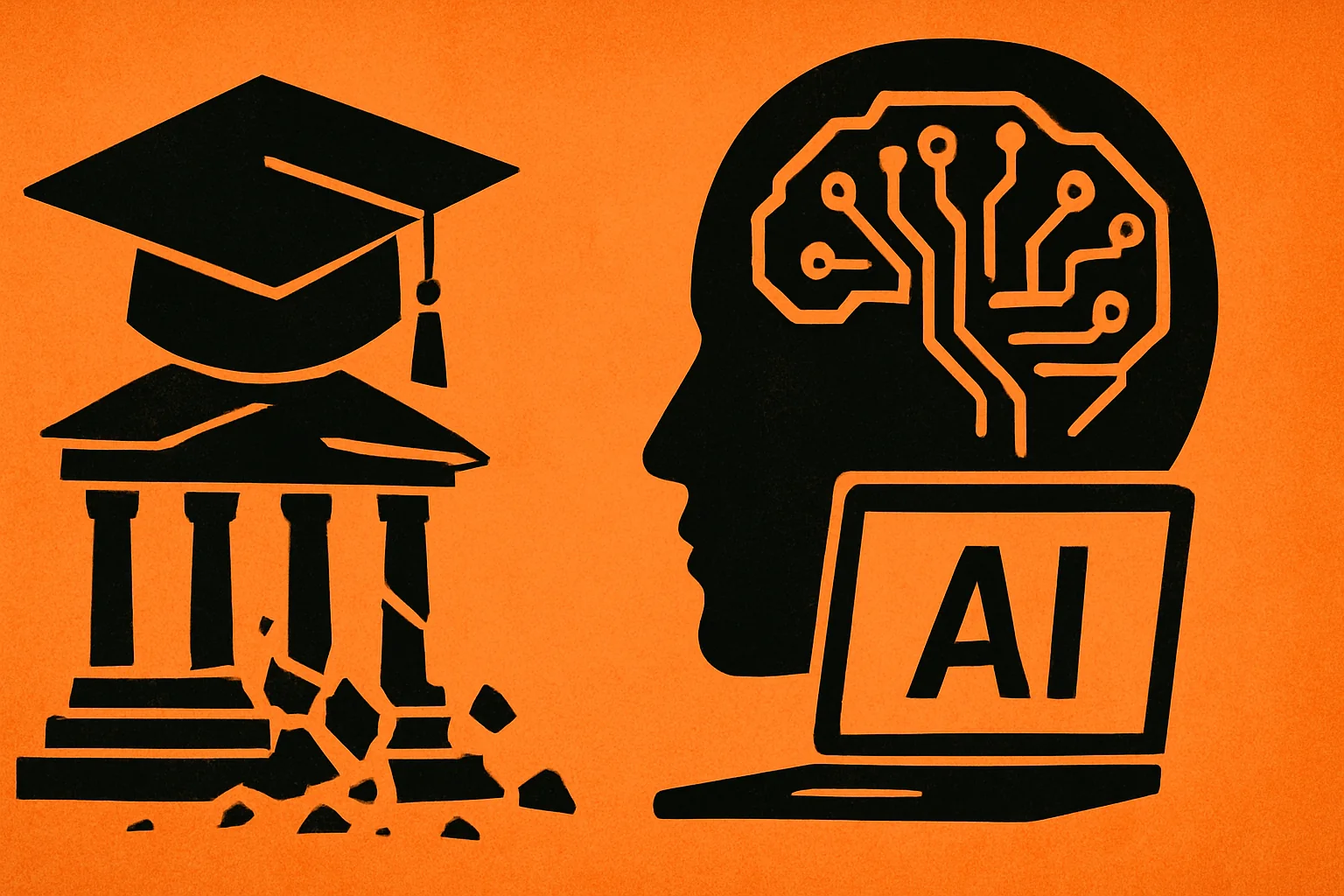
For centuries, the university was seen as "the only place for organized knowledge": a space that brings together books, laboratories, professors and accreditation, producing and categorizing knowledge and then giving it social legitimacy through certification. This perception was not only symbolic, it was practical: those who want to become doctors, engineers or lawyers often pass through the university gate, which teaches, tests and certifies.But the last decade, and even more violently with the advent of generative AI, has changed the landscape: tools like ChatGPT, Copilot, and Claude are no longer just "faster research" but instant explanation, summarization, interactive discussion, endless examples, and a personalized learning plan created in seconds.At such a historical moment, the opening question becomes acute: is the university still necessary in an age when an artificial intelligence engine can explain physics, law, medicine, or programming in seconds, and in multiple ways that suit each student's level?
However, the deeper question is not "is the campus dying?" but rather: are we facing the actual end of the concept of the university, or a radical redefinition of its function? While higher education has expanded globally to reach 264 million students in 2023 (UNESCO, 2025), which means that the university is still a huge central institution in the contemporary world, what has changed is the center of value: from possessing knowledge to being able to think about it, use it, and prove it ethically and professionally.
The thesis of this paper is that AI does not "end" university education, but rather exposes the fragility of the model based on indoctrination, tests and certificates as social signals, and pushes the university to either profound transformation or gradual loss of relevance.
Theme 1: How have universities functioned as a system of knowledge monopoly?
It is useful to think of the university as a "soft" monopoly system that relies less on direct prohibition and more on three overlapping monopoly functions: producing knowledge, conferring scientific legitimacy, and regulating access to professions. Historically, knowledge production was carried out through structures not easily available outside the university: archives, laboratories, research funding, and scholarly communities governed by arbitration and publication norms.In this sense, the university was not only a place where students received knowledge, but also its factory: it produced theses and dissertations, accumulated specialization, and determined what was considered "science" and what was considered non-standard.The second function was "legitimization": a diploma is not just a piece of paper, but a social seal that says: "This person has undergone a recognized evaluative process." The third function was professional regulation: many sensitive professions are managed by chains of accreditation, licensing, clinical, engineering or legal training, and the university was the most stable link in this chain.
This monopoly seemed to hold even with the advent of the internet, then the explosion of MOOCs and self-directed learning. If the issue was simply "content availability," the internet would have dismantled the university long ago. What happened is the opposite: content became available, while the degree remained as a socio-economic sorting mechanism." Here a key point becomes clear: the university did not survive because it had the information, but because it had the institutional "recognition" that turns information into a career path.Despite the growth of learning alternatives, the labor market has long treated a degree as a mental shorthand for discipline, ability, and commitment. But that shorthand is starting to crack: recent reports indicate that the percentage of jobs requiring a bachelor's degree has fallen to 44% from 51% in 2017 (Burning Glass Institute, 2024). However, this does not mean that the university has lost its influence, but rather that its "monopoly" is no longer absolute.
In terms of global scale, higher education is still expanding: 264 million students in 2023 reveals that the university is not a marginal institution that can quickly disappear, but a major socio-economic structure (UNESCO, 2025). But the same expansion exposes an old crisis: a teaching model that relies on a group lecture, a rigid curriculum, an exam that measures memory rather than analysis, and then reproduces the same pyramid every semester.This crisis was not created by AI; the internet partially exposed it, and open courses pressurized it, but generative AI did something more subtle: it provided a direct functional replacement for much of the "explanation service" that the university used to provide in the classroom.A student who needed a professor's appointment or library hours to solve a conceptual knot can now talk to a linguistic model that explains with examples and verbal diagrams and re-explains in multiple ways. When the "explanation service" becomes a commodity available to everyone, a portion of the knowledge monopoly that the university was practicing without announcing it is diminished.
However, why hasn't the university ended, and why might AI not? Because alternatives to education have often failed to produce "legitimacy" as strongly: they may give you knowledge and skills, but they don't always give you the recognition that opens doors, nor do they provide a social environment that shapes professional identity, networks, and scholarly habits.However, there are indications that the recognition system itself is changing outside the university: the major learning platforms speak of a base of more than 170 million learners and the rapid growth of short professional certificates, which means that "recognition" can be built in new ways outside the traditional ladder (Coursera, 2025). Hence, the central idea seems accurate: AI did not create the crisis, but revealed a decades-old crisis in a university model that kept changing the tools (slides, platforms) without changing the philosophy (teaching, testing, certification).
The second theme: Artificial Intelligence as a substitute teacher or educational partner?
In the traditional classroom, there is one path for everyone: one teacher, one time, one assignment, one exam, with individual differences often addressed outside of class for those with time or resources. In AI-assisted learning, the core idea is personalization: the student asks questions tailored to their level of difficulty.This is not "information overload," but a change in learning architecture: from mass broadcasting to one-on-one dialog. So it is not surprising that surveys show a big jump in usage: in a global survey of over 3,800 students from 16 countries, 86% of students said they use AI regularly, 54% use it weekly, and 66% use ChatGPT specifically (Digital Education Council, 2024).
In a repeated US tracking, student use of AI "for any purpose" rose to 89% in Spring 2025, and "for school/academic purposes" to 84% (Pearson, 2025). In the UK, a student survey indicated that 92% of students use AI tools, and 88% use them for assessments/tasks (HEPI&Kortext, 2025).
But the critical question is: Does AI become a "substitute teacher" or an "educational partner"? Here, the functions must be deconstructed. AI is good at explaining, practicing, and initial feedback, but it alone does not guarantee deep understanding nor does it guarantee the formation of scientific judgment. The danger is not that the student gets an answer, but that he turns into a consumer of content: he requests ready-made solutions, copies them, and passes the exam without developing an interpretive structure or the ability to criticize the information.The irony is that the same tool that opens the door to personalization may close the door to thinking if it is used as a permanent crutch. This is what makes "academic integrity" more than just tuning and cheating: when the tool becomes capable of producing an essay, a report, and a program, the value of the traditional assignment as evidence of individual learning collapses, and the real measurement becomes "how did he think? How did he achieve? How did he justify?".Therefore, it can be said that AI makes the test less valuable than the way of thinking, because the issue is no longer accessing information, but rather constructing, verifying, and contextualizing it.
The university is at a crossroads: either it responds by blocking tools, losing reality and pushing usage into the shadows, or it redesigns learning and assessment so that AI becomes part of the environment rather than its enemy. DEC findings hint at a management gap: 80% of students said that AI in their universities does not meet expectations, and only 5% said they are "fully aware" of the guidelines (Digital Education Council, 2024).In contrast, student tracking data shows that academic use is trending towards daily use for a significant portion of the population (Pearson, 2025). AI can only become a "partner" if the university becomes a training ground for higher skills: formulating a good question, checking sources, detecting hallucinations, building arguments, designing experiments, and ethical writing that authorizes and documents use.
Post-university - what does education look like in the post-degree era?
"Post-university" doesn't mean that the university is off the map, it means that a degree is no longer the only currency of the market. Three trends are accelerating together: self-learning, micro-credentials, and the "skills-first" logic.In a recent skills report, Coursera talks about a community of over 170 million learners and an explosion in generative AI learning: 195% year-on-year growth, over 8 million cumulative enrollments, and 700 GenAI courses with an average of 12 enrollments per minute by 2025.More importantly, professional certifications are expanding: more than 15.4 million enrollments in entry-level professional certifications (Coursera, 2025). This suggests that "certification" could shift from a lifelong degree to stackable skill modules.
If the proportion of jobs that require a bachelor's degree is gradually decreasing, it doesn't mean that education has become worthless, but rather that companies are looking for more accurate indicators than "seat years."In the Micro-Credentials report, there are strong signs of employer recognition: 96% of employers agree that micro-credentials enhance job applications, 87% say they have hired candidates with them, and 90% say they are willing to pay higher starting salaries for those with them (Lumina Foundation, 2024).
In the background, the same skill dynamics are accelerating. The "Velocity of Skills Change" report indicates that about one-third of the skills required in the labor market in 2024 are different than they were in 2021, and 75% of occupations are changing dramatically, making "once memorized knowledge" insufficient in a rapidly shifting economy (Lightcast, 2025).In the global labor ecosystem, the Future of Jobs Report 2025 projects that 170 million jobs will be created and 92 million displaced by 2030, with 39% of basic skills changing, 59% of workers needing training, and 63% of employers seeing the skills gap as a major obstacle (World Economic Forum, 2025).
Within this context, three educational scenarios can be envisioned: first, a gradual erosion of the role of the university in favor of flexible skill pathways; second, the transformation of the university into a center for research and deep thinking; and third, a hybrid model where the professor and AI work together: the professor designs the experience, and the AI provides explanations, exercises, and personalization.
Conclusion:
After AI, the useful question is no longer: "Is the university dying?" but rather: "Can it evolve before it becomes unnecessary for some of its functions?" When the university was the most scarce source of information, it built its legitimacy on "owning content." Today, with the widespread use of artificial intelligence, the university's legitimacy is built on "owning content.Today, with AI use among students as high as 86% in global surveys (Digital Education Council, 2024) and academic use rising to near-universal levels (Pearson, 2025), the scarcity of content is no longer the center of value, but of systematic thinking, verification, ethics, and the ability to transform knowledge into responsible action.In a world where skills are changing rapidly (Lightcast, 2025; World Economic Forum, 2025), the university is faced with an existential test: whether to remain an institution that grants a "certificate" for attendance and testing, or to become an institution that teaches humans how to think with AI rather than against it.
The university of the future will not win by banning or ignoring tools, but by changing the philosophy of assessment and education: tasks based on interpretation, criticism and documentation, labs and projects, teaching questioning and verification skills, training ethics and transparency in the use of tools. The future does not need a university that eliminates AI, but a university that teaches humans how to think with AI, not against it.
Comments