Introduction
Self-development discourse is no longer a marginal event in people's lives, but has become an almost automatic daily presence: a book on the coffee table, a podcast on the way, a short course in the evening, a motivational post before bedtime, and a morning challenge that promises you a life-changing discipline in 21 days.As this content was amplified, its vocabulary became a common language: invest in yourself, you are responsible for everything, create your best version, until it seemed that ordinary life is not complete without a continuous improvement plan. This presence is not only cultural, but also economic; market reports state that the market for self-improvement products and services increased from $59.22 billion in 2024 to $64.48 billion in 2025, with expectations of continued growth in the coming years (The Business Research Company, 2025).
Ironically, this promise of reassurance often produces new anxieties: the anxiety of being late, the anxiety of inadequacy, the anxiety of being less productive than others.When the typical user spends about 2 hours and 23 minutes a day on social media platforms, comparison becomes an endless raw material; and when longitudinal analyses indicate that perfectionism rose across generations of university students between 1989 and 2016, it seems that the standard of always better is no longer an individual taste but a social trend (Kemp, 2024; Curran & Hill, 2019).
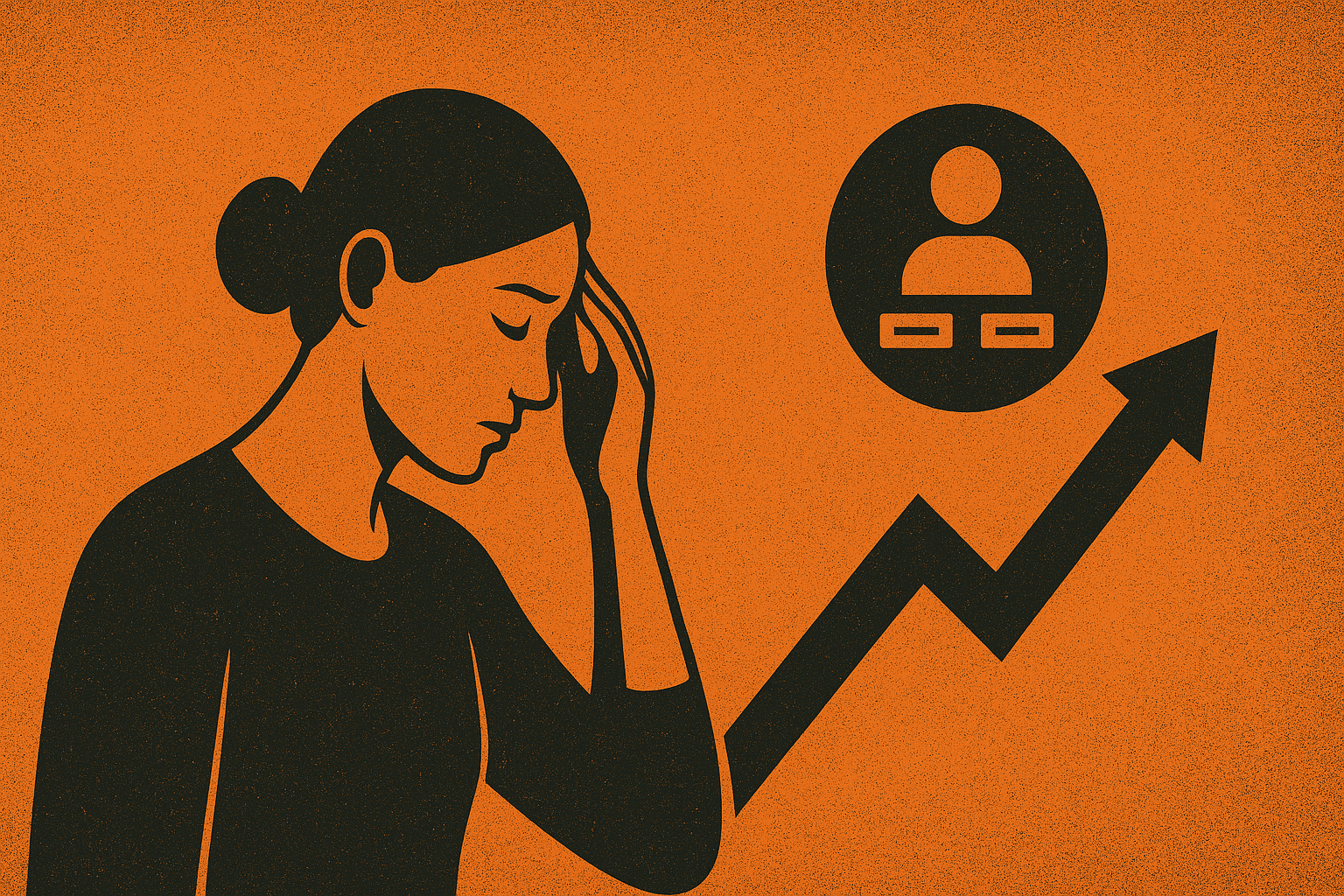
The paper poses its central question: When and why did self-improvement turn from a tool of liberation into a psychological burden? It sets the stage for a thesis that the issue is not improvement itself, but rather a dehumanized discourse through a culture of achievement, constant comparison, and turning humans into a never-ending improvement project. This paradox becomes more acute when self-improvement discourse is mixed with market and management discourses, turning mental health talk into to-do lists, meaning into indicators and metrics, and relationships into networks to be optimized.
Theme 1: From the Quest for Improvement to a Culture of Forced Achievement
The transformation of the quest for improvement from personal desire to forced achievement cannot be understood without returning to its cultural roots. Since the early twentieth century, popular success literature has linked morality, hard work, and social mobility, followed by the waves of positive thinking and potential, promising that only internal change can open doors.However, the contemporary discourse differs in two crucial points: first, it is more closely aligned with market values than ever before; second, it is more reliant on the language of measurement and management. Instead of general advice on self-confidence, we see prescriptions for improving performance: a habit chart, a focus timer, sleep tracking, a daily page count, a weekly production evaluation. These tools may be useful when kept within their limits, but they become a tool of pressure when measurement becomes an identity.
In the context of a competitive economy, success is redefined as a capacity for continuous production, not a work-life balance. Here, the work ethic intersects with the logic of investment: time is capital, the body is a project, and relationships are resources. Public stress indicators reveal how everyday life becomes fertile ground for this shift; according to the American Psychological Association's 2024 stress report, health issues at 66%, work at 65%, and money at 64% were among the most common sources of personal stress for US adults (American Psychological Association, 2024).When these percentages are this high, it is easy for the self-improvement discourse to present itself as an individualized quick fix: fix your daily routine instead of questioning working conditions, increase your productivity instead of negotiating a reasonable task load. In doing so, the discourse translates social issues into skill issues, replacing the question of fairness with the question of efficiency.
The culture of forced achievement also works by redefining self-worth. People are measured not by what they are, but by what they produce and how much control they have over themselves. Over time, failure acquires a moral meaning: it is not a natural stumbling block, but a sign of laziness or weak will. It is at this point that the glorification of harsh discipline and the demonization of tiredness and slowness take root.Phrases like "no excuses" and "get up no matter what" become a standard of virtue, while slowness is treated as a betrayal of the future. Interestingly, this logic picks up elements of the wellness and mental health discourse and recycles them in the opposite direction: instead of self-compassion, compassion becomes a luxury that impedes progress.
The effect of this shift is seen in the language that produces a constant sense of inadequacy. Even when an individual achieves some improvement, the discourse still sets the bar higher: a longer plan, a bigger goal, an endless list of skills. In a massive attention economy, this inadequacy becomes a marketing engine: every feeling of inadequacy can be met with a new product, a new course, a new app, or a coaching session. The result is that the individual is chasing an unattainable ideal: always superior, always productive, always happy, always coherent.
It is true that taking responsibility is an essential element in any change, but the common discourse tends to reduce everything to individual choice, as if structural conditions do not exist: income disparity, care burdens, health, educational environment, discrimination. In this way, people become responsible even for what they do not have, and failure becomes evidence of a personal flaw rather than a flaw in the context. This is why self-improvement turns from a liberating tool into a disciplinary tool: instead of expanding one's options, it narrows them within fixed performance standards.
It is important to link this pressure to the concept of burnout. Even international organizations point out that burnout is associated with chronic stress at work that is not successfully managed (World Health Organization, 2019). However, forced self-improvement discourse extends the same logic of pressure to all of life: sleeping becomes a performance, reading becomes a performance, sports becomes a performance, and even relationships become a performance.
This logic becomes even more compelling when fatigue seems to be a universal reality rather than an individual experience. Organizations often offer solutions through one-on-one training and resilience workshops rather than revisiting the organizational design itself.Gallup data reveals a global picture of stressed work environments: the percentage of globally engaged employees declined from 23% to 21% in 2024, Gallup estimated the cost to the global economy at $438 billion in lost productivity, and only 33% of employees say they are thriving in their lives overall (Gallup, 2025).When these indicators dominate, it is easy for personal development programs within companies to turn into a theoretical compensation for the absence of work health conditions: the individual is asked to manage themselves better, rather than the system managing their stress fairly.
The culture of forced achievement is also fueled by seasons of collective promises, such as year-end resolutions. In an American Psychiatric Association survey, 37% of U.S. adults said their mental health was fair or poor, 26% said they expected a higher level of stress by 2023, and 29% reported making mental health resolutions (American Psychiatric Association, 2022).In such an environment, self-improvement discourse can confuse self-care with harsh discipline, making improvement a moral obligation that accompanies the individual even in moments of vulnerability. In this sense, achievement is no longer a goal to be chosen by man, but a standard by which man chooses himself: he evaluates his existence as he evaluates his product, and learns to be more afraid of emptiness than always being lost.
Axis II: Constant comparison and the transformation of the self into a project
If the first theme explains how self-development discourse connects value and productivity, this theme explains how constant comparison makes that connection a tangible daily experience. Social media is not just an entertainment platform, but a constant display of achievements: before and after photos, habit schedules, learning outcomes, certificates, perfect bodies, and perfect work desks. Although these images do not represent life in all its complexity, they present a simple story of a will that always succeeds.The importance of this is not only moral, but also temporal: DataReportal data indicates that the typical user spends about 2 hours and 23 minutes a day on social networks, that social media accounts for an average of 35.8% of daily online time, and that the cumulative time consumed annually is equivalent to about 500 million human years (Kemp, 2024).When comparison becomes this large, it is no longer a passing incident, but a permanent climate for the self.
In self-improvement discourse, comparison takes on a very seductive linguistic form: the better version of you. This phrase sounds nice, but it carries an implicit assumption that the current version is imperfect. With repetition, imperfection turns from a fleeting sensation into a stable definition of self.Research supports the idea that upward comparison on communication platforms tends to produce negative responses; a large meta-analytic review on exposure to social comparison on platforms suggests that upward comparison is often associated with more negative self-evaluations, because the dominant response is contrast or paradox rather than inspiration (McComb et al., 2023).). The implication here is that viewing the achievements of others does not necessarily increase motivation; rather, it may deepen the feeling of being too far from the goal, especially when the achievements are presented in edited and selected images.
In a culture of routine, even the simplest actions become shareable products: your morning becomes a template, your food becomes content, your time becomes a personal brand. Here, self-improvement slips from internal meaning to social performance. Instead of progress being a meaningful experience, it becomes measurable and countable: the number of steps, the number of hours, the number of pages, the number of courses, the number of followers.These numbers do not measure meaning, but they give an illusion of control and create quick comparability. It is enough to notice how the platforms themselves reproduce this logic through visible indicators: likes, shares, views, and interactions. A person then turns into a project that must show their progress to others in order for them to believe it themselves.
In this climate, the individual lives in a state of constant self-evaluation. Not only do they ask: "Am I okay?" but "How do others see me?" and "Am I advanced enough?" This leads to a loss of self-satisfaction, because the standard of satisfaction moves from the inside to the screen. Over time, a sense of incompleteness forms: every achievement seems incomplete because there is always someone ahead of you, or the platform shows you a shinier version of your own life.The literature on problematic media use hints at the link between this pattern and psychological symptoms; a meta-analytic review of adolescents and young adults found significant associations between problematic social media use and indicators of depression, anxiety, and stress (Shannon et al., 2022).Although correlation does not imply causation alone, the message is important: when platforms become a mirror of constant evaluation, the psyche becomes more prone to fluctuate according to external reactions.
DataReportal data also indicates that the world spends about 15 billion hours a day consuming social media content, which is equivalent to more than 1.7 million years of human existence each day (Kemp, 2024).On these scales, improvement becomes not a personal subject, but a collective standard that is reproduced moment by moment, even when the individual tries to withdraw from comparison, he finds himself surrounded by its logic within the development applications themselves: leaderboards, commitment chains, achievement badges, and alert messages that remind you that you are late. The result is that the self loses its right to normality, and learns to justify its existence by constant improvement, not by balanced living.
The psychological cost and the limits of self-improvement discourse
The psychological cost of the obsession with self-improvement manifests itself when constant effort becomes a condition of dignity, and when rest becomes a sin. Exhaustion here is not a passing symptom, but a cumulative experience: attrition, loss of passion, and numbness towards what used to give meaning.It is useful to remember that the World Health Organization has defined burnout as a syndrome resulting from chronic unmanaged workplace stress, characterized by attrition, mental distancing, and reduced effectiveness (World Health Organization, 2019). However, the forced self-improvement discourse extends the same logic of stress to cover all of life, making humans "employees" of the self: monitoring it, holding it accountable, and demanding it to improve even outside of work.
Instead of understanding rest as a physical and psychological need, it is redefined as a waste of time, while failure is redefined as a character flaw rather than a part of learning. In this moment, the language of "habits" is transformed from a tool of organization to a tool of reproach: if you break the routine, you are solely at fault; if you do not progress, your willpower is lacking.This logic puts pressure on people who live in circumstances of hardship or resource disparity because it ignores structural and individual differences: health, disability, care burdens, poverty, instability, and discrimination. When the discourse asks everyone to follow the "same rules" to succeed, it equates the unequal, and then blames individuals when they falter.
Here the critical question arises: Has self-improvement become a soft form of psychological violence? The violence here is not screaming, but rather the engineering of consciousness that makes the individual observe themselves with a harsh eye, reproducing stress without a clear external authority. There are signs that the cycle can be broken when the comparison environment changes; an experimental review (randomized controlled trials) found that reducing social media use is associated with a small average effect on depressive symptoms (May et al., 2025), so the paper calls for a reexamination of the discourse.). The paper therefore calls for a more humane redefinition of psychological growth: one that recognizes limits, accepts slowness, relates improvement to meaning rather than race, and redistributes responsibility between the individual and the context rather than to the individual alone.
Conclusion:
This paper reveals that the issue does not lie in the human desire to learn and improve, but rather that contemporary self-development discourse has reconfigured this desire as a permanent duty within a culture of achievement that measures value by productivity and is fueled by endless comparison platforms.When a person becomes an endless "project", life turns into a continuous evaluation, and a psychological cost of exhaustion, guilt, and burnout emerges, ignoring individual differences and structural conditions. The alternative is not to reject growth, but to reclaim it as a more humane path: accepting slowness, recognizing weakness, separating dignity from achievement, and giving rest its natural meaning. The open question remains: do we want to become better...or just less hard on ourselves?
Comments