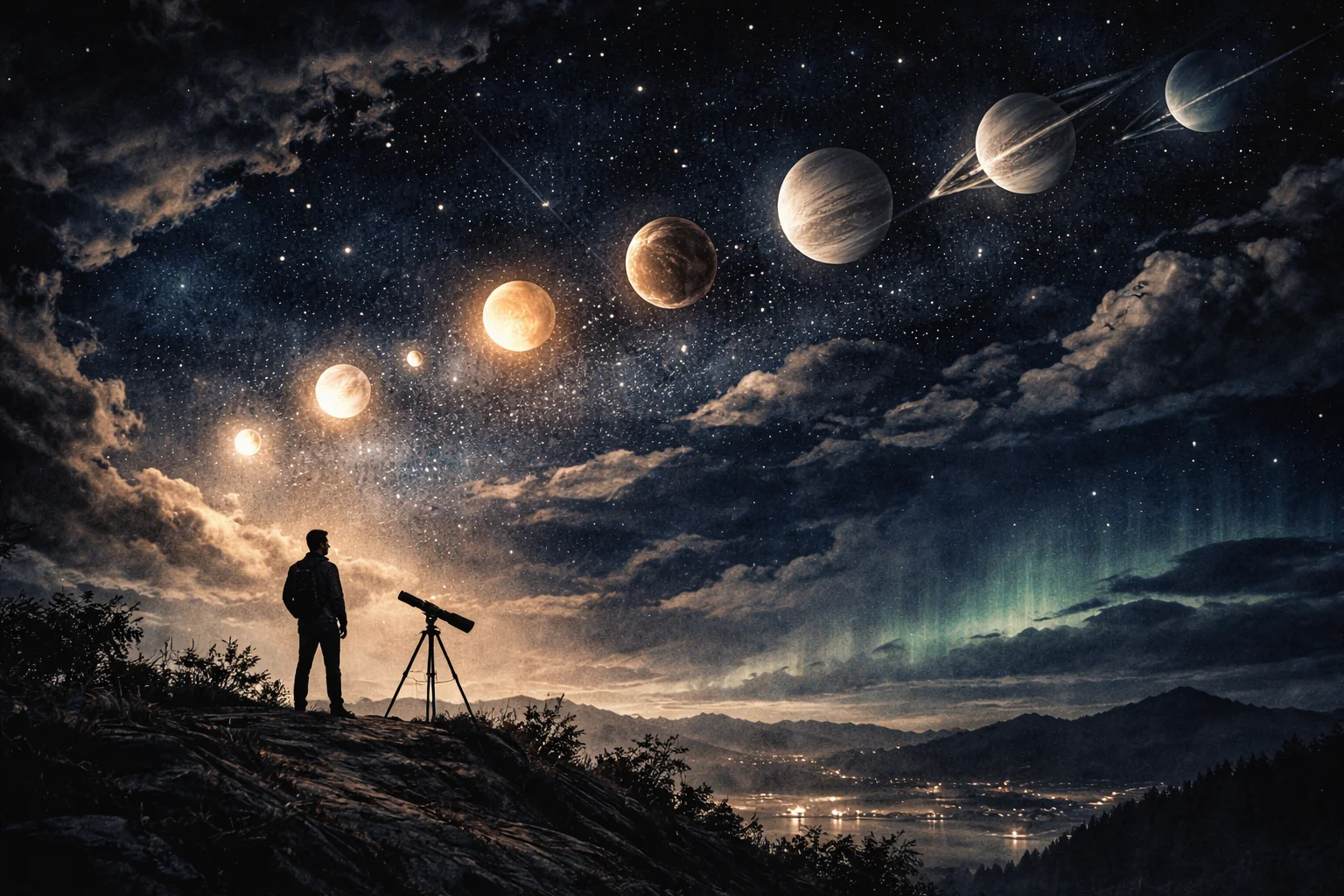
The evening of the end of February 2026 will witness a globally noteworthy astronomical event popularly known as a "planetary parade" or "planetary procession." Six planets appear in one sector of the sky after sunset: Six planets appear in one sector of the sky after sunset, appearing as if they are visually aligned or "close" from the perspective of the observer on Earth. The main idea here is not that the planets are lined up in a real straight line, nor that they have actually approached each other, but rather that their orbits (close to one plane called the ecliptic plane) make them, at specific times, appear on one side of the sun and at close angles on the planetarium.For this reason, the "parade" is repeated every few years, but what is remarkable at the end of February 2026 is the meeting of six planets in a relatively short observation window with the possibility of seeing most of them with the naked eye when suitable conditions are available.
Details of the planets participating in this "parade" according to reports by the Associated Press and others: The planets are Mercury, Venus, Jupiter, Saturn, Uranus, Neptune. What can be seen with the naked eye is often Mercury, Venus, Jupiter and Saturn, while Uranus and Neptune have hidden their relative light and their great distance from most observers, so they usually need binoculars or a small telescope, in addition to a clear sky away from light pollution.
The peak time that is repeated in most guides is the evening of Saturday, February 28, 2026, with the observing opportunity extending through the weekend and a few days after, before Mercury becomes very low on the horizon and gradually disappears in the glow of sunset.This detail is important, because the "time leader" in this scene is Mercury: being closest to the Sun means it doesn't travel far from it in the sky, appearing briefly after sunset (or before sunrise) and then disappearing quickly.So the window for seeing most of the planets together is often short, and the observation takes on a "once-in-a-lifetime" character even if the astronomical principle is repeated periodically.
Practically speaking, where should an observer look? Most guidelines suggest starting about half an hour to an hour after sunset, looking toward the western sky (where the sun is still just below the horizon). Venus is usually the easiest starting point because it is very bright and looks like a steady beacon, then you can look below it or near the horizon for Mercury, which is fainter and closer to the horizon line, and near this sector Saturn may appear as a fainter object than Venus but with a steady non-flickering light. Jupiter is often higher in the sky and brighter than most nearby stars, making it a good second "marker" to stabilize the visual map. After fixing these four by eye, binoculars can be used to track the positions of Uranus and Neptune, which are louder or fainter depending on your location.
Scientifically speaking, it is useful to clarify the concept of "alignment" so that the event does not become the subject of hyperbole.The planets are not lined up on a single line in space, as some popular images might suggest, but rather appear in the sky on an arc close to the eclipse plane. The explanation for this is simple: all planets orbit the sun in orbits that lie roughly within the same plane, so when several planets are on the same side of the sun relative to the earth, we see them converging on the same celestial strip. The "proximity" here is angular, not spatial; the real distances between these objects are enormous, but visually compressed by the viewing perspective.
As for how to distinguish between planets and stars, there is a practical rule of thumb mentioned by AP and confirmed by multiple observing guides: Stars flicker more due to atmospheric turbulence, while planets appear more stable because they are small disks and not pure points of light like distant stars. Of course, it is not an absolute rule in all circumstances, but it is very useful for beginners, especially near the horizon where visual turbulence increases.
To turn this opportunity into a successful observation, there is a short but crucial "recipe". Choose a place with an open western horizon away from buildings and trees, as Mercury and Saturn may be very low. Give your eyes a few minutes to adjust to the darkness and stay away from phone lights as much as possible. Start with Venus and then move on to Jupiter as two very bright references, then look for Mercury and Saturn near the horizon. If you have binoculars, use them after confirming directions, not before, as binoculars narrow the field of view and may confuse a novice. If you have a celestial observation app, make it a "confirmation" tool rather than a substitute for direct vision. These tips are converging in several sources, including the AP and published observational evidence from the scientific community.
In the end, the significance of the Six Planets Parade is not only that it is a rare astronomical event, but that it is an excellent example of how science can enter the public domain through a simple experiment: the sky becomes an open laboratory, and people learn concepts like ecliptic plane and angular perspective without a formal lesson.At a time when screens are crowded with heavy news, this event offers a shared global moment: the same sky, the same objects, and an experience that everyone can share with the naked eye or with simple tools: It reminds us that there is knowledge to be lived, not just read.
Bibliography:
The Associated Press.(2026, February).Six planets in the sky by the end of February 2026 can be seen with the naked eye under the right conditions.AP News.
Six planets in one evening: What awaits us at the end of February 2026?
The parade of six planets at the end of February 2026 is not a true alignment in space, but rather an angular convergence caused by their positioning in the same orbital plane around the Sun.
Comments