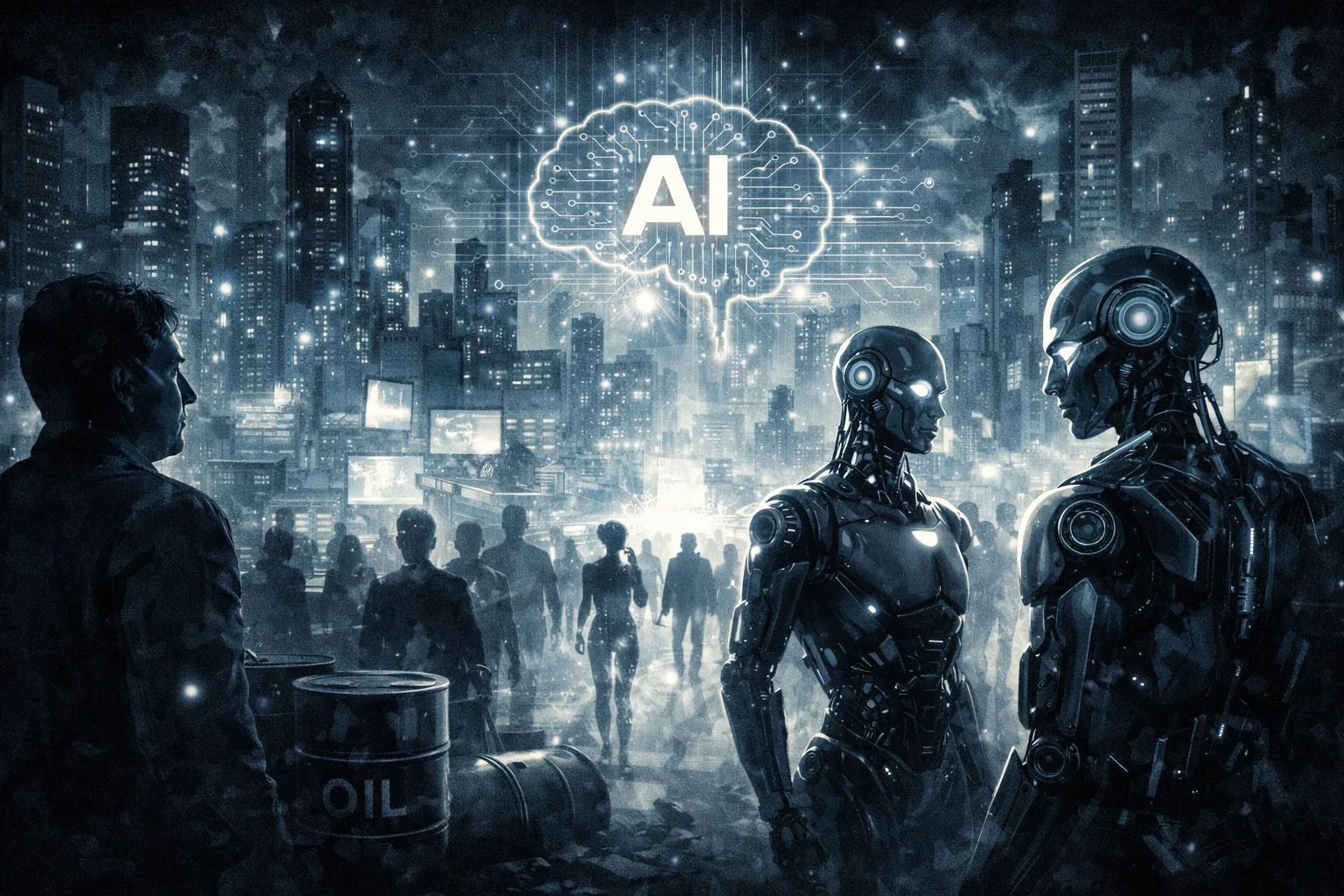
In the past few years, the public debate about artificial intelligence has mostly revolved around a single question: What can a model do on its own? Does it write? Does it program? Does it translate? Does it persuade? But what is starting to change today is that the question is no longer just individual, but also social: What happens when models interact with each other, rather than when they work in isolation? This shift is what prompted the journal Nature to say that the first AI communities are taking shape, referring to research examining forms of social interaction between AI agents, and whether these interactions produce patterns such as norms, behavioral contagion, social influence, and group bias (Nature, 2026).
The essence of the idea here is that a single model is no longer always the optimal unit of thought and execution. In newer applications, the task is divided among multiple agents: One plans, another researches, a third verifies, a fourth drafts, and a fifth revises. This isn't just a futuristic fantasy, it's already part of the architecture of some actual systems. Anthropic, for example, explained how it built a multi-agent research system that relies on an agent that creates a research plan and then creates sub-agents that work in parallel to explore multiple paths, with a clear recognition that this pattern offers benefits in open and complex issues, but at the same time creates new challenges related to coordination, evaluation and reliability. Communities appear here not as a literary idea, but as a practical operating structure: A group of agents, each with a job, exchanging roles and outcomes in order to achieve a better output than that of a single agent (Anthropic, 2024).
What makes this development important is that it moves us from conceptualizing AI as a single tool to conceptualizing it as an emerging social construct. We are not just dealing with a model that answers a question, but with multi-agent systems that can negotiate, copy each other, and form stable patterns of behavior. This is not just theorizing. In 2026, Nature published a report on a complete social platform for AI agents, where these agents have their own space for interaction and publish papers on their own pre-publication server. At the same time, preliminary studies have emerged on the concept of AI socialization, defined as a behavioral adaptation that arises from continuous interaction within a community of agents, examining how semantic convergence, similarity in tone, and collective drift occur within this type of environment (Nature, 2026).
The most exciting question is not: Are these societies exactly like human societies? Is it enough to be functionally similar to them to change the world? Herein lies the hinge point. Models may not have human desires or self-awareness, but if they can produce norms, imitation, social pressure, and collective bias, that alone is enough to reshape action, knowledge, and decision-making. We already have evidence that agents can be influenced by social power. Some preliminary studies have shown that AI agents show a systematic bias towards conforming to group size, consensus, and task difficulty, and that their near-perfect performance in isolation may become more fragile when exposed to group influence. Other studies also suggest that cooperative norms can extend between humans and AIs in hybrid groups, partially blurring the boundaries between human and machine norms in teamwork (Zhang et al., 2026).
If we take these findings seriously, the first sector that will change is labor. When models were an individual tool, the most that could be imagined was a smart assistant for each employee. If we are already entering the phase of AI societies, the picture becomes different: Whole teams of agents sharing roles, distributing tasks, reviewing each other's output, negotiating priorities, and only calling on humans at certain points. Nature mentions platforms that allow agents to hire human assistants when they are unable to carry out certain tasks on their own, a seemingly small but significant detail, because in this case the human is not the sole operator but a resource within a network driven by coordination processes between AI agents (Nature, 2026).
But perhaps the most profound impact will be in knowledge itself. In 2025, Science published an important paper arguing that large linguistic models should be understood not as autonomous minds, but as new cultural and social technologies, closer in historical impact to writing, printing, and online search. What this means is that the value of AI lies not only in its ability to calculate or predict, but in its being a medium that reorganizes how knowledge circulates, who talks to whom, who rewrites what, and what becomes visible or centralized within the knowledge space (Bender & Hanna, 2025).
If we add to this the existence of communities of agents exchanging texts, recommendations, evaluations and summaries, we are not only adding a new tool to the human library; we are adding a new social layer on top of knowledge itself. This layer could reshape the pathways of knowledge production and dissemination, and possibly redefine who has the power to influence scientific and cultural debates.
And herein lies the most important danger: AI communities may not only produce coordination and efficiency, but also group bias. A study published by Science Advances on emerging norms not only talks about consensus, but also points to the potential emergence of group biases. Nature also raises the important question of whether we are at the beginning of a new sociology, or just a clever simulation of human behavior. This question is not just philosophical; if models tend to form internal norms based on similar training data or similar design incentives, they may produce very similar environments that recycle the same assumptions, values, and biases (Centola et al., 2025; Nature, 2026).
This is where decision-making becomes the most sensitive arena. Imagine public institutions or major corporations using networks of agents to analyze data, formulate options, prioritize, and present an automated consensus to a manager, minister, judge, or doctor. It may seem that humans are still at the top, but the reality is that the human decision space may be narrowed if the recommendation reaches them after passing through an entire community of agents who have reviewed each other and produced a seemingly strong consensus. More dangerously, this consensus may carry with it all the characteristics of social pressure such as compliance, consensus bias, and marginalization of dissent.
Some preliminary studies on multi-agent AI security are already warning that agents may negotiate, collude, or influence each other in unexpected ways. If this happens within organizational decision-making systems, it may become difficult to trace the true source of the decision or understand the logic of reaching it.
However, this scenario should not be read only as a threatening story. There is another possible face. If these emerging communities are well understood, they may allow us to build more resilient work and decision systems, where review is distributed, agents expose each other's mistakes, and knowledge becomes less dependent on a single individual. But this hinges on a crucial point: Will we design AI communities as accountable structures, or will we let them grow as invisible layers between humans and the world?
So perhaps the right question today is not whether we are already at the beginning of the AI societies phase, but how we will deal with this beginning before it becomes a normal, invisible architecture. The data available through 2026 doesn't say we've arrived at an autonomous robotic civilization, but it does say something less dramatic and more important: AI agents are no longer just individual tools, but are beginning to form collective patterns that can be studied, with norms, social influence, behavioral contagion, and the potential for internalization.
This alone is enough to make the next phase different. We may not yet be in full-fledged AI societies, but we are likely already living their organizational and social beginnings (Nature, 2026).
References:
Bender, E. M., & Hanna, A. (2025). On the social and cultural implications of large language models. Science, 370(6521).
Centola, D., Becker, J., Brackbill, D., & Baronchelli, A. (2025). Emergent social conventions and collective dynamics in large language model populations. Science Advances, 11.
Nature. (2026). The emergence of AI societies and multi-agent interaction. Nature, 631.
Zhang, Y., Li, Q., & Chen, R. (2026). Social influence and conformity in artificial agent groups. arXiv preprint.
Comments