Introduction
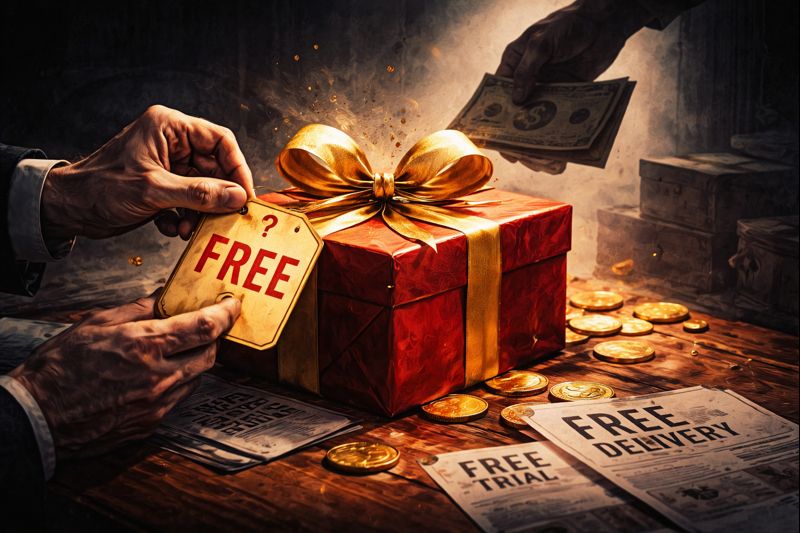
At the end of a normal day, free may seem like a small gift: free delivery with the first order, a month's trial with no fees, or a gift "on account" upon payment. The moment of acceptance gives us an immediate sense of profit, because the zero price shortens the thinking and makes the decision easier than any paid decision. But the paradox appears later: time wasted on a free app, personal data turned into a profitable resource, a trial subscription that automatically renews, or a price that increases after the service becomes a habit.The European Commission's Digital Justice Review hints at the magnitude of the phenomenon when it notes that 29% of consumers said that free trials "often" automatically turn into a paid subscription, and 38% reported that canceling subscriptions was difficult (European Commission, 2024). The paper's question is: If everything has a price, where is the price of "free" hiding? Its thesis is that free does not eliminate the cost, but redistributes it over time, data, commitment, or future price.
Theme 1: How does "free" work psychologically?
Free works psychologically as a more powerful signal than discounting, because it not only changes the value of the offer but also changes the rules of comparison in the brain. The zero price effect literature explains that a zero price option creates a disproportionate attraction compared to a slightly cheaper but non-zero price option, because zero erases part of the risk in consciousness and shifts the decision from a cost-benefit calculation to a sense that loss is impossible.A recent analysis summarizes this through two related concepts: the zero effect and the no-comparison effect, where the tendency to weigh the nuances between alternatives is weakened when a free option appears; the question shifts from "which is better for me?" to "why not try?", and questions of actual need disappear in favor of the impulse to experiment (Yang, 2023).
In an experimental study of hotel promotions, the preference for a free night remained stronger than the preference for a small discount even when the total price was equal, which the researchers interpreted as an irrational choice resulting from the power of zero as a signal (Zhang, Grisolía, & Lane, 2023).This is where the freebies function as a decision palliative: it removes the sense of guilt when buying or registering, because the person can justify their decision by not losing anything. In contrast, a normal discount keeps the comparison present: How much do I pay? Is it worth it? Is there an alternative? While freebies jump over these questions, making the decision more emotional than mathematical.
More importantly, free redistributes the risk over time: instead of asking you to pay now, the offer pushes you to postpone the evaluation until after use, at which point other forces such as present bias and inertia come into play. In a trial subscription, for example, the psychological idea is to reduce the perceived risk by giving the user the illusion that they can easily stop later, but many people do not stop because they forget or because the cost of the decision increases after investing in account setup and customization.This is what policy analysts call forced persistence when easy acceptance turns into a paid commitment through automatic renewal or complicated exit (OECD, 2022). Free does not necessarily make the offer better, but it does make the entry threshold lower and replaces one clear decision with a series of small deferred decisions, an ideal environment for impulsive decisions that seem rational in the moment.
Theme 2: Where does the cost shift? Deferred Payment Maps
When we say that free redistributes cost, we are describing an entire economy based on shifting payment from the money column to other columns. The first of these columns is time and attention, especially in "free" services that rely on ads or in-app sales.Sensor Tower's State of Mobile report states that the average time spent on the phone across major markets exceeded five hours per day in 2023, and with it the mobile economy recorded a significant advertising spend of $362 billion in 2023, illustrating how "free" minutes turn into a saleable commodity (Sensor Tower, 2024). In this model, the user does not pay a fee, but pays with their attention, which contributes to funding the platform, and their behavior, which generates data that improves targeting and profits.
The second is the data itself: location, preferences, browsing habits, and digital "who I am" sensitivity. Policy reports describe how deceptive designs can lead individuals to provide more data than they intended, or to accept default tracking settings, so that the "user becomes the product" (OECD, 2022; ICPEN, 2024).The third box is commitment: a trial subscription that automatically converts to a paid one, or one that makes canceling a cumbersome experience part of the cost.In a European Digital Justice Checkup survey, 29% of consumers said that free trials often turned into paid subscriptions without sufficient attention, while 38% indicated that canceling the subscription was very difficult (European Commission, 2024).In a recent BEUC document citing the same survey results, 69% found cancellation technically difficult and 62% did not receive a reminder when renewing unused subscriptions, figures that explain how "free" becomes a soft lock through forgetfulness and friction (BEUC, 2025). This experience is not only European: a CPRC report in Australia found that 75% of those with subscriptions had negative experiences when trying to cancel (CPRC, 2024).
In the "free" membership shipping model, recent marketing research shows that free subscription shipping programs change purchase behavior and increase frequency, helping to offset the cost by increasing overall demand. The question is: Is free a gateway to the service, or a soft lock that is difficult to get out of?
The third axis: Uncovering the "hidden tax" - the reader's practical tool
After the diagnosis, what is important is a daily use tool that detects the hidden tax before acceptance.It can be formulated as a quick test: Before any free delivery, trial subscription or gift, ask yourself sequentially: "What will this take from me other than money (time, attention, data)? Is there a clear end date for the trial or automatic renewal? What happens if I want to stop?Is cancellation as easy as signing up or through cumbersome steps and interfaces? Will I pay a higher price later for the same thing? Would I have done it if it wasn't free? These five questions reactivate the comparison disrupted by zero, and reveal whether "free" is a useful incentive or a behavioral trap.
To turn testing into practice, make "opting out" part of the "opting in" decision: check the cancellation button before starting, read when the discount starts, put a reminder two days before the end of the trial, and keep a copy of the basic terms. This does not make one skeptical, but aware of what policy reports describe as the proliferation of interfaces that push subscription and hinder cancellation (OECD, 2022; ICPEN, 2024).
Conclusion
Free is not always a lie, but it is never innocent. What changes is the place of payment: you may not come up with money now, but you may pay time and attention, give data that turns into commercial value, enter a hard-to-break commitment, or accept a higher price later after building a habit.This is why redefining "payment" is necessary to protect the decision: not just what comes out of your wallet, but what is consumed from your life. Not to reject every free offer, but to read it as a complete deal: who benefits, what is compensated, and what are the exit conditions. When the terms become clearer, the decision becomes calmer. In the last free offer you accepted, ask yourself honestly: where did you really pay for it?
Comments