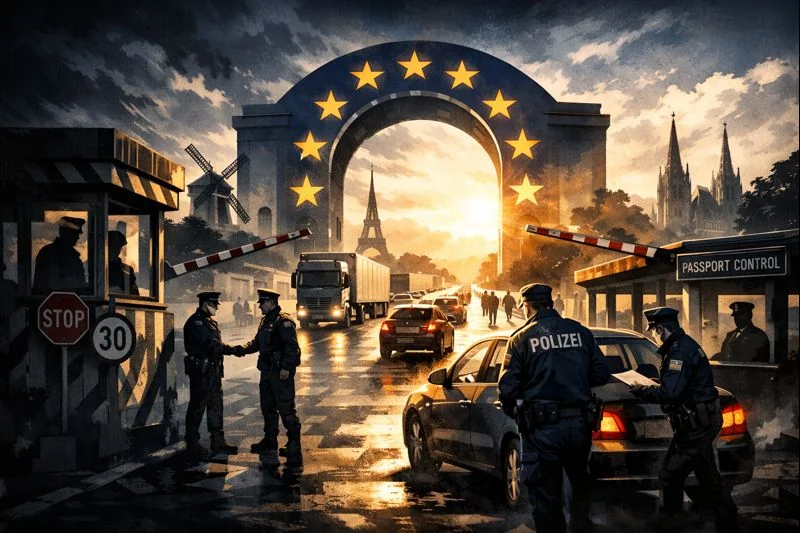
Introduction:
Today, when we look at the map of the European Union, where goods, people, and capital move across 27 countries without stopping at crossings, the disappearance of economic borders seems like a natural outcome of a long path of integration. However, this outcome was neither intuitive nor easy. It was the result of a deep political-economic project that emerged from the womb of the most war-torn continent of the twentieth century.
Post-World War II Europe was not only a physically devastated continent, but an economically fragmented space governed by tariffs, quantitative restrictions, multiple currencies, and conflicting national standards. Economic borders were as rigid as military borders, and every dividing line between two countries became a barrier to trade, growth, and reconstruction. In this context, the "single market" was not just an economic project to improve efficiency, but at its core an attempt to redefine the relationship between European countries: from zero competition to regulated interdependence.
What distinguishes the European experience is that the removal of borders was not done by abolishing states or dissolving sovereignties, but by building a legal and institutional framework that allows them to coexist within a single space. The single market did not mean unifying all laws, but rather creating common rules that guarantee freedom of movement and prevent discrimination, while leaving a wide margin for national specificities.
This paper attempts to answer a central question:How did Europe succeed in ending the economic borders between its countries? Why is the single market one of the most ambitious integration experiments in modern history? It also looks at the political and social costs of this achievement, the tensions that accompanied it, and the limits of its success in a world that is witnessing the return of anxiety about sovereignty and borders.
Theme 1: From a fragmented continent to a single legal space: How were invisible borders removed?
Europe's biggest challenge was not just the removal of tariffs, but the removal of what were later called "invisible borders": different laws, technical standards, administrative regulations, safety, health, and competition rules. Even after the creation of the Common Market in the 1960s, these regulatory barriers continued to impede the free flow of goods and services.
The real shift came with the Internal Market White Paper in the mid-1980s, which outlined the hundreds of legislative measures needed to create a de facto single market. The essence of this shift was not to impose a complete unification of laws, but to adopt the principle of mutual recognition:a product or service that is legally accepted in one member state should be accepted in other countries, unless there are substantial health or safety reasons.This principle was a quiet revolution in European legal thought. Instead of waiting for all rules to be standardized, diversity was allowed within a common framework. Borders were transformed from physical barriers to administrative lines within a single legal system, where competition is monitored and discriminatory practices are prevented.
In addition, the European Court of Justice played a pivotal role in consolidating the single market through rulings that expanded the interpretation of the four freedoms (free movement of goods, services, capital, and persons) and made the single market a judicial reality rather than a political text.
Axis II: What did Europe gain from breaking down borders?
Economically, the single market represented a quantum leap in the size and depth of the internal market, as Europe moved from a group of medium-sized national markets to the largest single market in the world, comprising more than 440 million consumers. This expansion created enormous economies of scale, allowing European companies to grow, reduce costs, and expand cross-border supply chains. Intra-trade between member states flourished and became the largest share of their trade, which strengthened economic interdependence and made separation more costly than integration.
On the other hand, the single market has made Europe an attractive destination for foreign direct investment, not only because of the size of the market, but also because of the stability of rules and the standardization of competition conditions. The investor is not dealing with 27 different regulations, but with a relatively single legal framework, which reduces regulatory risks. The single market has also allowed the emergence of European cross-border companies capable of competing globally in areas such as industry, aviation, energy, and financial services.
More importantly, the single market has become an instrument of external power, in what is known as Europe's "regulatory power." By standardizing its internal standards, Europe has been able to impose these standards externally, whether in environmental protection, competition policies, or data protection and privacy. If global companies want to access the European market, they must adhere to these standards, making them in many cases de facto global standards.Thus, the removal of internal borders has become a means of maximizing external influence.
Politically, the single market has enabled the EU to negotiate trade as a single bloc, rather than 27 individual countries with limited negotiating weight. This has enhanced the European ability to conclude free trade agreements, defend its interests in the World Trade Organization, and deal relatively even-handedly with major economic powers such as the United States and China.
However, a critical angle cannot be ignored: not all countries, nor all social groups, have benefited to the same degree. Countries with more developed economies and stronger infrastructures have been better able to exploit the opportunities, while others have faced challenges in adapting and accusations that the single market has become a tool to concentrate gains in certain economic centers. Some sectors and workers have also come under competitive pressure, fueling a sense that the single market has created winners and losers within the union itself.
Theme 3: Borders without barriers...but without tension?
Despite the depth of integration, major crises have exposed the fragility of the idea of "borderless borders." The 2008 global financial crisis, followed by the sovereign debt crisis, showed that the single market does not necessarily mean full financial solidarity. During the coronavirus pandemic, countries returned to closing borders, imposing restrictions on the movement of people and medical goods, in a scene that seemed to be the antithesis of the single market. The war in Ukraine led to a rethinking of energy security, supply chains, and economic sovereignty.
How to maintain an open market while protecting workers from social dumping? How to balance freedom of movement, health security, and economic stability? These questions have fueled the rise of populist rhetoric in several countries, which sees the single market as a threat to national sovereignty, identity, and the ability to control domestic decision-making.
In this context, the single market appears to be an inherently incomplete project that needs constant readjustment. It is not a steady state, but a delicate balance between openness and regulation, between the market and the state, and between the national and European levels. Every crisis re-tests this balance, and poses the same question in a new formulation: how far can integration be expanded without breaking its political and social acceptance?
Conclusion
The European single market did not abolish borders in the traditional sense, but it changed their function. Borders are no longer lines that impede trade and movement, but are part of a broader legal and regulatory framework that balances openness and sovereignty. This transformation was not only technical, but also political and cultural, as it required countries to accept that some decisions are no longer purely national.
The success of the single market lay in the fact that it did not seek to create a single European state, but rather a common space that allowed countries to remain different within the same rules. However, this success remained conditional on Europe's ability to manage disparities, contain shocks, and maintain the political legitimacy of the project in the eyes of its citizens.
Today, in a world where borders and sovereignty are once again being debated, the European single market is a unique experiment: not an easily replicable model, but proof that ending borders does not mean abolishing states, but redefining the relationship between them. The open question is not whether Europe has ended borders, but whether it can defend this achievement in the face of future crises without turning the single market from a tool of integration into a source of division.
Comments