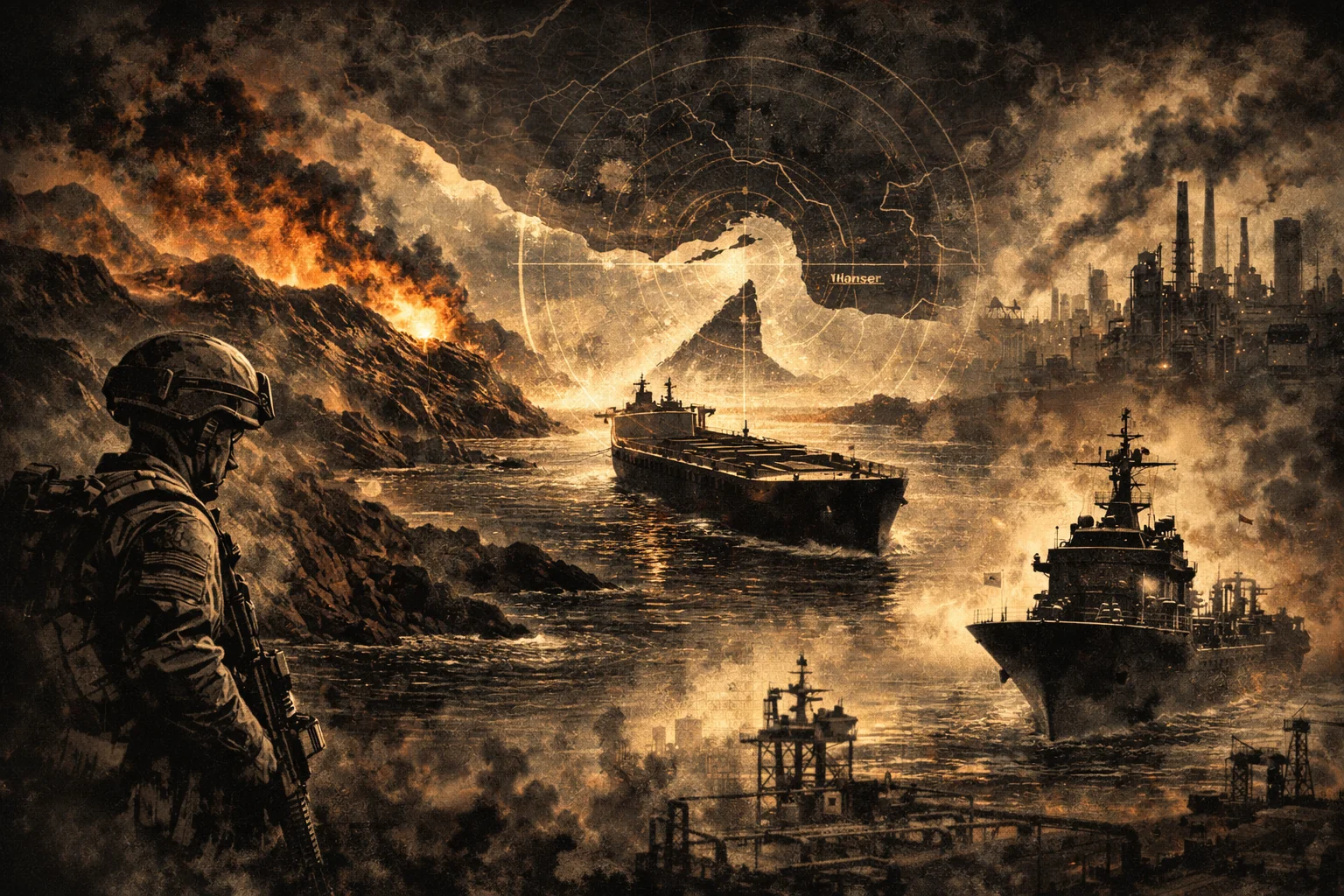
The Strait of Hormuz is one of the most sensitive waterways in the contemporary international system, not only because of its geographical location connecting the Arabian Gulf to the Gulf of Oman and the Indian Ocean, but also because it represents a vital artery for global energy flows. Despite its relatively small geographical area, its impact extends beyond its maritime borders to include financial markets, military deterrence strategies, major power calculations, and even the course of the global shift toward alternative energy. Understanding the importance of this strait requires viewing it as a complex intersection of geography, politics, economics, and international security, where regional and international interests intersect in an apparently limited maritime space that is dense in terms of strategic influence. The Strait of Hormuz not only serves as a transit channel for ships, but also as a crucial element in the stability of the global energy system, so that any change in its security or political situation directly affects the structure of the global economy.
At its narrowest point, the Strait of Hormuz is about thirty-three kilometers wide, while the width of the navigation lanes for ships does not exceed a few kilometers in each direction, turning it into a geopolitical bottleneck, where a limited disturbance or a small security incident is enough to cause widespread repercussions. Throughout history, straits have played pivotal roles in shaping the balance of power, but the Strait of Hormuz has the distinction of being the main maritime outlet for oil and gas exports from the Gulf region, making it more closely linked to global energy security than most other corridors. The narrowness of the passage and its proximity to the Iranian and Omani coasts make the issue of controlling or influencing it dependent on factors that go beyond traditional navigation to include coastal missiles, drones, and various naval capabilities, turning geography itself into an active element in shaping the political and military behavior of the parties concerned.
Approximately one-fifth of the world's seaborne oil trade and large quantities of liquefied natural gas pass through the Strait of Hormuz, making it an essential artery for major industrialized economies that depend on energy supplies from the Gulf. The sensitivity of oil prices to any tension in the region reflects the extent of the strait's centrality in market calculations, as it does not require an actual closure or a large-scale military confrontation for prices to rise; it is enough to announce a limited incident or an escalation in political rhetoric to increase the risk premium in oil transactions. This shows that the importance of the Strait is not limited to being a physical passage for tankers, but extends to its symbolism as an indicator of the stability of global supplies, so that its stability becomes a factor of reassurance for markets, and its disruption is a source of widespread concern.
From a deeper economic perspective, the Strait of Hormuz represents the practical embodiment of the idea of globalized interdependence, as a disruption in a limited maritime spot can affect transportation costs, fuel prices, inflation rates, and supply chains on distant continents. The global economy's dependence on safe sea lanes makes the strait a structural vulnerability, with each crisis revealing the fragility of a system based on the constant flow of goods and energy. As economies become increasingly interconnected, the impact of any local tension is multiplied, reinforcing the importance of the strait not only as an energy corridor, but also as an indicator of the stability of globalization itself.
In the political and strategic context, the Strait of Hormuz is sometimes seen as a potential leverage tool in cases of regional tension or economic sanctions, where the possibility of disrupting navigation is threatened as a negotiating or deterrent card. However, this threat has a clear dilemma, as closing the Strait would cause serious damage to energy-importing countries, but at the same time it would hit exporting countries whose budgets depend on oil and gas revenues.
The importance of the strait is also enhanced in light of the rivalry between major powers, as its stability is linked to the security of global supply chains and the concept of freedom of navigation. The major industrialized countries that depend on Gulf oil see the stability of the strait as an issue that goes beyond the region to national security, prompting them to maintain a naval presence or security arrangements that ensure the continued flow of energy. Thus, the strait becomes part of a broader equation related to global power balances, where the economic dimension intersects with the military dimension in a limited geographical area.
The recurring tensions in the Strait of Hormuz can be seen as a catalyst for rethinking global energy policies, as previous crises have prompted many countries to diversify their sources and invest in conventional energy alternatives. The greater the risks associated with critical sea lanes, the greater the incentive to reduce dependence on oil transported through them, whether through supplier diversification or renewable energy expansion. In this sense, the strait may indirectly accelerate the transition to a more diversified energy system that is less vulnerable to geopolitical shocks.
In the event of a full-scale closure of the Strait, the potential repercussions on the global economy would be profound, as oil prices could spike in a short period of time, with direct implications for inflation and economic growth in many countries. Although some importing countries have strategic stockpiles, these stockpiles represent a temporary solution that cannot compensate for a long-term supply disruption. Moreover, other land or maritime alternatives do not have sufficient capacity to compensate for the quantities that pass through the strait on a daily basis, which reinforces the international community's realization of the importance of maintaining its stability.
In light of the above, the importance of the Strait of Hormuz is evident in the fact that it is a crucial meeting point between geography, politics, economics and international security. It is not just a narrow sea lane, but a strategic node that controls global energy flows, affects the stability of markets, and interferes in the calculations of deterrence and international balances. The study of this strait clearly reveals that geography is still a central factor in shaping international relations, and that maritime choke points can turn into hotspots of tension with a global impact. In a world of increasing geopolitical challenges, the Strait of Hormuz will remain one of the most prominent indicators of the stability of the international system and one of the most important determinants of the future of global energy security.
Comments