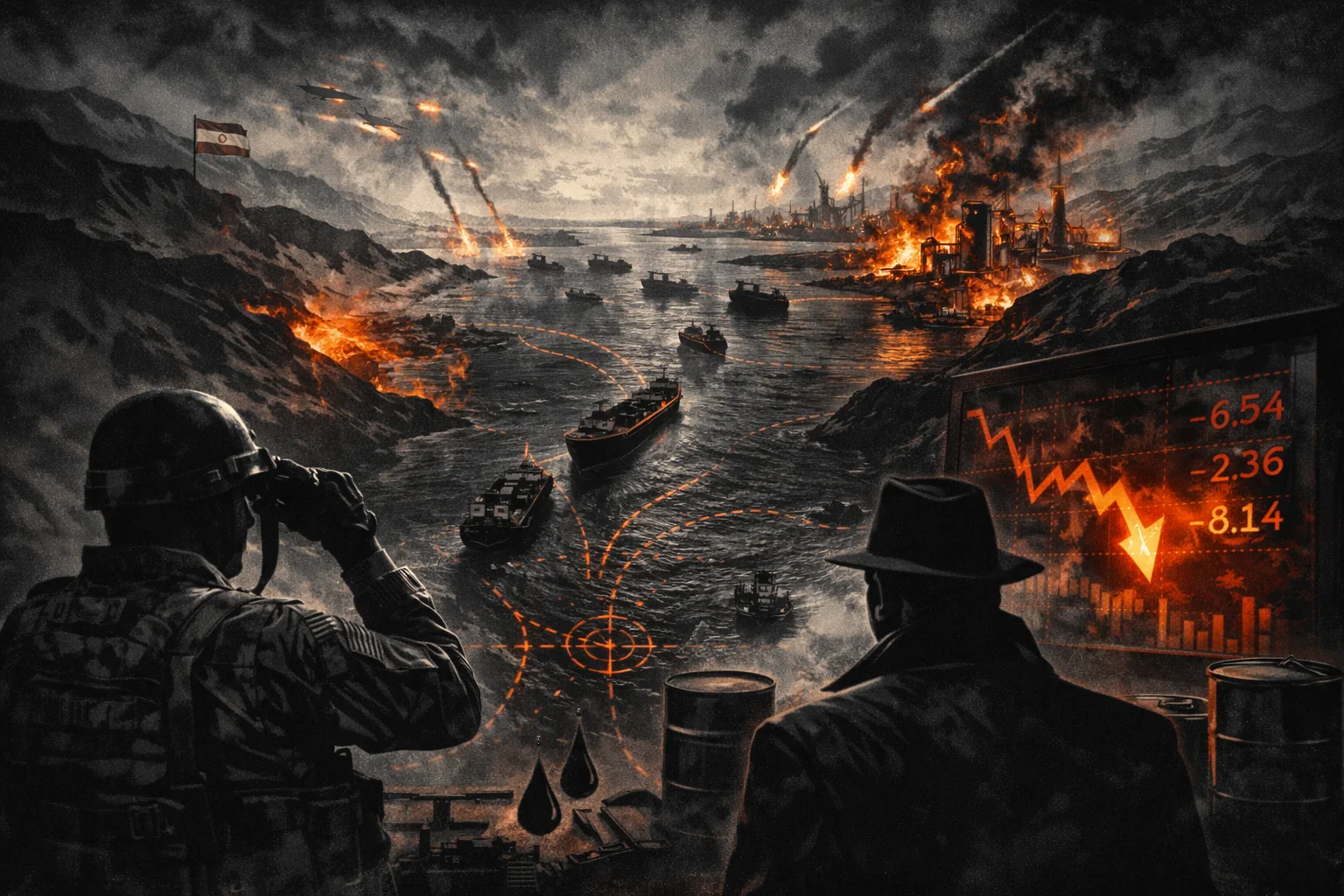
The Strait of Hormuz is one of the most sensitive points in global economic geography, not only because it is a narrow sea lane, but because it effectively controls the rhythm of a large part of the global energy trade, and the mood of markets, prices, insurance and shipping. Its importance stems from the fact that it is the almost the only maritime gateway that connects the oil and gas-rich Gulf countries to global markets through the Arabian Sea and then the Indian Ocean, making any disruption in it quickly move from navigation charts to stock exchange screens, and then to the cost of fuel, electricity, commodities and supply chains in dozens of countries. This role does not stop at crude oil, but extends to petroleum products and liquefied natural gas, making the strait more like a valve in a global energy system that depends more on regular flow than on the availability of reserves in the ground.
In quantitative terms, the centrality of the strait becomes clear when we look at the volume of flows that pass through it annually. U.S. Energy Information Administration data indicate that flows through the Strait of Hormuz in 2024 and the first quarter of 2025 accounted for more than a quarter of global seaborne oil trade and about a fifth of global consumption of oil and petroleum products, ranking it as the most important oil corridor in terms of its impact on the balance between supply and demand (U.S. Energy Information Administration, 2025a). In more recent years, the administration has estimated the average flow of oil through the Strait at 21 million barrels per day in 2022, equivalent to about 21 percent of global consumption of petroleum liquids in that year (U.S. Energy Information Administration, 2024a). These figures are not just statistical indicators, but a translation of the economic reality that any noticeable delay or increase in risk on this shipping lane can reprice oil globally even before the supply is actually reduced, because the market prices risk as much as it prices a barrel.
The importance of the strait increases when we add the LNG dimension. According to the U.S. Energy Information Administration, about one-fifth of global LNG trade passed through the Strait of Hormuz in 2024, most of it linked to Qatar's exports, with a smaller contribution from the UAE (U.S. Energy Information Administration, 2025a). This means that the threat is not limited to liquid fuels used in transportation and industry, but also to fuel for power plants and heavy industries in countries that rely on imported gas to stabilize their electrical grids. In a world that is gradually shifting to gas as a lower-emission option compared to coal in some markets, LNG disruption becomes even more critical, as the flexibility to switch from gas to other alternatives is not guaranteed, and LNG contracts and supply chains involving liquefaction plants, tankers, and regasification plants are more complex than crude oil in many cases.
From a geo-navigational point of view, the strait combines the narrowness of geography with the breadth of impact: The shipping lanes available to commercial vessels are limited, and congestion is normal due to the density of oil and gas tankers, making contact with hazards more likely than in wider corridors. Any major incident, whether technical or security, could lead to a ripple effect: First, a slowdown in transit, second, an immediate spike in marine insurance and war risk premiums, third, rescheduling of shipments, and fourth, pressure on spot prices and delivery premiums. This chain doesn't need a complete shutdown to start; sometimes it's enough for the risk potential to rise for markets to move. In moments of extreme stress, an additional issue arises: Even if export volumes from the Gulf countries do not drop, shipping companies, insurers, or financing banks may be reluctant to cover the trips, shifting the risk from the field to commercial financing, effectively narrowing the flow capacity.
Against this sensitivity, some producing countries are trying to reduce dependence on the strait through alternative routes and pipelines to ports outside the Gulf, but the ability to bypass the strait remains limited compared to the size of the flows it passes. Reports based on EIA data indicate that alternative infrastructure in Saudi Arabia and the UAE can partially mitigate this, but it remains limited in terms of capacity compared to the total flow through the Strait (The Daily Star, 2026). This means that alternatives help absorb a short or partial shock, but do not compensate for a widespread or prolonged disruption scenario, because the issue is not only the existence of another route, but also the existence of another route capable of carrying tens of millions of barrels per day, something that has not been realized to date.
The importance of the Strait of Hormuz is also highlighted in terms of the distribution of global demand, because a large part of the transit shipments are destined for Asian markets, making major economies more sensitive to any disruption. The EIA estimates that 84% of crude oil and condensate shipments through the Strait in 2024 were destined for Asia, with a similar pattern in liquefied petroleum gas (Al Jazeera, 2026). This fact explains why any tension in the Strait is quickly reflected in energy security concerns in major importing countries, and why the repercussions spread to shipping prices and industrial supply chains in East Asia, and then to the rest of the global economy through trade and inflation. Because of the interconnectedness between energy and inflation, the Hormuz crisis may shift from an oil price issue to a monetary policy issue, financing costs and investment confidence across several continents.
In short, the importance of the Strait of Hormuz is not only as a transit point for oil and gas, but also as a global risk pricing point: The higher the tension, the higher the cost of shipping and insurance, the wider the price premiums, and the more fragile the balance between supply and demand, even if production remains constant. While oil can be partially offset by strategic stockpiles or trade transfers, the LNG component makes the sensitivity deeper, as there is less flexibility to offset and the supply chain is more specialized. Therefore, the strait is seen as an international strategic connector: Its stability reflects stability in prices and supply chains, and its turbulence injects an anxiety premium into the entire global economy, which makes its importance continue even with repeated talk of diversifying energy sources and shifting to alternatives, because the current global trade structure still depends on it as a central link in global energy security (U.S. Energy Information Administration, 2025a).
Comments