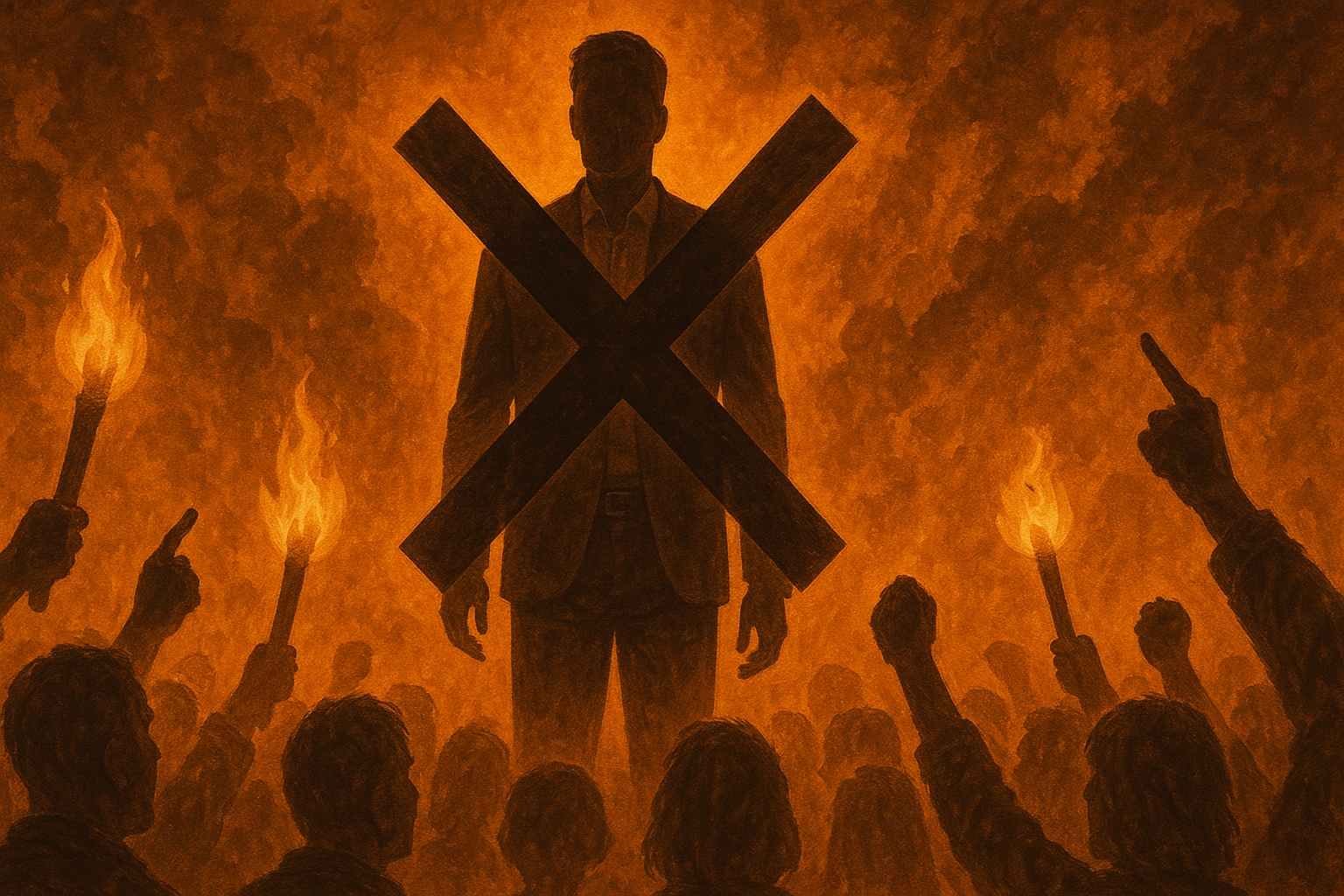
In the last decade, the world has witnessed the emergence of one of the most controversial social phenomena in the digital space: Cancel Culture. The phrase has come to be used to describe a collective rejection, boycott, and shaming of a public figure, a company, or even a private individual for an action or opinion deemed "unethical" or "offensive" by the public.Initially, the phenomenon originated in the context of movements aimed at exposing abuses, such as the #MeToo or Black Lives Matter movements, but it quickly turned into a collective mechanism for disciplining people online, sometimes to the point of destroying their professional and social reputations entirely.
Undo culture presents itself as a form of "popular justice," where people take on the role of moral courts when they feel that legal institutions are unable to confront abusers, or are complicit with them. But as its influence grows, a debate has begun to emerge: is undoing a necessary tool to hold powerful people accountable, or has it become a chaos of norms, excluding every dissenting opinion and turning the internet into a space of fear?
First: The context of the emergence of the "culture of abolition" - from social justice to digital pressure
The phenomenon did not emerge suddenly, but arose from a social environment that witnessed widespread anger at the lack of accountability for harassers, racists, abusers, and those in power who were immune to criticism or punishment. In its beginnings, the internet was an open space for disclosure and exposing violations that the media or state agencies could not reach. Hence, the culture of elimination began as a tool to empower the marginalized.
In the context of the #MeToo movement, lists of people accused of harassment in the workplace were published. The goal was clear: to protect women from people covered up by institutions. Similarly, in the Black Lives Matter movement, the internet played a pivotal role in exposing police violence and structural racism.But over time, with the proliferation of social media, the dynamics of these practices have changed. Today, no actual crime or serious behavior is required. Sometimes the reason for revocation is an old opinion posted ten years ago, a bad joke, or even the use of a word deemed "sensitive" in an unclear context. The phenomenon has thus expanded to include small behaviors, intellectual differences, and political opinions.
One of the factors contributing to the amplification of the phenomenon is the way algorithms work. Social media pushes outrageous content to the forefront, because it generates higher engagement. The bigger the wave of outrage, the more it spreads, and revocation becomes a collective social phenomenon. It is no longer a matter of holding a specific person accountable; it has become a trend that people are racing to participate in.
Another important factor is the loss of trust in traditional authorities. The public perceives the judiciary as slow, the media as biased, and corporations as more concerned with profit than morality, so people resort to revocation as "parallel justice" or an alternative authority to correct wrongs.This sense of empowerment made the phenomenon spread among different groups, and it became easy for anyone to become a "digital judge," if only for a moment. However, the real issue lies in the transition of the revocation culture from a tool of justice to a social weapon. While it was initially directed to confront crimes and violations, it has now turned into a way to punish anyone who deviates from the dominant discourse.
Second: Revocation as a tool of social control - between digital morality and group pressure
With the spread of the phenomenon, takedowns have become part of the new internet morality, where moral standards intersect with individuals' desire to belong to digital groups. This creates a kind of "instant morality", where values are formed not through rational debate or collective consciousness, but through successive waves of anger. One of the phenomena associated with this is herd psychology. When takedowns begin against a character, many feel that they must join the wave to avoid being seen as "complicit." This makes takedowns a formidable force.This is what makes revocation so powerful: not because it is morally justified, but because people are afraid of being outside the digital consensus. Revocation becomes a social pressure tool that forces everyone to adopt one discourse, one stance, and one view of what is right or wrong. One of its most dangerous consequences is that it drives people to practice self-censorship. Many creators, writers, and media professionals today openly say they are afraid of revocation and prefer silence to speaking an opinion that might anger digital communities.
In addition, deletion does not differentiate between intent and context. A simple mistake, or a complex opinion that takes time to explain, can be summarized in a short clip that triggers a wave of anger, and the person is held accountable as if he had committed a moral crime. Digital morality becomes a distorted law, applied without clear standards or guarantees.Many users participate in deactivation not because they believe in the cause, but because they are afraid of being criticized. Some do it to gain likes, a desire for visibility, or a sense of moral heroism. It is a morality produced outside of institutions, and it lives in fear.
Major companies have fired employees or suspended celebrities due to public outrage, even before investigating the facts. The fear of financial loss or media damage makes them act quickly, and sometimes impulsively. In addition, revocation opens the door to ideological battles, as people are attacked simply because of political differences. Morality becomes a weapon in the cultural conflict rather than a standard of accountability.
Third: From justice to anarchy - the negative social effects and the price of abolition
If revocation began as a tool of accountability, today it carries many risks for individuals and society. The most prominent of these risks is defamation. A person's reputation can be destroyed in a few hours, based on a fragmented clip or an unverified accusation. There is no real mechanism to restore reputation afterwards, because the internet does not forget. The biggest issue is the absence of the principle of proportionality.This confusion makes punishment harsh and unfair. Someone could lose their job, their family, or their mental health because of a temporary outburst. There is also the issue of lack of context. Much of the revocation is based on old statements made at a time when society had different values. Judging by today's standards on past situations creates injustice and prevents any possibility of evolution or learning from mistakes.
In addition, invalidation stifles creativity and critical thinking. In an environment where people fear invalidation, public discourse cannot be vibrant or diverse. Universities, art, journalism, scientific research-all need freedom of debate, not the constant fear of mass censorship. On a psychological level, invalidation can lead to depression, isolation, and in some cases, suicide.There is also the risk of political manipulation. Certain parties may use waves of takedowns to settle scores or silence opponents. In this case, the phenomenon turns from a societal mechanism into a political weapon.
In short, when revocation loses the conditions of justice - investigation, proportionality, the right to apologize - it turns into anarchy. Unaccountable revocation is like a court without a judge and a public without standards.
Conclusion
The culture of revocation seems to be a complex phenomenon that is difficult to simply categorize as good or bad. At its origin, it is a collective attempt to bridge the justice gap and force institutions to hold abusers accountable, especially in a time when media power is mixed with economy and politics. However, the expansion of the phenomenon and its transformation into a fast digital weapon loses much of its moral value and turns it into a means to impose fear and silence instead of justice.
The difference between justice and revocation is that justice provides an opportunity for correction, while revocation often ends a person's career without discussion or defense. The real question is not: "Should we abolish the culture of revocation?" but rather: "How do we reset it so that it is a means of responsible accountability, not moral chaos?" The real question is not: "Should we abolish the culture of revocation?
In a time when social media has become an essential part of our lives, we need to rethink our role as participants in this discourse and distinguish between constructive criticism and mass bullying, between accountability and digital execution. Only in this way can digital society be more just, compassionate and balanced.
Comments