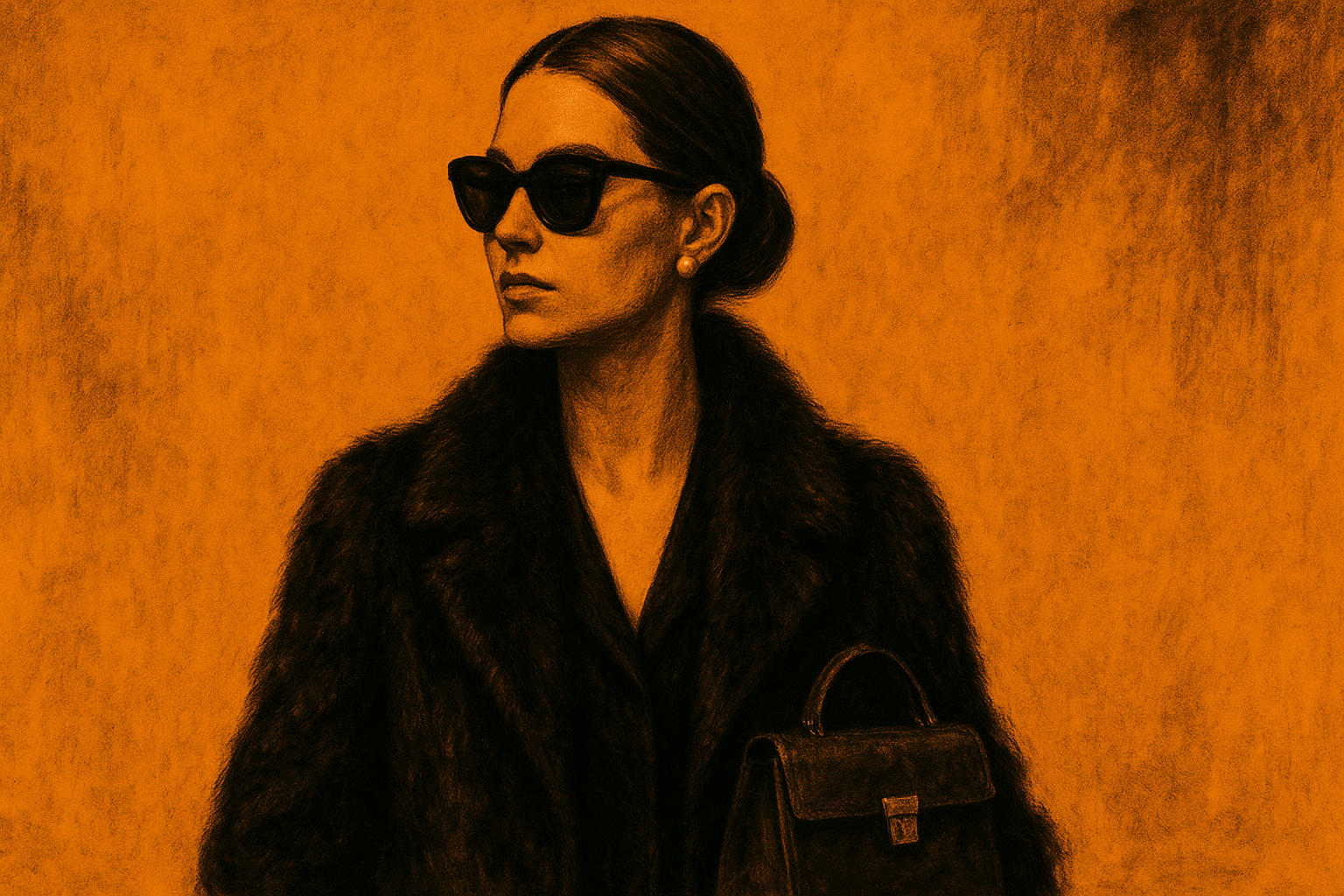
On the surface, Quiet Luxury seems like a simple aesthetic choice: neutral colors, clean cuts, high-quality materials, and a general feeling that elegance does not need a big logo. However, this silence is not entirely innocent in the cultural and social context. Historically, fashion is not just a fabric but a status language: those who can afford to buy quiet quality send a different message than those who have to buy an explicit sign (logo/logo) to prove their presence in the symbolic market.This is why Quiet Luxury in 2023-2024 became a phenomenon that goes beyond taste, becoming a general theme of class, identity, and social anxiety: How did luxury become desirable when it doesn't scream? How can something visually modest be a class provocation? This question is reinforced by writings that linked the phenomenon to stealth wealth culture and old money aesthetic, and that it is a new version of bragging but with different rules: not bragging about the brand, but bragging about being able to dispense with the brand publicly, while keeping its value a secret.
To understand the rise of this fashion, it is useful to look at its close cultural environment: social media has become a stage for displaying the daily lives of the wealthy, and at the same time a space to observe, analyze, and decipher their style. It was in this climate that the term Succession-core emerged, associated with the series Succession, which presented extreme wealth in quiet clothes that seem ordinary to those who do not know the brands and materials, but expensive and intentional to those who do.The lenses of popular media also contributed to the idea that a truly wealthy person does not need a logo to prove his wealth, and that good taste goes through craftsmanship, materiality and simplicity. This media treatment does not create fashion alone, but it provides it with an attractive and easy-to-repeat storyline: wealth whispers.
But social analysis requires caution: what appears to be a call for simplicity may be a redesign of class distinctions. Pierre Bourdieu argues that taste is not just an individual preference, but a social product linked to what he calls cultural capital and the ability to read and own symbols.In this perspective, Quiet Luxury functions as a cognitive privilege: those who have the education, friction, time, and environment to know the difference between fine wool and plain wool, between a neutral but geometrically correct coat cut, can send an indirect status signal that not everyone understands.Here, a kind of soft exclusion occurs: there is no sign that says I am from a higher class, but rather subtle signals that only those who belong to the same circle can pick up. This reproduces differences not through shouting, but through the naturalness of taste, which makes silent fashion closer to a social discrimination mechanism than a neutral beauty.
If we go back to Veblen, we find that fashion has historically been a tool of conspicuous consumption: you buy what you don't need in order to be seen by others. What is new here is that the display itself has changed form: in a time when logos are available by imitation or installment purchase, the crude gesture has lost some of its power, and differentiation is looking for a more difficult territory: conspicuous but expensive consumption that requires knowledge.This is why Quiet Luxury feels like a transition from displaying wealth on the surface to burying it in the details: a material that not everyone knows, a tailoring detail that only a specialist notices, a brand that doesn't even put its name. Veblen makes us see that the issue is not the logo itself, but the function of fashion as a race for status; when the rules of the race change, the tools of the race only change.
More recent literature on conspicuous consumption helps explain this shift. Elizabeth Corrid-Halkett suggests that a new aspirational class is not content with shiny goods, but invests in small but highly meaningful things: education, health, organic food, experiences, tastes that require knowledge. This logic is consistent with Quiet Luxury: the goal is not to be seen by everyone, but to be seen by the right kind of people.The irony is that this type of consumption may seem more ethical or less crude, but it may be more classist because it hides behind the rhetoric of quality, sustainability, and taste, while remaining expensive and exclusive.
Not only did social media promote Quiet Luxury, it turned it into a visual sensation. How can it be silent when it's trending? Here is the paradox of platform culture: everything that works is turned into a hashtag, then into tutorials (what old money looks like), then into mass imitation. The viral indicators are not just an impression; TikTok trend tracking data shows that the hashtag #oldmoney has billions of views (according to Vogue Business tracking as of October 2024).This proliferation means that the symbol of scarcity is consumed by the masses, forcing the elite to escape one step further: either to higher customization (tailoring/bespoke) or to finer marks, or even to the return of embellishment when silence loses its usefulness. This was also hinted at by press readings that saw quiet luxury losing its luster as a single formula, with subsequent fashion shows and scenes tending to flair or a new exaggeration.
From a classical sociological perspective, Georges Zemmel described fashion as a game between two tendencies: imitation (fusion) and distinction (difference). When the lower classes adopt the form of the upper classes, the upper classes look for a new form to regain distinction; and so the cycle goes on.Quiet Luxury can be read as an advanced episode in this game: after the waves of loud logos, the signal moved to details that can only be immediately replicated by high-quality manufacturing or knowledge, and then imitated through fast fashion, gradually losing the signal of scarcity. In other words, silence is not the end of showmanship, but rather a tactic within a permanent cycle of transformation.
Quiet Luxury hides or reveals distinctions; in fact, it does both. It hides them visually, as the difference between a super-expensive coat and a regular coat is not obvious to the uninitiated, but it reveals them socially as it turns knowledge itself into a privilege.When the ability to recognize a particular material or an undisclosed brand becomes a criterion of belonging, the class divide becomes even deeper: it is not just who has money, but who has standards as well. This corresponds to a reading that saw the stealth wealth craze as a message about the anxiety of the broader classes and their desire to understand or emulate the world of the rich, at a moment when the economic gap is widening and social voyeurism of unattainable wealth is on the rise.
However, it would be simplistic to accuse everyone who prefers quiet of practicing conscious class exclusion. There is a potentially honest side: some consumers do indeed reject conspicuous consumption, and tend to buy fewer and longer-lasting pieces, looking for craftsmanship, materiality and respect for the body and time. The press itself has noticed this tension: quiet luxury can be read as a response to the pressure of rapid consumption and the climate crisis, but at the same time it is still loaded with the aura of status and money, and status does not disappear by simply turning down the volume.The difference here depends on context and ability: buying less may be environmentally conscious for those who have alternatives, but it may be forced for those who can only buy the cheapest every season due to poor quality. Here the class nature becomes clear again: even the discourse of sustainability can act as a class filter if it becomes expensive and exclusive.
In sum, Quiet Luxury is neither a refined taste nor a class trick; it is a hybrid cultural formula that brings beauty and power together. It is a taste because it favors simplicity and craftsmanship, but it is also a symbolic politics because it rearranges status signals from logo to knowledge, from public display to insider recognition.In the age of platforms, these signals quickly turn into reproducible content, lose their specificity, and a new race for finer distinctions begins. So perhaps the more accurate truth is that Quiet Luxury neither eliminates nor completely hides class distinctions; it reformulates them in a quieter language and makes them work through a code that seems innocent, but is very effective in sorting people into circles: who understands, who does not understand, who can, and who cannot.
Comments