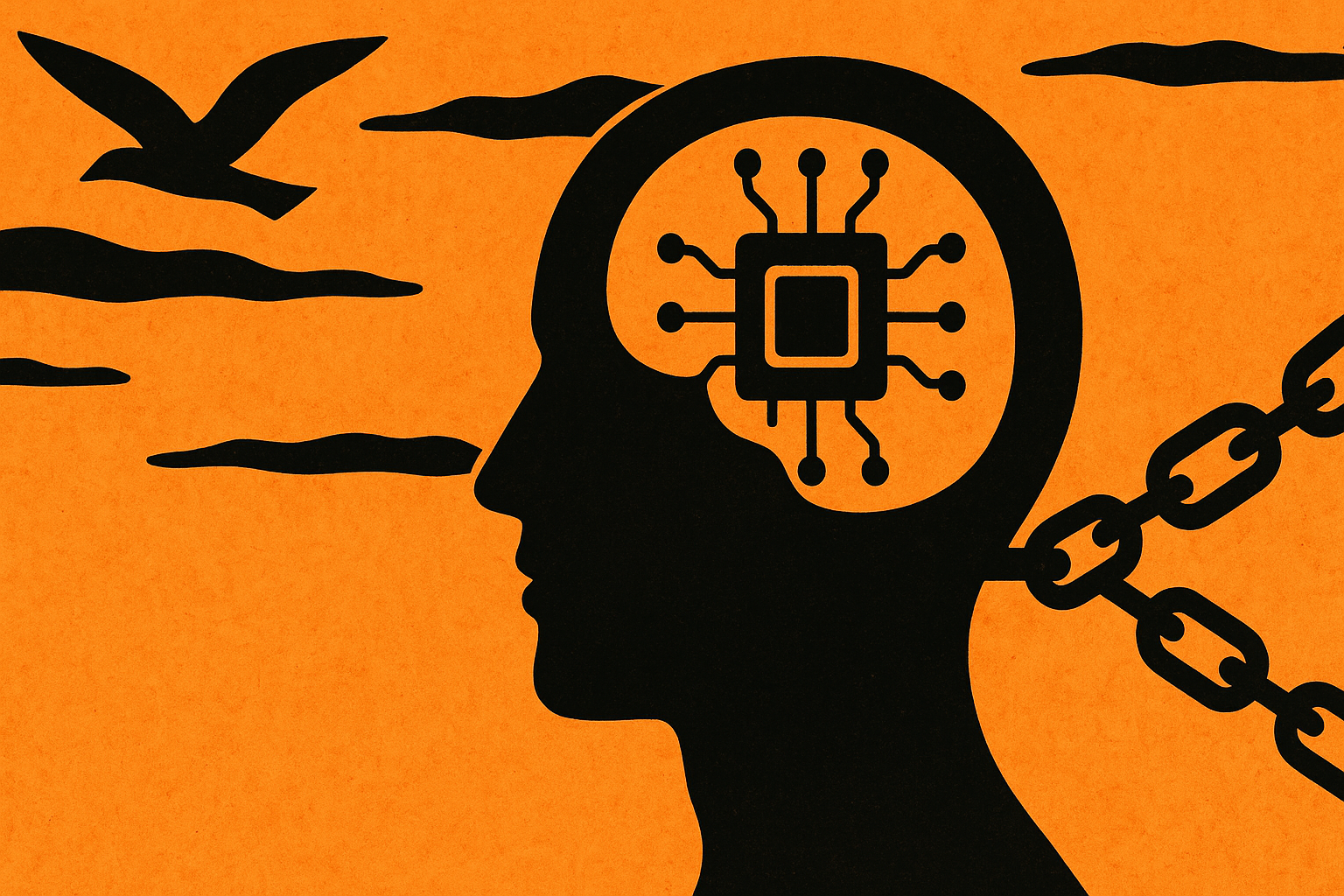
Today's brain-computer interfaces are raising questions that go beyond medical and engineering labs and into the heart of philosophical and social debate:Are we talking about technology that frees humans from the constraints of the body, or are we taking a first step towards digital systems capable of accessing the deepest layers of our thoughts? Companies like Neuralink and Paradromics exemplify this accelerating shift, moving in a few years from animal experiments to clinical trials on people with paralysis or "locked-in" syndrome, with the goal of restoring the ability to communicate and control devices through neural signals.with the goal of restoring the ability to communicate and control devices via neural signals, with real expectations that these technologies will be commercialized before 2030 (Clinical Trials Arena, 2024; Forbes, 2024).
Neuralink, for example, has begun its first clinical study, PRIME, to evaluate the effectiveness of the N1 wireless implant in helping quadriplegics control a computer or robotic arm by simply thinking, after the company received regulatory approvals in the US and expanded to Canada and the UK (ClinicalTrials.Updates from the company indicate that a number of participants are able to move the cursor, interact online, and even engage in some digital activities independently; this was evident in the case of Noland Arbo, who regained his ability to interact on a daily basis despite being completely paralyzed (Neuralink, 2025; Fitzpatrick, 2024).
On a parallel track, Paradromics received FDA approval to launch the Connect-One study for Connexus, a device designed to read speech cortex signals and convert them into text or voice in people with severe neurological disorders such as ALS or strokes (Paradromics, 2025). Analytical reports from ClinicalTrials Arenashow thatthese systems could reach initial commercialization before the end of the decade, supported by a growing investment discourse that points to a market that could exceed hundreds of billions (Rao, 2024).
Recent studies have shown that wireless BCI systems enable people with complete paralysis to computerize, write, and communicate independently, even at home and without direct technical supervision, transforming disability from a state of isolation to a new capacity for social interaction (Livanis et al., 2024).Research on decoding speech from the cerebral cortex shows that "voice" can be restored in people who lost it years ago, using deep learning algorithms that directly manipulate the neural signal and convert it into spoken or written words in real time (Livanis et al., 2024; Bocquelet, 2016). Thus, the ethical literature tends to consider the therapeutic use of these technologies as legitimate and fair, as long as it is directed to compensate for an existing disability and is based on informed consent and adequate medical protection (McGee, 2014).
However, the boundary between "restoring function" and "human enhancement" is not so much technical as it is social and political. The vision presented by Neuralink, for example, goes beyond treating disability to "unlocking human potential" and creating large-scale direct brain-AI communication, as presented by Elon Musk, who speaks of millions of augmented users by 2030 (Fitzpatrick, 2024).Scientific and investment reports available via Wiley Online Library and Forbes envision brain-computer interfaces as tools for merging human and machine in education, work and entertainment, not just in operating rooms (Wiley Online Library, 2016; Forbes, 2024).From this perspective, paralyzed patients become a "first stage" in a series of broader uses aimed at healthy users seeking stronger memory, higher concentration, or direct access to platforms. Issues of access equity arise: who will get this boost? Will a class of "augmented humans" emerge as opposed to a majority that does not have the capacity to adopt these technologies (Yang, 2025)?
These shifts are linked to a central question about privacy: what does it mean for brain signals to be readable, stored, and processed? Brain data is fundamentally different from traditional health data, because it not only describes what happens to the body, but can reveal attention, feelings, intentions, and even political and religious preferences if collected and analyzed over the long term (European Data Protection Supervisor, 2024; Yang, 2025).This is why legal scholars have spoken of the need to recognize new "neural rights" to protect brain activity from commercial or governmental use, noting that legislation such as the GDPR still fails to protect this complex type of data (EDPS, 2024).Research reviews show that some consumer neurotech companies may share captured data with third parties for marketing purposes or to train artificial intelligence models, raising concerns about the loss of control over the "private self" (Livanis et al., 2024).
The privacy question intersects with another equally important question: where does medical treatment end and "human modification" begin? Specialized literature, such as that published via Wiley Online Library, distinguishes between three categories: restoring a lost function, improving a normal function, and creating entirely new capabilities (Bocquelet, 2016; McGee, 2014).While the first level is legitimate within the practice of medicine, the second and third levels become an area of ethical debate, especially with the potential for the technology to "normalize" natural human traits such as forgetfulness or anxiety. With major military and commercial players in the funding pipeline, fears of mandating the use of these interfaces in certain sectors such as militaries or highly competitive industries are growing (Livanis et al., 2024).
The main research question is: To what extent do brain-computer interfaces represent a liberation from the constraints of the body, or the beginning of the subjugation of humans to new digital systems that have access to even their most elementary thoughts? On an individual level, people who have regained the ability to communicate through Neuralink or Paradromics implants have experienced a true form of liberation, moving from absolute dependence to self-expression and decision-making (Neuralink, 2025).But on a structural level, this freedom can turn into a new dependency, because the brain interface only works within a closed technical system that is subject to software updates, cannot be used without a connection to the company's servers, and risks hacking or manipulating neural signals (Yang, 2025). At this point, freedom from the body becomes linked to surrendering to digital networks that hold the "keys" to the mind (Yang, 2025).
In conclusion, brain-computer interfaces hold an intrinsic tension that cannot be technically resolved: they are at once a profoundly empowering tool for people with disabilities and the seed of a potential project of an augmented and controlled human.The legal and political framework that will surround these technologies will determine their true future: will brain data be treated as protected space? Will transparent standards be imposed to prevent monopolization and limit data collection to therapeutic purposes? Or will we see a repeat of the scenario of digital platforms that have become an inseparable part of our psychological lives? The answer to these questions will determine whether brain-computer interfaces are the beginning of a new era of liberation, or a step towards digital systems that own even our raw thoughts.
Comments