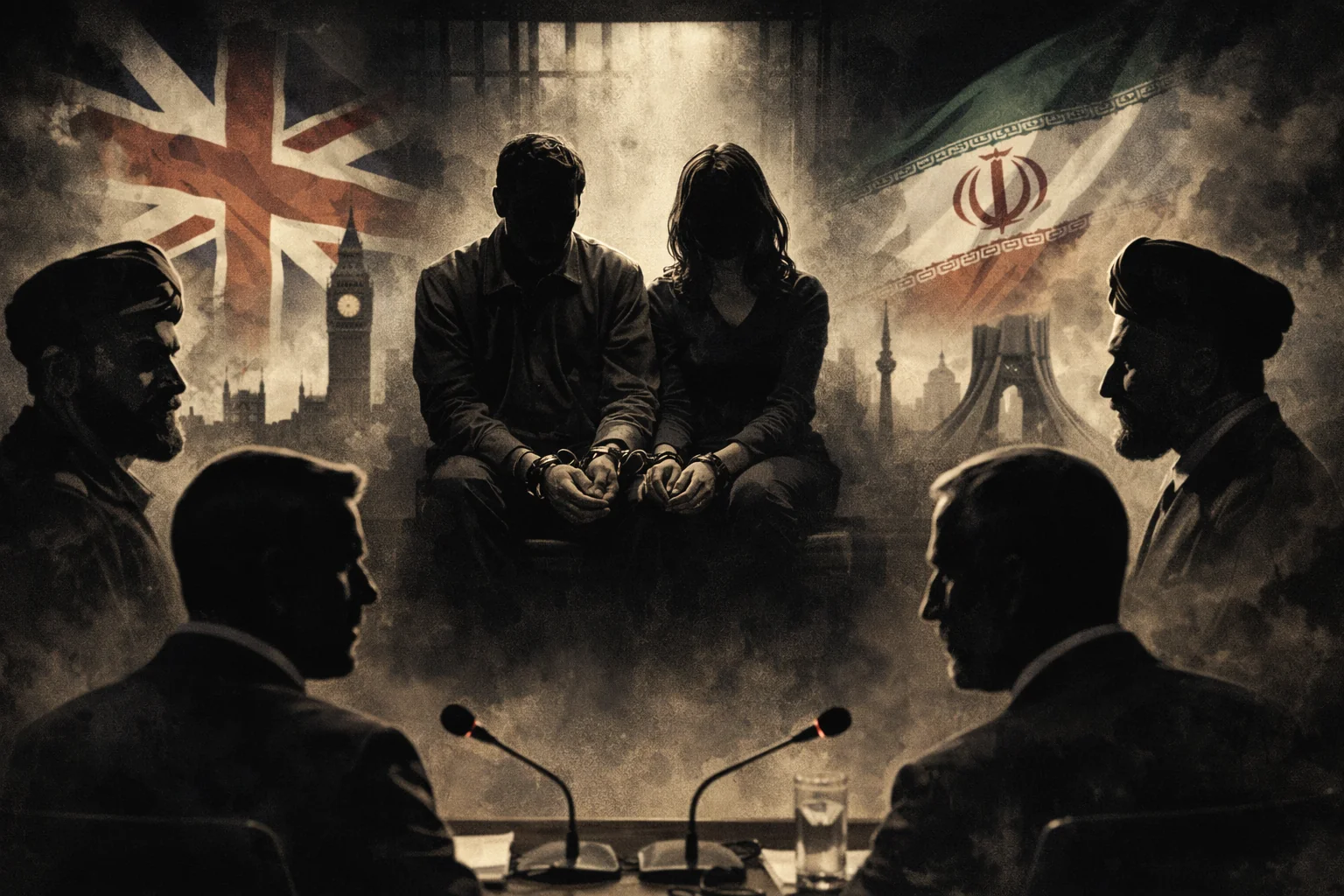
"Espionage cases" in international relations usually turn from closed legal files into open diplomatic crises when three elements intersect: ambiguous evidence, national security sensitivity, and the presence of public opinion. This is exactly what the story of British couple Craig Foreman and Lindsay Foreman, who were sentenced by an Iranian court to 10 years in prison for "spying," reveals in a case that quickly took a political and media trajectory that tested the already strained relationship between London and Tehran.According to Reuters coverage, the British government called the verdict "completely unjustified," while the family says they saw "no evidence" to support the charge, and that the trial was so short that it raises doubts about the fairness of the proceedings (Reuters, 2026a).
The details of the case available so far paint a story with elements of a "real-life" drama: a couple on a long travel trip suddenly becomes a security file. According to Reuters and cross-reports, the couple was on a motorcycle trip around the world and was stopped by Iranian authorities in January 2025 while inside the country.Later, the Iranian judiciary announced through Mizan that the two Britons were charged with "espionage" and accused of "gathering information" in different parts of Iran (Reuters, 2025).
The Iranian version of the case, as reported by the judiciary's Mizan agency, explains that the couple entered the country "as tourists" but "gathered information in several provinces," a characterization that makes the case a national security issue for Tehran rather than a mere consular dispute.According to a judicial official quoted in Mizan, investigations linked the couple to what was described as "intelligence services," and investigations were underway at the time of the announcement of the charge to determine the nature of those connections, with no public details about what information was gathered or how it was translated into a charge of espionage before the court (Reuters, 2025).This type of brevity is not uncommon in national security cases, where authorities tend to limit the publication of details on the grounds of protecting investigative methods or preventing the disclosure of sensitive information, but at the same time it leaves plenty of room for outside interpretation about the strength of the evidence and the standards of the trial.From an Iranian perspective, simply moving across multiple regions with an activity interpreted as "information gathering" may amount to a security threat, especially in a context of tension with Western countries, sanctions, and open political files, which prompts judicial and security agencies to read some travel behaviors through the eyes of "preventive suspicion" rather than "tourist intentions." This is what prompts judicial and security agencies to read some travel behaviors through the eyes of "preventive suspicion" rather than through the eyes of "tourist intentions.
In a related context, reports circulated statements attributed to the Iranian judiciary spokesperson indicating that the case is not presented internally as a passing incident, but rather as a file to which the procedures of revolutionary courts are applied in cases of "espionage" and "security".According to judicial spokespersons quoted in this context, the accusation is based on the idea of "disguising as tourism" while carrying out missions characterized as intelligence, a framework that Iran sometimes uses to explain situations where field activities-photographing, blogging, or communicating-are perceived to have exceeded the limits of normal tourist behavior (Reuters, 2025).But from Iran's perspective, national security issues are not often discussed in the public sphere in the same way as civilian cases, and keeping certain details secret is part of the "logic of the file" rather than a sign of its weakness. The diplomatic crisis thus becomes a reflection of the clash of two norms: the norm of procedural transparency demanded by London and the family of the accused, and the norm of security secrecy invoked by Tehran in cases it considers sensitive.
But the knot that pushed the case from "judicial news" to "diplomatic crisis" was the family's account of the course of the trial. According to Reuters, the family said that the couple was brought before a revolutionary court in a three-hour session and was not allowed to present an effective defense (Reuters, 2026a).This sentiment was echoed in other reports such as the Financial Times and the Guardian, describing it as a quick and closed procedure in a very serious case (Financial Times, 2026; The Guardian, 2026). This particular point puts pressure on London because criticizing the verdict effectively becomes a criticism of the fairness of the Iranian judicial system itself, which Tehran usually rejects as "politicization."
In terms of facts, Reuters reports that the couple are being held in Tehran's Evin prison: Lindsay in the women's section, and Craig in a wing referred to as the political wing (Reuters, 2026a). According to family statements, there have been periods of isolation, difficulties in communication, limited access to lawyers, and complications with consular visits.Such details, even when they cannot be independently verified, become part of the "pressure file" because the British media, parliament, and human rights organizations often take them as indicators of the fragility of procedural safeguards in national security cases.
British Foreign Secretary Yvette Cooper's statements were sharp, according to Reuters and FT: "utterly appalling" and "totally unjustified," with a promise to keep pressing for release. In contrast, family members - including Lindsay's son, Joe Bennett - spoke of how they had seen no evidence and were concerned for their safety (The Guardian, 2026).When family statements become daily headlines, the British government is forced to show diplomatic "movement" to avoid being accused of inaction, especially since the public memory in Britain still holds previous cases of British/Iranian-British detention and the long political controversy that accompanied them.
This does not mean that the case was "manufactured" for this purpose, but it does explain why it quickly turns into a diplomatic crisis: because each side reads it within the context of its larger struggle with the other. Therefore, the case is not only managed through consular channels, but through message calculations: Britain wants to protect its citizens and impose a political cost on their detention, and Iran wants to establish the discourse of judicial sovereignty and not respond to what it sees as "pressure." The case is not only managed through consular channels, but also through message calculations: Britain wants to protect its citizens and impose a political cost on their detention, and Iran wants to establish the discourse of judicial sovereignty.
References
Reuters.(2025).British citizens charged with espionage in Iran, judiciary says.
Reuters.(2026a).Britain condemns 10-year prison sentence for British couple in Iran.
Mizan News Agency.(2025).Judiciary's statement on the case of British citizens.Tehran.
Human Rights Activists News Agency (HRANA).(2026).Reports on the case of British citizens detained in Iran.
Comments