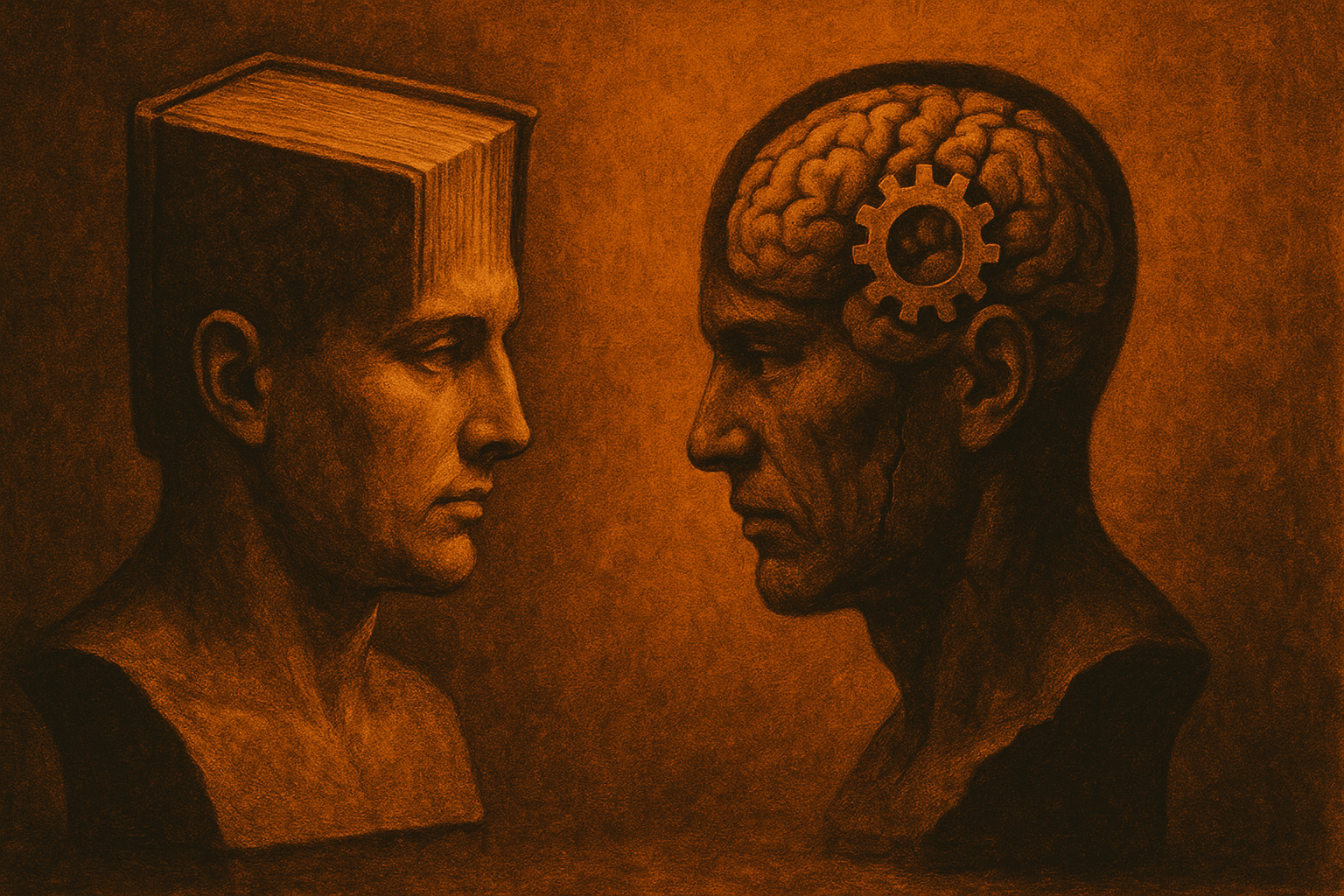
Access to knowledge in today's age is no longer a challenge. With the click of a button, a student - or anyone - can get the answer to almost any question. With the widespread proliferation of digital technologies and artificial intelligence, the meaning of "learning" has changed profoundly.While traditional educational systems relied on memorization and retention as the key skills for success, this model is now being questioned, as human memory is no longer a real competitor to search engines or smart technologies. However, many schools and universities in the Arab world and globally still use exams and grades as a central criterion for student assessment, raising an important question: are we measuring what is really worth measuring?
The gap seems to be widening between what the modern world requires in terms of critical thinking and problem-solving skills, and what traditional educational systems still insist on providing. This contradiction prompts a reconsideration of the philosophy of education itself: what does it mean to "learn" in a time when knowledge is instantly available? Is the goal of education to know facts ... or to have a mind capable of understanding, analyzing, and using them? On the other hand, overreliance on exams raises issues of time pressure, unhealthy competition, and education becoming a race for grades instead of a journey of cognitive growth.
This paper aims to analyze this profound shift in the meaning of learning, critique the memorization-based education model, and propose a vision for a contemporary education that focuses on building an analytical mind capable of thinking, rather than simply retrieving information.
First: The Crisis of the Traditional Education Model in the Age of Instant Knowledge
Education today lives at a sharp crossroads between two worlds: the world for which the traditional school was designed, where information was scarce, and a new world in which information is available in seconds through the phone and artificial intelligence.In this context, the question becomes: what does it mean to "learn" when any student can get a definition, history, or scientific law in seconds from a search engine or a language model? This is where the fundamental difference between "information" and "knowledge" comes into play:Information is a discrete unit of data (number, date, definition), while knowledge is an interconnected network of meanings, understanding, context, and values that allows its owner to interpret phenomena, criticize, and apply what he or she has learned to new situations.Although the world is flooded with information, reports by the World Bank and other international organizations indicate that nearly 70% of children in low- and middle-income countries suffer from "learning poverty", meaning that they cannot read and understand a simple text by the age of ten, and a recent report based on the Global Monitoring Report on Education 2024-2025 indicates that 73% of children in developing countries cannot understand a short text at this age (World Bank, 2023; UNESCO, 2025).This contradiction - an abundance of digital information versus a lack of basic comprehension skills - illustrates the depth of the crisis of the memorization-based educational model.
In societies with little access to books and written knowledge, memorizing texts and facts was a way to protect knowledge and transfer it between generations. But recent educational research shows the limitations of this model in our time. A comparative study on "rote learning" shows that rote memorization is typically associated with short-term performance on tests, while learning based on deep understanding is associated with better long-term recall and transfer of knowledge to new situations (Ahmed & Ahmad, 2017).A cumulative analysis published in 2024 showed that programs that target the development of critical thinking skills lead to a significant improvement in academic achievement compared to traditional rote methods (Batdı, 2024). In an age where "information" can be retrieved at the click of a button, simply storing it in memory becomes a waste of the learner's time and abilities, while the real value is in the ability to sift, connect, interpret, and take a stand.
However, the de-centralization of memorization does not mean that "basic knowledge" is no longer necessary; critical thinking does not work in a vacuum, but needs a stock of concepts, examples and models in long-term memory so that the student can analyze, compare and innovate. The issue is not memorizing something, but turning the curriculum into an endless list of separate details and facts that can be easily accessed digitally, at the expense of building comprehensible mind maps.A comprehensive review of the "21st century skills" literature indicates a growing consensus that today's key skills are: problem solving, critical thinking, creativity, and collaboration (Kain, 2024). However, curricula in many countries are still crammed with partial knowledge, leading teachers - under pressure of time and exams - to reproduce the "quick explanation + memorization" model instead of allowing time for experimentation, dialogue, and project building.
This imbalance deepens when we look at the discrepancy between what schools train and what the labor market actually needs. The World Bank and OECD reports show that the global economy is moving towards the automation of routine tasks, while the economic value of tasks that require problem solving, analytical thinking, and collaboration between multidisciplinary teams is rising (World Bank, 2023; Golden, 2023).Future jobs-even in technical professions-do not require a worker who memorizes as much information as possible, but someone who can use the available information, understand it, and translate it into decisions and solutions within changing contexts. In contrast, education practices in many schools are still based on a lesson taught by the teacher, a textbook memorized by the student, and a test that measures the ability to retrieve what was said verbatim (Kagaba, 2025).
This gap between school and professional reality is directly reflected in students' daily experiences: many study hard before exams, memorize definitions and lists, and then forget most of what they have learned a few weeks later. This "short-term learning" is often accompanied by a gradual loss of passion, as students feel that the knowledge they accumulate has nothing to do with their questions about the world or their future careers.On the other hand, the constant pressure to catch up with the curriculum and ensure "finishing the book" generates stress among teachers, so they are less willing to venture into critical activities or research projects that may consume time at the expense of the "curriculum." Thus, the system remains captive to the logic of quantity over quality.The bottom line is that traditional education based on memorization deals with a world that no longer exists: the world of scarcity of information, while today's world needs an education that redefines "learning" as building a mind that thinks and criticizes, not just a memory that memorizes and retrieves.
Second: The dominance of exams and the culture of grades
The dominance of exams in school culture is not an accident, but the result of a long history of building educational systems as "factories" that operate according to the logic of standardized competency measurement and social sorting. In the context of the expansion of mass education in the twentieth century and with the swelling of student numbers, standardized written exams seemed a "practical" solution: they can be quickly corrected, converted into numbers, and compared between schools, regions, and countries.International reports on assessment trends confirm that decision-makers tend to favor what is "easy to measure" even if it is less relevant to what we really need to measure, because numbers give the illusion of objectivity and control (UNESCO, 2025; OECD, 2024). Thus, a culture has historically been established in which the state equates the quality of education with national or international test results and bases funding decisions, school rankings, and teacher accountability on them.
In official rhetoric, everyone emphasizes the importance of "understanding" and "thinking," but in daily classroom practice, especially in high-stakes testing systems, the de facto success criterion becomes a score, not depth of learning.The practical goal - for the student, teacher, and family - is to pass the final exam, or the certification exam, with the highest possible score, even if this comes at the expense of the learner's curiosity and ability to question.
Instead of success being an indicator of understanding and meaning, it has become a number measured in the "average".A student who answers memorized answers gets a score that may equal or exceed a student who analyzes and reformulates ideas in his own language, because the marking system is based on a single "model answer." This pattern is fully consistent with the culture of memorization; the more closed the question, and the same answer, the easier it is to correct and compare.But it fails to capture other dimensions of learning, such as the ability to relate knowledge to a student's life, to use information in new contexts, or to collaborate to solve complex issues.Even international tests that seek to measure higher order skills - such as the Program for International Student Assessment (PISA) tests - showed that when the "creative thinking" domain was introduced in 2022, a large percentage of students in many countries found it difficult to generate multiple ideas or evaluate innovative solutions (OECD, 2024). This indicates that the culture of national exams still emphasizes retention over synthesis and creativity.
The dominance of the exam not only affects the structure of the curriculum, but also mental health and well-being. The Organization for Economic Cooperation and Development (OECD) report on "Student Well-being" (PISA 2015) showed that, on average, 55% of students across OECD countries reported that they feel very anxious before the test even when they are well prepared, and that these anxiety levels are negatively related to their performance and life satisfaction (OECD, 2017).This means that the grading culture not only kills creativity but also creates a constant sense of threat, making learning associated with fear rather than curiosity. In such a climate, students tend to avoid intellectual risk-taking: they do not try new ways of solving problems or ask questions that may seem "stupid" because they fear it will affect grades or the image of the "top student." The safety of the grade wins out over the adventure of thinking.
On the other hand, this culture puts great pressure on teachers. In many systems, teachers are not measured by their ability to build independent minds, but by the average score of their students in the final exam. They are forced to intensify "question practice", give repeated examples, and "tricks" to solve questions in a short time, at the expense of group activities, projects, and open dialogues.Studies on the impact of too much testing on the quality of learning suggest that an overemphasis on formal assessment leads teachers to sacrifice aspects of the curriculum that do not appear on the test, even though they are crucial for building thinking skills (Golden, 2023; UNESCO, 2025). The test thus turns from a means of measuring learning into an invisible force that reshapes what is taught and how.
UNESCO's 2025 analytical article "The Future of Assessment in the Age of Artificial Intelligence" argues that relying on tests that measure knowledge that machines can easily generate is no longer feasible, and calls for shifting the focus of assessment towards higher order thinking, creativity, ethical reasoning, and the ability to use digital tools flexibly and responsibly (UNESCO, 2025).If a student can ask a linguistic model to write a "perfect" essay in minutes, a test that asks them to return this essay on the exam paper is no longer a reliable indicator of their learning. At this point, it becomes legitimate to ask: Do exams test what is worth testing? Or do they only measure what is easy to measure, leaving aside what a person needs to live, learn, and work in a complex world?
Third: Toward an education based on critical thinking and building an analytical mind
If the previous themes reveal the crisis of memorization and testing, the central question here is: What is the alternative? In a world where information flow is increasingly fast and complex, the skill of "critical thinking" - the ability to analyze data, evaluate its sources, expose biases, and relate it to a broader context - becomes a requirement for daily life, not just an academic luxury.The aforementioned UNESCO article argues that the emergence of generative AI tools has made it impossible to rely on assessment that measures only the production of a text or solution, and calls for education to focus on the ability to examine and critique AI output, not to compete with it in its production (UNESCO, 2025). In other words, the challenge is no longer to "know everything" but to know how to deal with a "flood" of conflicting information and to distinguish between correct and misleading, between raw data and thoughtful analysis.
Recent literature on the development of critical thinking emphasizes that this skill is not acquired through lecture, but through active and repeated practice within a rich learning context. Cumulative analysis of critical thinking development curricula indicates that programs that build the skills of analyzing arguments, questioning assumptions, and solving open-ended issues have a significant positive impact on student achievement at different stages (Batdı, 2024).The "21st Century Skills" reviews also show that integrating critical thinking into the curriculum does not mean adding a new subject called "critical thinking", but rather redesigning the entire curriculum to require analysis in math, science, languages and social studies together (Kain, 2024). The "essence" of learning then becomes dealing with open questions and real situations, not just memorizing ready-made answers.
In this mode, students work on a relatively long project to solve a real issue or design a product, forcing them to research, evaluate sources, divide roles, and make decisions as part of a team. Empirical evidence suggests that this mode - when well designed - simultaneously enhances content understanding, collaboration, and problem-solving skills (Golden, 2023).In parallel, Design Thinking offers a framework for approaching issues that begins with empathy for the user, accurate issue definition, brainstorming solutions, rapid modeling, and experimentation, putting the student in a continuous cycle of hypothesis, experimentation, and modification, rather than a single correct answer.
The "flipped classroom" model also opens up more room for building a thinking mind: the theoretical explanation moves outside the classroom, while class time is used for discussion, solving complex exercises, and group work.The results of the PISA 2022 assessment of "creative thinking" skills revealed that students who reported that their teachers encouraged them to present multiple ideas performed better on creativity tasks (OECD, 2024). This confirms that the classroom environment is a crucial element in building a flexible analytical mind.
In the memorization model, the teacher is an "explainer" who provides ready-made answers, and the student is a "receiver." In the critical thinking model, the teacher is more like a research guide: asking questions, helping students formulate their own questions, and designing learning situations that force them to use analytical and interpretive skills.The PISA study on student well-being also indicated that students who see their teachers as individually supportive experience lower levels of test anxiety (OECD, 2017). In this context, training teachers to manage discussion and constructive feedback becomes an integral part of any serious educational reform.
UNESCO's paper on assessment in the age of artificial intelligence suggests: focusing on open-ended tasks that measure thinking, moving part of the assessment to the "learning process", and expanding the use of oral assessment where students explain their reasoning and answer unexpected questions (UNESCO, 2025).In addition, there is a growing consensus on the importance of continuous "formative assessment", rather than mortgaging a student's fate to a single test at the end of the year.
To summarize, the transition from memorization to thinking education cannot be reduced to a few additional activities; it requires a change in philosophy: from conceptualizing education as the transmission of information, to conceptualizing it as the construction of critical minds.
Conclusion
The three themes reveal that the crisis of education today is not just an issue of "means" or "tools", but a crisis of a complete perception of what learning and success are. In the first theme, we saw how an educational model founded in a world of information scarcity continues to impose a culture of memorization and retrieval in a time of digital overload, leaving millions of students between poverty in basic skills and the inability to think about complex data.In the second axis, it was shown that the dominance of exams and the culture of grades has redefined success as a narrow digital standard, and that this focus on easy measurement comes at the expense of deep learning and students' psychological health. The third axis highlighted the features of an alternative based on critical thinking, project-based learning, redefining the role of the teacher and evaluation.
A radical shift in the philosophy of education is required, from a "grading system" to an "environment that builds minds that think, criticize and create." Critical thinking is not a luxury, but a life skill.Hence, redefining success should go beyond "how much a student memorizes" to ask: "What can they do with what they know? How do they think? How do they collaborate? How do they take moral and cognitive responsibility in a world shaped as much by algorithms as by books?" Future education, if it is to be just and effective, must build minds that think, not just memorize.
Comments